- Presents state-of-the-art protocols and algorithms
- Includes end-of-chapter summaries, exercises, and references
- For students, there are hardware overviews, reading links, programming examples, and tests available at [website]
- For Instructors, there are PowerPoint slides and solutions available at [website]

- English
- ePUB (mobile friendly)
- Available on iOS & Android
eBook - ePub
Introduction to Wireless Sensor Networks
About this book
Explores real-world wireless sensor network development, deployment, and applications
Information
1
WHAT ARE WIRELESS SENSOR NETWORKS?
This chapter introduces wireless sensor networks, what are they as well as what types and applications exist. If you have previously worked with wireless sensor networks and know about their possible application areas, you may want to skip this chapter.
1.1 Wireless Sensor Networks
Wireless sensor network (WSN) is a collective term to specify a rather independent set of tiny computers with the main target of sensing some physical property of their environment such as vibration, humidity, or temperature. They consist of a few to thousands of
sensor nodes, often also referred to as nodes or sensors, which are connected to each other via wireless communications. Typically, there is also at least one special node, called the sink or the base station, which connects the sensor network to the outside world. Figure 1.1 provides a general example of a sensor network.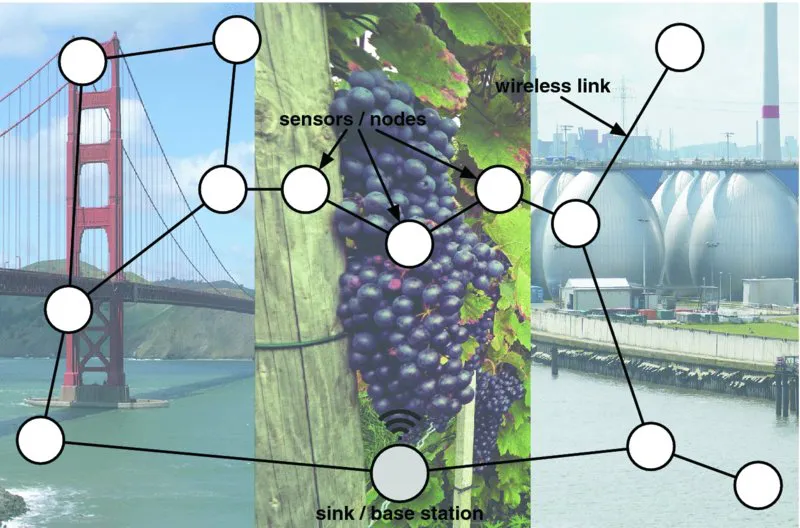
Figure 1.1 A typical sensor network with several sensor nodes and one base station. The sensors are connected to each other via wireless links, whereas the base station is typically more powerful and connected to the outside world. The application areas and environments are endless!
There are several assumptions or general properties of WSNs, which make them different from other types of wireless networks.
The resources of individual sensor nodes are highly limited. In order to cover large areas for monitoring, the individual sensor nodes need to be cheap. In order to be cheap, their components need to be cheap. Thus, the absolute minimum is installed and used on sensor nodes so their hardware resembles more of a PC from the 1980s than a modern device. All the properties and limitations of sensor networks come from this minimal hardware design. For example, this is the reason why not each of the sensor nodes can be equipped with a GPS receiver and a GPRS antenna for communication, but instead only one node can usually afford it (the sink/base station).
The wireless links are spontaneous and not planned. Different from other wireless networks, such as Wi-Fi hotspots, WSNs are not carefully planned to perfectly communicate and enable specific service quality levels. Instead, the assumption is that each of them tries to detect its brothers and sisters, and to exchange some minimally required data with them. Thus, WSNs are deployed (installed) quickly and without much knowledge of the environment. Existing experience with real WSNs and some theoretical foundations help installing more robust and self-sustainable networks than simply spreading them around the environment. However, the original dream of throwing sensor nodes out of an airplane to monitor thousands of square kilometers remains a dream.
The sensor network senses some phenomenon and needs to transfer the data to an external user. There is always something to sense out there: humidity, temperature, vibration, acceleration, sun radiation, rain, chemical substances, and many others. The main target of a sensor network is to sense some phenomenon and to transfer the gathered information to the interested user, typically an application residing somewhere outside the monitored area. The limited resources on the sensor nodes do not allow them to process the information extensively locally.
The main functionalities of a sensor node are sensing and sending.
1.2 Sample Applications Around the World
Vineyard monitoring is one of the most classical examples of sensor network monitoring. The goal is to reduce water irrigation and to predict or discover vine sicknesses as soon as possible. This not only minimizes costs of growing the vines through less water usage, but also enables organic growing with low usage of pesticides. Sensors used include air temperature, air humidity, solar radiation, air pressure, soil moisture, leaf moisture, ultraviolet radiation, pluviometer (rain sensor), and anemometer (wind sensor). The sensors are typically spread over a large area of the vineyard and deliver their information to an external database, in which the information is processed by special environmental models. The results are shown to the scientist or to the vineyard farmer and can be automatically connected to the irrigation system. Figure 1.2 shows a typical vine sensor node installed in a vineyard in Slovakia from SmartVineyard Solutions,1 a Hungarian spin-off company.
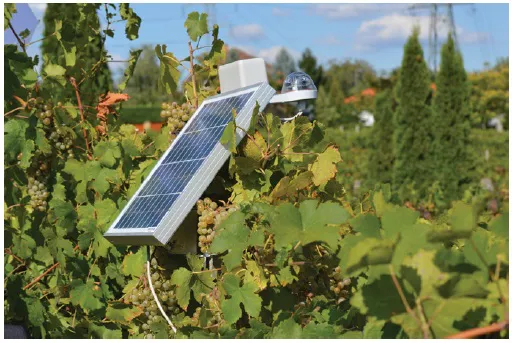
Figure 1.2 A sensor node from SmartVineyard Solutions installed in an organic vineyard in Slovakia. Reproduced with permission from SmartVineyard Solutions, Hungary.
A similar sensor network scenario is used for many other agricultural applications, often called precision agriculture. Examples are potato monitoring in Egypt [1], crop monitoring in Malawi [2], or a solution for vegetable monitoring on an organic farm in South Spain [3]. All of these systems have one problem in common: the foliage which develops over time. When the systems are first installed, the fields are almost empty or plants are small. However, as the crops grow, their foliage starts interfering with the system's work, particularly with its communications and sensors. Another common problem is that by harvesting time, the sensor nodes are well covered and hidden in the crops so their recovery is challenging. If unrecovered, they will most likely be damaged by the harvesting machines.
Bridge monitoring is a similar application in which the structural integrity of a bridge is monitored. Again, the space is limited, even if communication quality is better because of the outdoor, free-space environment. However, accessibility remains extremely limited.
There are two famous examples of bridges being monitored by sensor networks. The first example is tragic. On August 1, 2007, a bridge spanning the Mississippi river in Minneapolis collapsed suddenly under the weight of the rush hour traffic, killing 13 people and injuring another 145. The bridge was rebuilt shortly thereafter, this time equipped with hundreds of sensors to monitor its health and give early warnings.
The second example is more positive and presents the six-lane Charilaos Trikoupis bridge in Greece, which spans the Gulf of Corinth (Figure 1.3). It opened in 2003, with a monitoring system of more than 300 sensor nodes equipped with 3D accelerometers, tilt meters, tensiomag sensors, and many others. Shortly after opening, the sensor network signaled abnormal vibration of the construction's cables, which forced the engineers to install additional weights for stabilization. Since then the bridge has not had any further problems.

Figure 1.3 The Charilaos Trikoupis bridge in Greece, with a sensor network installed with over 300 sensor nodes. In its first days, it signaled abnormal vibrations, which could be quickly fixed. Source: Guillaume Piolle, Flickr.
Fire detection is crucial to save life and prevent damages. Sensor networks can be efficiently employed to detect fires early and send an alarm with the fire's exact position to fire brigades. This idea has been used worldwide in countries such as Spain, Greece, Australia, and Turkey. The main challenge with this application is the sensor node hardware itself and its resistance to high temperatures. It is quite inefficient...
Table of contents
- Cover
- IEEE Press
- Title page
- Copyright
- Dedication
- HOW TO USE THIS BOOK
- 1 WHAT ARE WIRELESS SENSOR NETWORKS?
- 2 ANATOMY OF A SENSOR NODE
- 3 RADIO COMMUNICATIONS
- 4 LINK MANAGEMENT
- 5 MULTI-HOP COMMUNICATIONS
- 6 DATA AGGREGATION AND CLUSTERING
- 7 TIME SYNCHRONIZATION
- 8 LOCALIZATION TECHNIQUES
- 9 SENSING TECHNIQUES
- 10 DESIGNING AND DEPLOYING WSN APPLICATIONS
- 11 SUMMARY AND OUTLOOK
- Index
- EULA
Trusted by 375,005 students
Access to over 1.5 million titles for a fair monthly price.
Study more efficiently using our study tools.
Frequently asked questions
Yes, you can cancel anytime from the Subscription tab in your account settings on the Perlego website. Your subscription will stay active until the end of your current billing period. Learn how to cancel your subscription
No, books cannot be downloaded as external files, such as PDFs, for use outside of Perlego. However, you can download books within the Perlego app for offline reading on mobile or tablet. Learn how to download books offline
Perlego offers two plans: Essential and Complete
- Essential is ideal for learners and professionals who enjoy exploring a wide range of subjects. Access the Essential Library with 800,000+ trusted titles and best-sellers across business, personal growth, and the humanities. Includes unlimited reading time and Standard Read Aloud voice.
- Complete: Perfect for advanced learners and researchers needing full, unrestricted access. Unlock 1.5M+ books across hundreds of subjects, including academic and specialized titles. The Complete Plan also includes advanced features like Premium Read Aloud and Research Assistant.
We are an online textbook subscription service, where you can get access to an entire online library for less than the price of a single book per month. With over 1.5 million books across 990+ topics, we’ve got you covered! Learn about our mission
Look out for the read-aloud symbol on your next book to see if you can listen to it. The read-aloud tool reads text aloud for you, highlighting the text as it is being read. You can pause it, speed it up and slow it down. Learn more about Read Aloud
Yes! You can use the Perlego app on both iOS and Android devices to read anytime, anywhere — even offline. Perfect for commutes or when you’re on the go.
Please note we cannot support devices running on iOS 13 and Android 7 or earlier. Learn more about using the app
Please note we cannot support devices running on iOS 13 and Android 7 or earlier. Learn more about using the app
Yes, you can access Introduction to Wireless Sensor Networks by Anna Forster in PDF and/or ePUB format, as well as other popular books in Technology & Engineering & Computer Networking. We have over 1.5 million books available in our catalogue for you to explore.