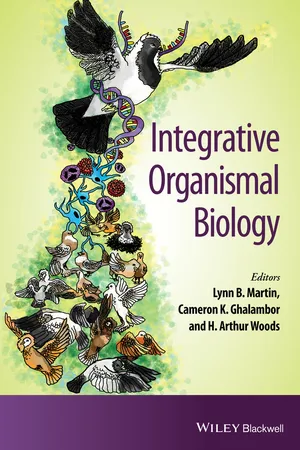
Integrative Organismal Biology synthesizes current understandings of the causes and consequences of individual variation at the physiological, behavioral and organismal levels. Emphasizing key topics such as phenotypic plasticity and flexibility, and summarizing emerging areas such as ecological immunology, oxidative stress biology and others, Integrative Organismal Biology pulls together information from diverse disciplines to provide a synthetic view of the role of the individual in evolution.
Beginning with the role of the individual in evolutionary and ecological processes, the book covers theory and mechanism from both classic and modern perspectives. Chapters explore concepts such as phenotypic plasticity, genetic and epigenetic variation, physiological and phenotypic variation, homeostasis, and gene and physiological regulatory networks. A concluding section interweaves these concepts through a series of case studies of life processes such as aging, reproduction, and immune defense.
- English
- ePUB (mobile friendly)
- Available on iOS & Android
eBook - ePub
Integrative Organismal Biology
About this book
Information
Table of contents
- Cover
- Title Page
- Copyright
- Dedication
- Acknowledgments
- Notes on Contributors
- Chapter 1: Plasticity, Complexity, and the Individual
- Chapter 2: The Ecological and Evolutionary Importance of Variation in Life History Reaction Norms
- Chapter 3: Curve-Thinking: Understanding Reaction Norms and Developmental Trajectories as Traits
- Chapter 4: Plasticity and Personality
- Chapter 5: Induction and Function of Polyphenic Morphs: Proximate Regulatory Mechanisms and Evolutionary Implications
- Chapter 6: Evolutionary Systems Biology: Shifting Focus to the Context-Dependency of Genetic Effects
- Chapter 7: The Role of Ecological Epigenetics in Integrative Biology
- Chapter 8: An Elephant in the Fog: Unifying Concepts of Physiological Stasis and Change
- Chapter 9: Physiological Regulatory Networks: The Orchestra of Life?
- Chapter 10: Integrating Costs of Reproduction between the Sexes
- Chapter 11: Immune Systems: Linking Organisms, Populations, and Evolution through Disease
- Chapter 12: Developmental Plasticity of Individual Variation in Stress Responses
- Chapter 13: A Common Framework for the Regulation of Growth and Size: Stepping Away from the Trees to See the Forest
- Chapter 14: Adding Fuel to the “Fire of Life”: Energy Budgets across Levels of Variation in Ectotherms and Endotherms
- Chapter 15: Biological Timekeeping: Individual Variation, Performance, and Fitness
- Chapter 16: Senescence: Integrating Biology from Cradle to the Grave
- Chapter 17: Linking Physiology, Climate, and Species Distributional Ranges
- Chapter 18: Trade-offs and Biological Diversity: Integrative Answers to Ecological Questions
- Chapter 19: Conclusions: The Central Role of the Organism in Biology
- Index
- End User License Agreement
Trusted by 375,005 students
Access to over 1.5 million titles for a fair monthly price.
Study more efficiently using our study tools.
Frequently asked questions
Yes, you can cancel anytime from the Subscription tab in your account settings on the Perlego website. Your subscription will stay active until the end of your current billing period. Learn how to cancel your subscription
No, books cannot be downloaded as external files, such as PDFs, for use outside of Perlego. However, you can download books within the Perlego app for offline reading on mobile or tablet. Learn how to download books offline
Perlego offers two plans: Essential and Complete
- Essential is ideal for learners and professionals who enjoy exploring a wide range of subjects. Access the Essential Library with 800,000+ trusted titles and best-sellers across business, personal growth, and the humanities. Includes unlimited reading time and Standard Read Aloud voice.
- Complete: Perfect for advanced learners and researchers needing full, unrestricted access. Unlock 1.5M+ books across hundreds of subjects, including academic and specialized titles. The Complete Plan also includes advanced features like Premium Read Aloud and Research Assistant.
We are an online textbook subscription service, where you can get access to an entire online library for less than the price of a single book per month. With over 1.5 million books across 990+ topics, we’ve got you covered! Learn about our mission
Look out for the read-aloud symbol on your next book to see if you can listen to it. The read-aloud tool reads text aloud for you, highlighting the text as it is being read. You can pause it, speed it up and slow it down. Learn more about Read Aloud
Yes! You can use the Perlego app on both iOS and Android devices to read anytime, anywhere — even offline. Perfect for commutes or when you’re on the go.
Please note we cannot support devices running on iOS 13 and Android 7 or earlier. Learn more about using the app
Please note we cannot support devices running on iOS 13 and Android 7 or earlier. Learn more about using the app
Yes, you can access Integrative Organismal Biology by Lynn B. Martin,Cameron K. Ghalambor,H. Arthur Woods in PDF and/or ePUB format, as well as other popular books in Biological Sciences & Evolution. We have over 1.5 million books available in our catalogue for you to explore.