![]()
Part 1
Getting Started with NFC
IN THIS PART …
Discovering how NFC came into being
Understanding why NFC is such a cool technology
Obtaining a brief overview of how NFC works
Seeing NFC from the user perspective
Differentiating NFC from other wireless technologies
![]()
Chapter 1
Introducing Near Field Communication (NFC)
IN THIS CHAPTER
Introducing the history of NFC
Discovering why you need NFC
Considering how you might use NFC wallets
Getting the simple facts about how NFC works
Near Field Communication (NFC) is an amazing technology that helps you interact with both the people and things around you in ways that you can’t really imagine until you start using the technology. When using NFC to tap things (physically place your NFC-enabled device against something like an NFC tag), you gain advantages in efficiency that save both time and money. In addition, you can rely on NFC to help reduce costly errors that can cause problems for both you and your organization. Unlike older technologies, NFC is also quite flexible and can be found in almost all new smartphones today, so you can use it in more ways and places than you might initially think. Everyone can use NFC — developers, hobbyists, and the average person on the street. This chapter helps you gain an understanding of how NFC came to be and how it can give your organization a competitive advantage. Throughout this book, you gain insights into how you can use NFC to perform useful tasks. This chapter begins with the concept of using NFC to enable digital wallets — a topic that is in all the headlines. Using NFC means that you can make purchases with greater confidence and with a smaller chance of having to deal with issues such as identity theft. In fact, you’ll be amazed at all the ways in which you can use NFC wallets to make your life easier. So, although you might initially think about all the ways you can use NFC to make things easier for your organization, you also need to think of all the ways you can use it to help yourself. After all, you do have a life outside of work that NFC can and will affect!
This chapter ends by providing you with a quick overview of how NFC works. You don’t have to endure a long lecture about all the bits and bytes of NFC technology, nor do you have to become an electrical engineer. Rather, this chapter provides an introduction to the technology so that you can talk about it with other people and make a few simple decisions about how you might use NFC as an individual or within your organization. In addition, you gain insights into how NFC can make your life simpler because you now have a better idea of where you’ve already seen NFC used in real-world applications.
Presenting a Quick History of NFC
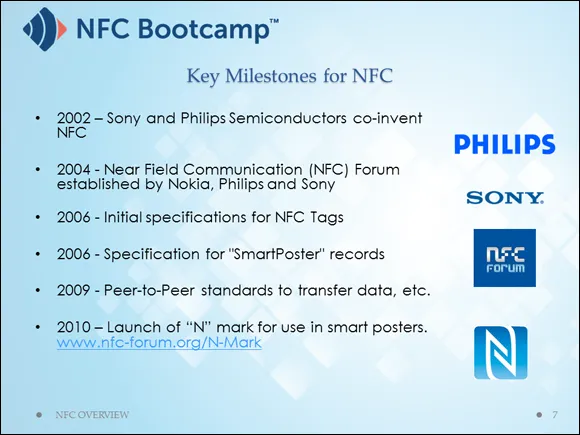
As with most technologies, NFC didn’t just appear on the horizon one day. Various companies spent a good deal of time putting the specifics for NFC together. In addition, these companies used existing technologies, in this case Radio Frequency Identification (RFID), as a starting point. (RFID was a 1983 invention of Charles Walton, but its origins can be traced back to WWII. You can find an excellent history of RFID at http://www.rfidjournal.com/articles/view?1338.) NFC is actually a technology that overlaps RFID — it uses a shorter operating distance for the sake of security. Figure 1-1 shows the key dates for NFC milestones that have affected how the technology has changed over time. Even though the NFC effort started in 2002, the International Standards Organization (ISO) didn’t approve NFC as an acceptable standard until 2003.
As shown in Figure 1-1, NFC tags — small sticker-like devices used to store information or data in a manner that an NFC-enabled device can read or optionally write — didn’t come in a standardized form until 2006. When an NFC-enabled device moves over the tag, it can retrieve the information the tag contains. However, don’t worry about how the hardware works for now. All that is important to remember at this point is that NFC tags use a standardized form so that any NFC-enabled device can interact with any NFC tag — making NFC exceptionally easy to use.
One of the technologies that truly distinguishes NFC is the use of SmartPoster technology (a kind of visual display that incorporates both traditional poster content and digital content that an NFC-enabled device can read or optionally write). This standardized technology also appeared in 2006. You use it to provide digital information in a physical printed poster for people to access. Passing a smartphone or other NFC-enabled device over specifically marked areas of the poster provides viewers with details they can take with them. The first use for SmartPosters that comes to mind is for public venues such as trade shows — no more need to waste money printing take-away brochures that end up on the floor anyway (see companies such as Poken, http://www.poken.com/, and ITN, http://www.itnint.com/, for examples of this use). However, SmartPosters can appear in all sorts of places, such as bus shelters, malls, and airports (see BlueBite, at http://www.bluebite.com/, for an example of these uses).
February 2006 saw the introduction of the first NFC-enabled cellphone, the Nokia 6131 NFC. (Not all versions of the Nokia 6131 provide NFC support.) This phone started the whole idea of being able to pass the phone over a tag and obtain information from it. By the time the Samsung Nexus S appeared on the scene in 2010, NFC support became a standard feature and the capabilities of NFC had improved significantly.
One of the significant additions to NFC is its capability to provide peer-to-peer support. In addition to reading information from tags, you can exchange information with another person by bringing your NFC-enabled smartphones closely together. Instead of having to deal with bulky business cards, NFC-enabled smartphones let you keep your connections in a place where they’re easily found, used, and managed. In addition to business connections, your peer-to-peer connection can also exchange data such as pictures, movies, and music.
NFC is growing significantly. It’s predicted that within five years, half or more of all phones made will have NFC support. Within ten years, people will use NFC data exchange as a preferred method for obtaining publicly available information from physical objects; although, the use of NFC will remain completely optional.
Defining the Need for NFC
NFC solves all sorts of problems, and throughout this book you get introduced to a lot of these solutions. However, before you spend time reading about NFC, you might like to know how you can use it to meet your needs immediately. In fact, you might be surprised to learn that you already use NFC and simply don’t know it. NFC appears all over the place. The following sections provide you with a quick summary of some of the most interesting uses. As you progress through the book, you find additional uses described in more detail.
Interacting with devices using simpler methods
Imagine being able to interact with any device just by tapping it with an NFC-enabled device such as your smartphone. For example, you tap your portable speakers, and the music currently playing on your smartphone starts playing out of the speakers instead. You get the full effect of those high-quality speakers you purchased, but with the music that you like from your smartphone. Bluetooth pairing of devices is normally a painful process when done manually. NFC makes the pairing possible with a single tap. Even though the music still relies on Bluetooth to get from the device to the speakers, the pairing is done with NFC.
The same concepts hold true with your television. A single tap is enough to make a connection with your smartphone so that you can see the pictures or video currently displayed on the smartphone, but at television size and resolution. Sony and other companies are currently engaged in making NFC connectivity happen in all sorts of ways. You can read about some of the latest Sony offerings at http://venturebeat.com/2013/01/12/nfc-makes-it-easy-to-connect-sonys-devices-with-one-touch/.
Buying products with ease
You walk up to the cash register with a cartful of goods you want to buy. Whether the cash register is actually manned by someone is unimportant (some stores are now experimenting with self-serve checkouts that really do save the store money and make the shopping experience much faster for most people). The goods are swiped across the scann...