A top priority in climate research is obtaining broad-extent and long-term data to support analyses of historical patterns and trends, and for model development and evaluation. Along with directly measured climate data from the present and recent past, it is important to obtain estimates of long past climate variations spanning multiple centuries and millennia.
Dendroclimatic Studies at the North American Tree Line presents an overview of the current state of dendroclimatology, its contributions over the past few decades, and its future potential. The material included is not useful not only to those who generate tree-ring records of past climate-dendroclimatologists, but also to users of their results-climatologists, hydrologists, ecologists and archeologists.
In summary, this book:
Sheds light on recent and future climate trends by assessing long term past climatic variations from tree rings
Is a timely coverage of a crucial topic in climate science portraying recent warming trends which are of serious concern today
Features well-reputed scientists highlighting new advanced methodologies to reconstruct past climate change
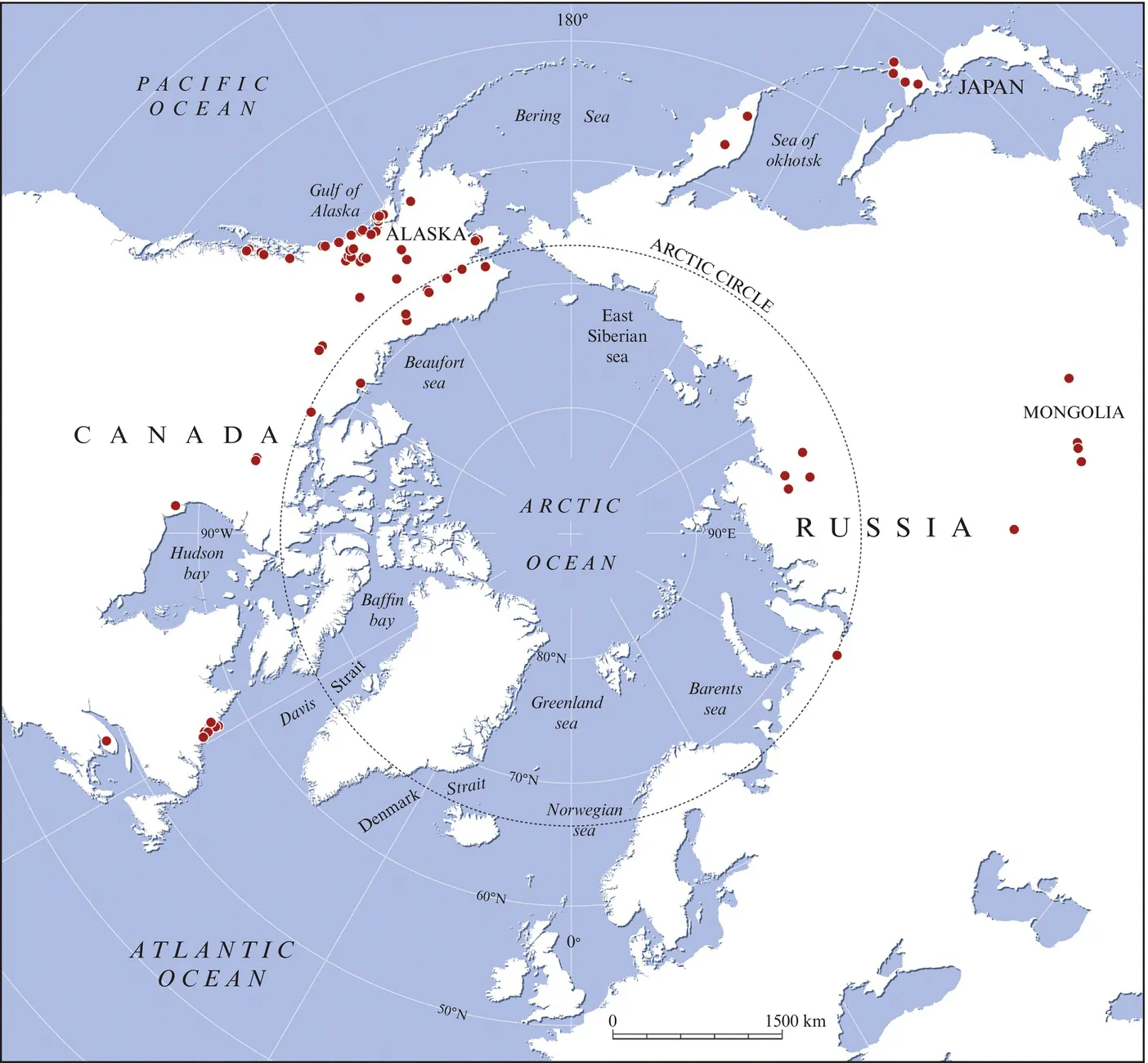
This monograph provides a comprehensive synthesis of dendroclimatic research based on northern old growth sites in the forests of North America and Eurasia, as conducted by the scientists at the Lamont-Doherty Earth Observatory’s Tree-Ring Laboratory (TRL-LDEO) of Columbia University over the past four decades (Figure 1.1).
Figure 1.1 Locations of tree-ring chronologies sampled from northern forest sites over the past few decades by TRL-LDEO scientists and colleagues. Many more have been sampled by other scientists for these areas. For color detail, please see color plate section.
We focus herein mainly on the latitudinal northern treeline (see Glossary), as well as other locations further south (such as the elevational treeline in Mongolia, and the Russian Far East) where trees are often sensitive indicators of past temperature variability. In keeping with the requirements of the “Opportunities for Promoting Understanding through Synthesis” (OPUS) program of the National Science Foundation that funded the writing of this monograph, we emphasize the research conducted by scientists at the TRL-LDEO. However, we place these studies in the context of the broader field of Northern Hemispheric dendroclimatology (Glossary), conducted by numerous other researchers and colleagues who have provided valuable and important insights into this topic over the years.
1.2. Basic Tree-Ring Principles
The research described herein adheres to the basic principles of dendrochronology, as outlined in introductory and general texts by Stokes and Smiley (1968), Fritts (1976), Schweingruber (1988), Cook and Kairiukstis (1990), Speer (2012), and others. The main premise of dendrochronology is the establishment of precise, high-resolution (annually-resolved) tree-ring chronologies, derived using the method known as cross-dating (references above; Glossary). The cross-dating technique is based upon the observation that there is a common climatic and environmental signal in the ring-width variations of samples of wood compiled from trees (of the same species) from the same site and region. Relatively narrow (wide) rings are used to infer more adverse (favorable) environmental conditions for growth. When performed correctly, this method ensures that there are no dating errors resulting from anomalous growth patterns. These include, for example, false rings (Glossary); in which growth is slowed, resulting in thicker-walled cells, for a period during the growing season due to a particular adverse event, such as drought, or missing rings (in which radial growth is not laid down in a particular wood sample or tree due to an adverse event; Glossary). Although it has been suggested by Mann and colleagues (2012), based on tree-growth model simulations, that such missing rings can occur amongst all trees at a given site following major volcanic events (e.g., in 1258, 1815), there is no actual tree-ring evidence that this is in fact the case, as indicated in several subsequent presentations and publications (Anchukaitis et al., 2012a; Esper et al., 2013, in press; D’Arrigo et al., 2012a; D’Arrigo et al., 2001b; Journal of Geophysical Research, in press).
The science of dendroclimatology evolved from the need to understand past and present climate variability as well as the factors impacting tree growth and climate response on a range of spatial and temporal scales. Determination of how climate has varied in the past is also critically important for evaluating the sensitivity of the Earth’s climate system to both natural and anthropogenic forcing. Yet, instrumental observations are limited in length and spatial coverage, particularly in many remote far northern regions, where station records may only span a few decades. Overcoming these limitations requires high-resolution, precisely-dated proxy data archives, such as tree rings, so that we may derive a long-term perspective for conditions during the recent anthropogenic era, during which profound and rapid changes are now taking place.
1.3. Polar Amplification of Global Warming and Impacts on Forests
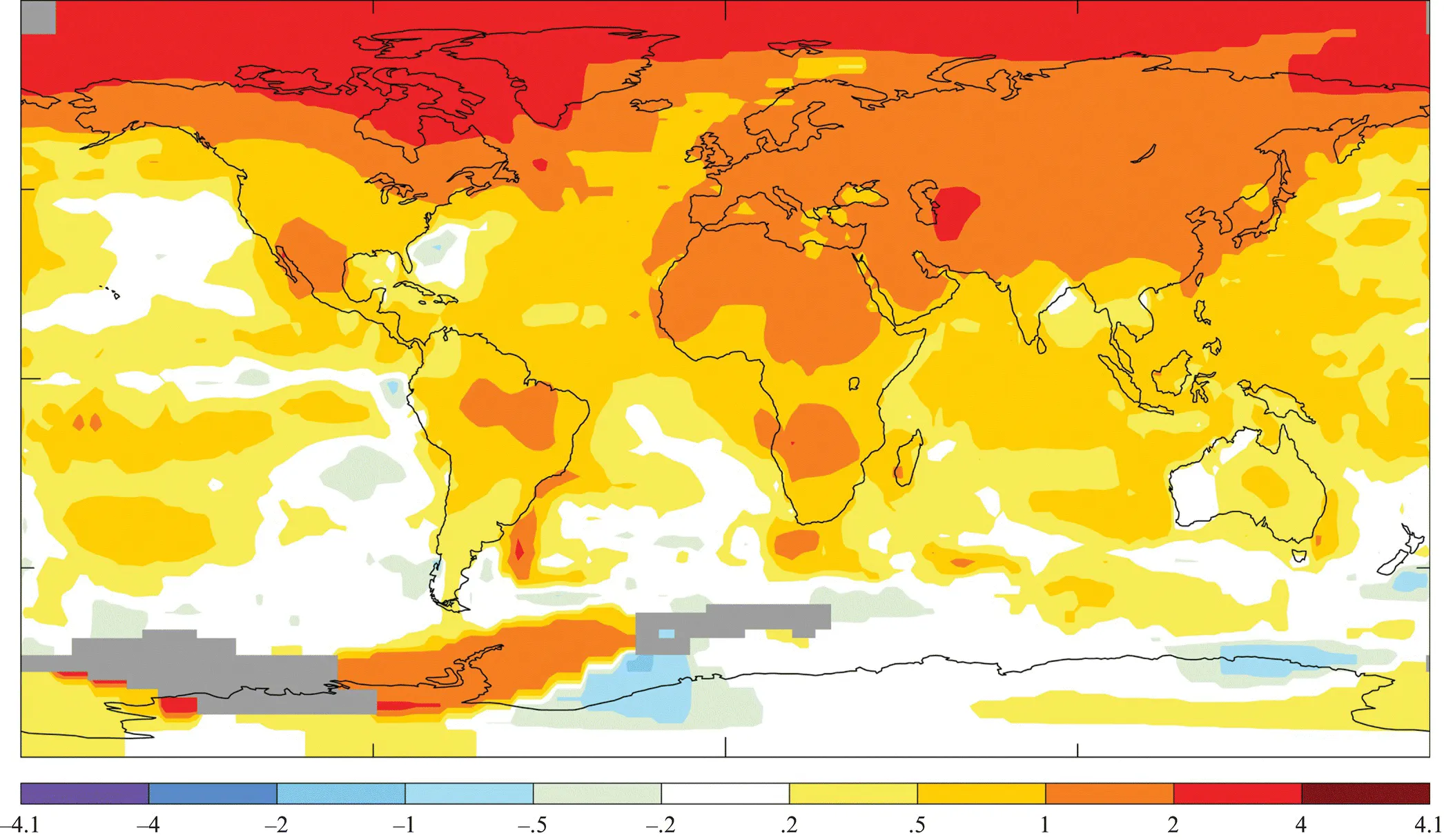
The far northern latitudes are uniquely sensitive to climatic change, with warming in some regions at nearly twice the rate of many other areas of the planet (Figure 1.2) (Hansen et al., 2010; ACIA, 2005).
Figure 1.2 Map showing evidence from annual (Jan–Dec) temperature data of large-scale warming and polar amplification in recent decades (temperatures averaged over 1975–2010 in degrees Celsius). Adapted from Goddard Institute for Space Studies (GISS) (http://data.giss.nasa.gov/gistemp/maps/; Hansen et al., 2010). For color detail, please see color plate section.
Alaska, for instance, has experienced a winter temperature increase of ~3.5 °C over the past ~50 years (NOAA Strategic Plan, 2010; National Academy of Sciences, 2011; Polar Frontiers Executive Summary, Grebmaier et al., 2011; Jansen et al., Intergovernmental Panel on Climatic Change [IPCC], 2007; U.S. Global Change Research Program—Regional Climate Impacts, Alaska Report, 2009; and AR5, www.ipcc.ch). Summer (Jun–Jul–Aug) temperatures in Arctic Alaska increased 1.4 °C between 1951 and 2000 (Hartmann and Wendler, 2005). Along with this so-called “polar amplification” of warming (Glossary), rapid melting of sea ice, stress on wildlife populations, increased fire frequency and severity, and other iconic changes have taken place in the Arctic in recent decades (see references above).
Boreal forests are undergoing substantial biome shifts as a result of these rapid changes (Barber et al., 2009; Andreu-Hayles et al., 2011; Beck et al., 2011; Beck et al., 2013; Juday, 2011; Xu et al., 2013). This is particularly noteworthy because boreal forests, estimated to account for approximately 22% of the carbon stored in forests worldwide, play an essential role in the carbon balance of the globe (Pan et al., 2011; Milakovsky et al., 2012). They also, importantly, represent some of the last remaining undisturbed wilderness areas on the earth today (ACIA, 2005). There is ample evidence that such shifts in growth patterns, such as migration of treeline position (Esper and Schweingruber, 2004), earlier growing season onset, and declining trends in forest productivity, are well under way, based on both satellite vegetation monitoring and ground-based observations (Bunn and Goetz, 2006; Beck et al., 2011; Beck et al., 2013; Juday, 2011).
The response of northern forest ecosystems to change appears to be complex and possibly nonlinear. This response can, in turn, cause significant feedbacks into the climate system, including changes to the planet’s albedo and carbon budget (Chapin et al., 2004; Jansen et al., 2007 [IPCC]; Lloyd and Bunn, 2007; Bonan, 2008). Widespread tree mortality in interior Alaska due to drought stress, fire, and insect outbreaks has been attributed to the negative impacts of global warming on forest growth (Juday, 2011). A related possible response is the observed decoupling between tree growth and temperature data, commonly now referred to as “divergence,” observed mainly in northern latitude treeline settings (e.g., D’Arrigo et al., 2008; Glossary; see later chapter for a discussion). It is important to note, however, that many northern forests are still responding positively to warmer temperatures, recording this signal in the recent period as well as back in time (e.g., D’Arrigo et al., 2001; Wilson et al., 2007b; Grudd, 2008; Esper et al., 2010; Beck et al., 2011; Büntgen et al., 2011; Melvin et al., 2012).
The tree-ring data and chronologies described herein have been transformed into climatic (temperature) reconstructions (Glossary), which are defined as records of local, regional to larger-scale thermal histories that extend back prior to the available instrumental record. These reconstructions are primarily related to temperature but also reflect, and integrate, to varying degrees, past fluctuations in hydroclimate, sea-level pressure, and synoptic and broad-scale atmosphere-ocean circulation dynamics and teleconnections. The tree-ring data we describe also yield valuable information and observations on forest growth productivity and how it has varied over annual to centennial time scales.
The generation of large-scale reconstructions of temperature from tree rings and other proxy archives is an ongoing, evolving process. These records will continue to improve as additional data coverage and new methodologies become available. Such data archives are essential for (1) constraining the sensitivity of the Earth’s climate system, (2) placing recent anthropogenically-forced variability in a long-term context, (3) understanding the response to both natural external radiative and other forcings (solar, volcanic, greenhouse gases, aerosols) and internal variability (e.g., the El Niño-Southern Oscillation or ENSO, the North Atlantic Oscillation or NAO, Arctic Oscillation or AO; all in Glossary), and (4) facilitating and providing input for constraining future modeled scenarios derived from climate and vegetation models via proxy/model comparisons. At the same time, this information must take into consideration the rapid, and at times unprecedented changes in forest growth and temperature now taking place.
1.4 “Northern Archive” Synthesis
We synthesize scientific results outlined in more than 50 peer-reviewed papers published over the past four decades by TRL-LDEO investigators on northern forests, in addition to various proceedings volumes and reports (e.g., National Research Council, National Academy of Sciences, Intergovernmental Panel on Climatic Change or IPCC). A listing of these core papers on northern forests over the past few decades is provided near the end of this monograph. Also included is an annotated compilation of long-term tree-ring raw data measurements, metadata, chronologies, and reconstructions, which is being made available under the heading “Northern Archive” on the NOAA Paleoclimatology (www.ncdc.noaa.gov) website. This data is being made available via the Internet for scientists, teachers, students and the public to allow them to pose their own questions about the research and to use...
Table of contents
Cover
Title page
Copyright page
Preface
Acknowledgments
1. Introduction
2. Tree-Ring Investigations at Northern Latitudes
3. Selected Local to Regional TRL-LDEO Northern Tree-Ring Studies
4. The Broader Context of Northern Dendroclimatic Studies
5. Temperature Reconstructions for the Northern Hemisphere
6. Tree Growth Issues in the Anthropogenic Era
7. Conclusions and Future Challenges
Glossary
References
Core TRL-LDEO Publications on Northern Forests
Supplementary Images
Index
End User License Agreement
Trusted by 375,005 students
Access to over 1.5 million titles for a fair monthly price.
Study more efficiently using our study tools.
Frequently asked questions
Yes, you can cancel anytime from the Subscription tab in your account settings on the Perlego website. Your subscription will stay active until the end of your current billing period. Learn how to cancel your subscription
No, books cannot be downloaded as external files, such as PDFs, for use outside of Perlego. However, you can download books within the Perlego app for offline reading on mobile or tablet. Learn how to download books offline
Perlego offers two plans: Essential and Complete
Essential is ideal for learners and professionals who enjoy exploring a wide range of subjects. Access the Essential Library with 800,000+ trusted titles and best-sellers across business, personal growth, and the humanities. Includes unlimited reading time and Standard Read Aloud voice.
Complete: Perfect for advanced learners and researchers needing full, unrestricted access. Unlock 1.5M+ books across hundreds of subjects, including academic and specialized titles. The Complete Plan also includes advanced features like Premium Read Aloud and Research Assistant.
Both plans are available with monthly, semester, or annual billing cycles.
We are an online textbook subscription service, where you can get access to an entire online library for less than the price of a single book per month. With over 1.5 million books across 990+ topics, we’ve got you covered! Learn about our mission
Look out for the read-aloud symbol on your next book to see if you can listen to it. The read-aloud tool reads text aloud for you, highlighting the text as it is being read. You can pause it, speed it up and slow it down. Learn more about Read Aloud
Yes! You can use the Perlego app on both iOS and Android devices to read anytime, anywhere — even offline. Perfect for commutes or when you’re on the go. Please note we cannot support devices running on iOS 13 and Android 7 or earlier. Learn more about using the app
Yes, you can access Dendroclimatic Studies by Rosanne D'Arrigo,Nicole Davi,Gordon Jacoby,Rob Wilson,Greg Wiles,Gordon Jacoby in PDF and/or ePUB format, as well as other popular books in Physical Sciences & Meteorology & Climatology. We have over 1.5 million books available in our catalogue for you to explore.