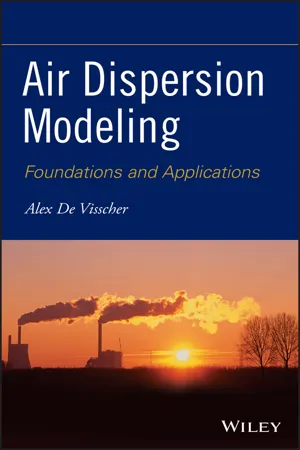
Air Dispersion Modeling
eBook - ePub

Air Dispersion Modeling

Foundations and Applications

  1. English
  2. ePUB (mobile friendly)
  3. Available on iOS & Android
eBook - ePub

Air Dispersion Modeling

Foundations and Applications

About this book

A single reference to all aspects of contemporary air dispersion modeling

The practice of air dispersion modeling has changed dramatically in recent years, in large part due to new EPA regulations. Current with the EPA's 40 CFR Part 51, this book serves as a complete reference to both the science and contemporary practice of air dispersion modeling. Throughout the book, author Alex De Visscher guides readers through complex calculations, equation by equation, helping them understand precisely how air dispersion models work, including such popular models as the EPA's AERMOD and CALPUFF.

Air Dispersion Modeling begins with a primer that enables readers to quickly grasp basic principles by developing their own air dispersion model. Next, the book offers everything readers need to work with air dispersion models and accurately interpret their results, including:

  • Full chapter dedicated to the meteorological basis of air dispersion
  • Examples throughout the book illustrating how theory translates into practice
  • Extensive discussions of Gaussian, Lagrangian, and Eulerian air dispersion modeling
  • Detailed descriptions of the AERMOD and CALPUFF model formulations

This book also includes access to a website with Microsoft Excel and MATLAB files that contain examples of air dispersion model calculations. Readers can work with these examples to perform their own calculations.

With its comprehensive and up-to-date coverage, Air Dispersion Modeling is recommended for environmental engineers and meteorologists who need to perform and evaluate environmental impact assessments. The book's many examples and step-by-step instructions also make it ideal as a textbook for students in the fields of environmental engineering, meteorology, chemical engineering, and environmental sciences.

Frequently asked questions

Yes, you can cancel anytime from the Subscription tab in your account settings on the Perlego website. Your subscription will stay active until the end of your current billing period. Learn how to cancel your subscription.
No, books cannot be downloaded as external files, such as PDFs, for use outside of Perlego. However, you can download books within the Perlego app for offline reading on mobile or tablet. Learn more here.
Perlego offers two plans: Essential and Complete
  • Essential is ideal for learners and professionals who enjoy exploring a wide range of subjects. Access the Essential Library with 800,000+ trusted titles and best-sellers across business, personal growth, and the humanities. Includes unlimited reading time and Standard Read Aloud voice.
  • Complete: Perfect for advanced learners and researchers needing full, unrestricted access. Unlock 1.4M+ books across hundreds of subjects, including academic and specialized titles. The Complete Plan also includes advanced features like Premium Read Aloud and Research Assistant.
Both plans are available with monthly, semester, or annual billing cycles.
We are an online textbook subscription service, where you can get access to an entire online library for less than the price of a single book per month. With over 1 million books across 1000+ topics, we’ve got you covered! Learn more here.
Look out for the read-aloud symbol on your next book to see if you can listen to it. The read-aloud tool reads text aloud for you, highlighting the text as it is being read. You can pause it, speed it up and slow it down. Learn more here.
Yes! You can use the Perlego app on both iOS or Android devices to read anytime, anywhere — even offline. Perfect for commutes or when you’re on the go.
Please note we cannot support devices running on iOS 13 and Android 7 or earlier. Learn more about using the app.
Yes, you can access Air Dispersion Modeling by Alex De Visscher in PDF and/or ePUB format, as well as other popular books in Technology & Engineering & Environmental Management. We have over one million books available in our catalogue for you to explore.

Table of contents

  1. Cover
  2. Title page
  3. Copyright
  4. Dedication
  5. PREFACE
  6. LIST OF SYMBOLS
  7. CHAPTER 1: INTRODUCTION
  8. CHAPTER 2: AN AIR DISPERSION MODELING PRIMER
  9. CHAPTER 3: AIR POLLUTANTS: AN OVERVIEW
  10. CHAPTER 4: REGULATION OF AIR QUALITY AND AIR QUALITY MODELING
  11. CHAPTER 5: METEOROLOGY FOR AIR DISPERSION MODELERS
  12. CHAPTER 6: GAUSSIAN DISPERSION MODELING: AN IN-DEPTH STUDY
  13. CHAPTER 7: PLUME–ATMOSPHERE INTERACTIONS
  14. CHAPTER 8: GAUSSIAN MODEL APPROACHES IN URBAN OR INDUSTRIAL TERRAIN
  15. CHAPTER 9: STOCHASTIC MODELING APPROACHES
  16. CHAPTER 10: COMPUTATIONAL FLUID DYNAMICS AND METEOROLOGICAL MODELING
  17. CHAPTER 11: EULERIAN MODEL APPROACHES
  18. CHAPTER 12: PRACTICAL ASPECTS OF AIR DISPERSION MODELING
  19. CHAPTER 13: ISC3 AND SCREEN3: A DETAILED DESCRIPTION
  20. CHAPTER 14: AERMOD AND AERMET: A DETAILED DESCRIPTION
  21. CHAPTER 15: CALPUFF AND CALMET: A DETAILED DESCRIPTION
  22. CHAPTER 16: CMAQ: A BRIEF DESCRIPTION
  23. APPENDIX A: AUXILIARY CALCULATIONS AND DERIVATIONS
  24. APPENDIX B: AUXILIARY DATA AND METHODS
  25. APPENDIX C: THEORY OF NEAR SURFACE TURBULENCE APPLIED TO WIND SPEED PROFILES, DRY DEPOSITION, AIR–WATER EXCHANGE, AND CANOPY EFFECTS
  26. INDEX