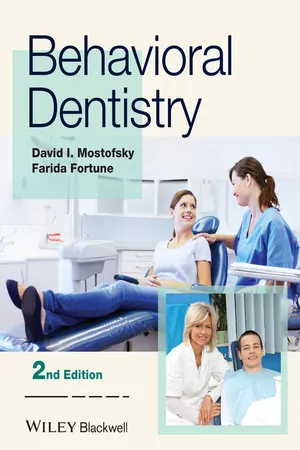
Behavioral Dentistry, Second Edition, surveys the vast and absorbing topic of the role of behavioral science in the study and clinical practice of dentistry. An understanding of social sciences has long been a central part of dental education, and essential for developing a clinician's appreciation of human behavior as it affects efficient dental treatment. This book gathers together contributions from leading experts in each of the major subspecialties of behavioral dentistry. Its aim is not merely to provide the student and clinician with a comprehensive review of the impressive literature or discussion of the theoretical background to the subject, but also with a practical guide to adapting the latest techniques and protocols and applying them to day-to-day clinical practice.
This second edition of Behavioral Dentistry discusses biobehavioral processes, including the psychobiology of inflammation and pain, oral health and quality of life, saliva health, and hypnosis in dentistry. The book goes on to examine anxiety, fear, and dental and chronic orofacial pain, and then reviews techniques for designing and managing behavior change. It concludes with a section on professional practice, including care of special needs, geriatric, and diabetic patients, and interpersonal communication in dental education.
- English
- ePUB (mobile friendly)
- Available on iOS & Android
eBook - ePub
Behavioral Dentistry
About this book
Information
IV
Professional Practice
18
Listening
Key points
- Good listening is essential to an effective practice.
- Hearing and listening are not synonymous.
- Most dental practices would benefit from better listening skills.
- Common barriers to good listening can be identified and modulated.
- Key listening skills described in this chapter are relatively simple and can be learned.
- Current trends in dental practice make it challenging to communicate with patients.
- Patients judge dental care, in large part, on the basis of psychosocial factors.
Few people … have had much training in listening. The training of most over verbalized professional intellectuals is in the opposite direction. Living in a competitive culture, most of us are most of the time chiefly concerned with getting our own views across, and we tend to find other people's speeches a tedious interruption of the flow of our own ideas.
—S.I. Hayakawa (1963, p. 32)
Apparently the act of attending carefully to another person is a difficult task for most people.
—Carl Rogers (1951, p. 349)
While much has been written about the obvious importance of listening in everyday life, there is precious little to be found in dental literature, in spite of the fact that dental patients typically judge the quality of dental care on the basis of social rather than technical factors. Patients really don't know how to evaluate a crown or a filling, but they very much know how they were treated and how they felt.
This chapter reviews what we know about listening in the doctor–patient relationship, describes the benefits of good listening along with common barriers, and prescribes several learnable methods to improve listening skills. It describes the essential skills involved in good listening, including the active listening skills such as restatement, paraphrasing, reflection, summarizing, physical listening, and listening for feelings. Common tendencies, errors, and barriers are described, along with ways to grow out of them. The “listening attitude” is described. Examples of effective prompts are provided (“tell me more …”). Open- and closed-ended questions are described as well as laundry-list questions, probing questions, and the use of positive reinforcement. The chapter is written to help dentists and their teams evaluate and improve their clinical listening skills.
Listening is one of those curious things in life where virtually everyone sings its praises yet few actually take the time and effort to assess and improve their skills. Most people—and dentists can certainly be this way—seem to think that since they have functioning ears they know how to listen. This is hardly the case, and everyone knows people who just don't seem to “get it.” In fact, many people think that they are better listeners than they really are.
Michael Nichols, a psychotherapist and author of The Lost Art of Listening wrote that his many years of practice led him to the conclusion that “much of the conflict in our lives can be explained by one simple but unhappy fact: we don't really listen to each other” (Nichols, 1995, p. 1). Truly good listeners are rare and precious. The issue of poor listening skills is a problem that hides in plain sight. The old Mark Twain quote about the weather is applicable: Everybody talks about the weather, but nobody does anything about it.
While most dentists would endorse the notion that listening skills are important to effective practice, dental education provides little or no curriculum time, and dental school applicants are not typically selected for their social skills. Continuing education related to these topics is rare, and training is hard to find outside of expensive consulting firms. As a result, the quality of listening in clinical dental practice is uneven at best.
Hearing sounds is one thing; hearing the message is something else entirely. Kratz and Kratz (1995, p. 2) provide a useful definition of listening: “The act by which we make sense of sounds.” Igor Stravinsky famously noted that “To listen is an effort, and just to hear is no merit. A duck hears also.” Appointments in health care involve the meeting of two people, each expert in his or her own domain. Doctors are experts in specialties such as medicine or dentistry; patients are expert in the nature and qualities of their own lives, their values, wishes, fears, and goals. Information from both domains must be included in discussions and decisions.
Listening in Health Care
It rather amazes me how often a new patient says, “My dentist doesn't listen to me!” Last week may have been a record with six or seven new patients in a row sitting in my consult room and complaining, “My dentist just doesn't listen!”
—William Halligan, DDS (2012) (http://halligantmj.com/)
The challenge of listening is larger than dentistry itself. In a review of two recent books on the communication of global warming to the public and policy makers, Peter Kareiva concludes that the authors “underemphasize the single biggest reason why scientists are often such ineffective communicators. The failure of scientists as communicators is that they do not know how to listen, especially when it comes to the ‘uneducated public’. Brilliant scientists can be stunningly dumb when it comes to dealing with people” (Kareiva, 2010, p. 35).
Robin Wright's observation is a good place to start the assessment of the state of current affairs: “If you are like many dental professionals, your treatment is better than your talk about treatment” (Wright, 1997, p. 2).
Much of what we know about communication in the doctor–patient relationship comes from medical literature. In contrast to dental practice, most of what happens in typical medical appointments is talk. Dental appointments usually consist of procedures; talk can be seen as superfluous sometimes. Nonetheless, there is a good deal to be learned from the available medical literature. Much of the information in this section comes from a highly recommended text by Debra Roter and Judith Hall titled Doctors Talking with Patients; Patients Talking with Doctors published in 2006.
It seems that communication in the physician–patient relationship began to deteriorate when effective sulfa drugs were introduced into medical practice in the 1930s and antibiotics (“the antibiotic revolution”) in the 1940s (Roter & Hall, 2006). Psychiatry was transformed—for better and for worse—with the introduction of effective antipsychotic medications in the 1950s. The role of the doctor shifted from teacher-healer to detective-prescriber, resulting in the brief, no-nonsense, business-like patient appointment typical in 2013. Dental appointments tend to be like this. But dentistry's identity as a profession depends upon communication skills, for without them, dentists are relegated to the role of tooth technician or mouth mechanic. If dental practice is to evolve from a heavy (sometimes exclusive) emphasis on restoration to a more preventive focus, effective communication skills will be mandatory. That said, even from the most narrow restorative view, dentists know that most of the difficulties of dental practice are related to mismatches or misunderstandings between people, not problems of a technical nature.
Add to all this the fact that dental appointments are typically anxiety provoking for patients—and often for doctors. Anxiety about dental treatment is extremely common, and studies have noted that anywhere from 46% to 75% of the population suffers at least some dental anxiety (Robbins, 1962; Milgrom et al., 1988). Roter and Hall (2006) observe that “Encounters with doctors are highly charged …” (p. xiv).
The seminal research on the impact of communication on patients in dental practice was done by the late Norman Corah who spent much of his career studying dental anxiety and developing questionnaires to measure it. In a 1985 study (Corah, O'Shea, & Bissell, 1985), he used an instrument that included questions on injections, the drill, probing for gum disease, scraping while cleaning, the rubber dam, and gagging, along with psychosocial aspects. He found that the following factors had the most powerful impact on patient satisfaction (not necessarily on anxiety):
- having a calm manner
- saying reassuring things
- taking seriously what the patient had to say
- telling the patient what was to be done
- encouraging the patient to ask questions.
It is interesting to note that while all the positive behaviors of dentists helped somewhat with patient satisfaction, the most powerful ones were psychosocial.
The notorious notion that doctors interrupt patients early and often is well-known. Studies by Beckman and Frankel (1984) and Marvel et al. (1999) revealed that physicians typically (69% of the time) interrupted or redirected patients' opening statements after an average of only 15–18 seconds (Roter & Hall, 2006). When patients were not interrupted, it turned out that they needed only 2.5 minutes to finish their story. Researchers also found that the first concerns mentioned by patients were not typically more important than concerns to be expressed later in the meeting. This implies that doctors never actually hear the issue that matters most to their patient.
Roter and Hall (2006) also observe that patients have theories about what has caused their health problems. It is likely that many dental patients hold incorrect views of oral health, caries production, bruxing, and home care. It would be helpful for dentists to know what patients think about these things in order to address them accurately. It is not helpful when dentists perceive that discussions are a distraction from the real business of dentistry, that of restoration. Patients can sense this attitude, but without encouragement, may keep quiet in order to be seen as a “good patient.”
Patient “noncompliance” is a huge issue in health care. Research indicates alarmingly high levels. A recent meta-analysis of patient adherence patterns by Martin et al. (2005) revealed general levels of patient nonadherence to be between 40% and 70%. Controlling factors were cognitive components, such as health literacy and beliefs (including misunderstandings), memory problems, the use of medical jargon, patient attitudes, cultural variations, and interpersonal problems between doctor and patient, especially a patient perception that their doctor is uninterested in them. They note on page 192 that “Patients who feel that their physicians communicate well with them and actively encourage them to be involved in their own care tend to be more motivated to adhere” (Frankel, 1995; Safran et al., 1998; Martin, DiMatteo, & Lepper, 2001; O'Malley, Forrest, & Mandelblatt, 2002). They reported that “Adherence rates have been found to be nearly 3 times higher in primary care relationships characterized by very high levels of trust coupled with physicians' knowledge of the patient as a whole person” (Martin et al., 2005, p. 193).
Knowing the patient as a person allows the health professional to understand elements crucial to the patient's adherence: beliefs, attitudes, subjective norms, cultural context, social supports, and mental health challenges, particularly self-concept and depression. What would be the point of telling a patient to brush and floss more when that patient does not know how to do those things properly and the dentist is unaware of that? What's the point of oral health instruction if the patient (silently) thinks to himself or herself, “That sounds like too much work for me. Plus, why should I bother when I know I'm going to end up in dentures anyway?”
Dental patients can be intimidated by doctors and the power that they seem to hold. When they perceive that the dentist is hurried, or in some other way disinterested, patients sometimes withhold information, and may even become passive-aggressive as a result. Cut off from direct communication, they resort to tardiness in arrival for appointments or in payments or even to litigation. They sometimes simply disappear.
The conne...
Table of contents
- Cover
- Title page
- Copyright page
- Contributors
- Foreword
- Preface
- I: Biobehavioral Processes
- II: Anxiety, Fear, and Pain
- III: Changing Behaviors
- IV: Professional Practice
- Appendix: Brief Relaxation Training Procedure for Use in Dentistry
- Index
Trusted by 375,005 students
Access to over 1.5 million titles for a fair monthly price.
Study more efficiently using our study tools.
Frequently asked questions
Yes, you can cancel anytime from the Subscription tab in your account settings on the Perlego website. Your subscription will stay active until the end of your current billing period. Learn how to cancel your subscription
No, books cannot be downloaded as external files, such as PDFs, for use outside of Perlego. However, you can download books within the Perlego app for offline reading on mobile or tablet. Learn how to download books offline
Perlego offers two plans: Essential and Complete
- Essential is ideal for learners and professionals who enjoy exploring a wide range of subjects. Access the Essential Library with 800,000+ trusted titles and best-sellers across business, personal growth, and the humanities. Includes unlimited reading time and Standard Read Aloud voice.
- Complete: Perfect for advanced learners and researchers needing full, unrestricted access. Unlock 1.5M+ books across hundreds of subjects, including academic and specialized titles. The Complete Plan also includes advanced features like Premium Read Aloud and Research Assistant.
We are an online textbook subscription service, where you can get access to an entire online library for less than the price of a single book per month. With over 1.5 million books across 990+ topics, we’ve got you covered! Learn about our mission
Look out for the read-aloud symbol on your next book to see if you can listen to it. The read-aloud tool reads text aloud for you, highlighting the text as it is being read. You can pause it, speed it up and slow it down. Learn more about Read Aloud
Yes! You can use the Perlego app on both iOS and Android devices to read anytime, anywhere — even offline. Perfect for commutes or when you’re on the go.
Please note we cannot support devices running on iOS 13 and Android 7 or earlier. Learn more about using the app
Please note we cannot support devices running on iOS 13 and Android 7 or earlier. Learn more about using the app
Yes, you can access Behavioral Dentistry by David I. Mostofsky,Farida Fortune in PDF and/or ePUB format, as well as other popular books in Medicine & Dentistry. We have over 1.5 million books available in our catalogue for you to explore.