Introducing Lean Thinking
Lean thinking focuses on enhancing value for the customer by improving and smoothing the process flow (see Chapter 11) and eliminating waste (covered in Chapter 9). Since Henry Ford’s first production line, Lean thinking has evolved through a number of sources, and over many years, but much of the development has been led by Toyota through the Toyota Production System (TPS). Toyota built on Ford’s production ideas, moving from high volume, low variety, to high variety, low volume.
Although Lean thinking is usually seen as being a manufacturing concept and application, many of the tools and techniques were originally developed in service organisations. These include, for example, spaghetti diagrams, part of the organisation and methods toolkit, and the visual system used by supermarkets to replenish shelves. Indeed, it was a supermarket that helped shape the thinking behind the Toyota Production System. During a tour to General Motors and Ford, Kiichiro Toyoda and Taiichi Ohno visited Piggly Wiggly, an American supermarket, and noticed Just in Time and kanban being applied. This innovation enabled Piggly Wiggly customers to ‘buy what they need at any time’ and avoided the store holding excess stock. Kanban is simply a card providing the signal to order more stock. Incidentally, Piggly Wiggly was founded in 1916 in Memphis, Tennessee by the innovative Clarence Saunders, who was also the first to introduce the concept of a self-service grocery shop.
Lean is called ‘Lean’ not because things are stripped to the bone. Lean isn’t a recipe for your organisation to slash its costs, although it will likely lead to reduced costs and better value for the customer. We trace the concept of the word ‘Lean’ back to 1987, when John Krafcik (who is joining Google to provide advice on the driverless car) was working as a researcher for MIT as part of the International Motor Vehicle Program. Krafcik needed a label for the TPS phenomenon that described what the system did. On a white board he wrote the performance attributes of the Toyota system compared with traditional mass production. TPS:
- Needed less human effort to design products and services.
- Required less investment for a given amount of production capacity.
- Created products with fewer delivered defects.
- Used fewer suppliers.
- Went from concept to launch, order to delivery and problem to repair in less time and with less human effort.
- Needed less inventory at every process step.
- Caused fewer employee injuries.
Krafcik commented:
The Lean enterprise was born.
Bringing on the basics of Lean
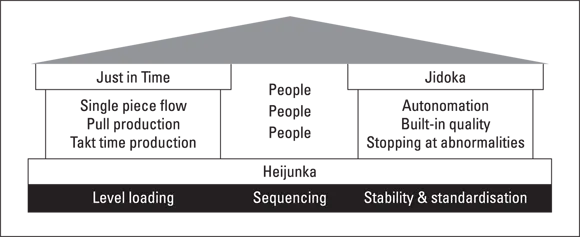
Figure 1-1 shows the Toyota Production System, highlighting various tools and Japanese Lean thinking terms that we use throughout this book. In this chapter we provide some brief descriptions to introduce the Lean basics and the TPS.
Toyota’s Taiichi Ohno describes the TPS approach very effectively:
All we are doing is looking at a timeline from the moment the customer gives us an order to the point when we collect the cash. And we are reducing that timeline by removing the non-value-added wastes.
The TPS approach really is about understanding how the work gets done, finding ways of doing it better, smoother and faster, and closing the time gap between the start and end points of our processes. And it applies to any process. Whether you’re working in the public or private sector, in service, transactional or manufacturing processes really doesn’t matter.
Think about your own processes for a moment. Do you feel that some unnecessary steps or activities seem to waste time and effort?
We must point out, however, that simply adopting the tools and techniques of the TPS isn’t enough to sustain improvement and embed the principles and thinking into your organisation. Toyota chairperson Fujio Cho provides a clue as to what’s also needed:
The key to the Toyota way is not any of the individual elements but all the elements together as a system. It must be practised every day in a very consistent manner – not in spurts. We place the highest value on taking action and implementation. By improvement based on action, one can rise to the higher level of practice and knowledge.
Picking on people power
Figure 1-1 shows that people are at the heart of TPS. The system focuses on training to develop exceptional people and teams that follow the company’s philosophy to gain exceptional results. Consider the following:
- Toyota creates a strong and stable culture wherein values and beliefs are widely shared and lived out over many years.
- Toyota works constantly to reinforce that culture.
- Toyota involves cross-functional teams to solve problems.
- Toyota keeps teaching individuals how to work together.
Being Lean means involving people in the process, equipping them to be able, and feel able, to challenge and improve their processes and the way they work. Never waste the creative potential of people!
Looking at the lingo
You can see from Figure 1-1 that Lean thinking involves a certain amount of jargon – some of it Japanese. This section defines the various terms to help you get Lean thinking as soon as possible:
- Heijunka provides the foundation. It encompasses the idea of smoothing processing and production by considering levelling, sequencing and standardising:
- Levelling involves smoothing the volume of production in order to reduce variation, that is, the ups and downs and peaks and troughs that can make planning difficult. Amongst other things, levelling seeks to prevent ‘end-of-period’ peaks, where production is initially slow at the beginning of the month, but then quickens in the last days of a sale or accounting period, for example.
- Sequencing may well involve mixing the types of work processed. So, for example, when setting up new loans in a bank, the type of loan being processed is mixed to better match customer demand, and help ensure applications are actioned in date order. So often, people are driven by internal efficiency targets, whereby they process the ‘simple tasks’ first to get them out of the way and ‘hit their numbers’, leaving the more difficult cases to be processed later on. This means tasks are not processed in date order, and people are reluctant to get down and tackle a pile of difficult cases at the end of the week, making things even worse f...