This book analyzes how social business and base of the pyramid approaches allow companies to reinvent themselves, or in other words how they are the levers for strategic renewal.
It highlights the constraints and possible difficulties encountered in the process of corporate renewal, drawing on individual and collective restraints to outline the key themes for a company's successful transition.
The author uses the case of Danone to explain how such a process of strategic renewal can take time and calls for a shared vision not only among the directors but between all the players, with a strong emphasis on long-term commitment.
Throughout this book, the author offers guidance to help others complete this process with success, encouraging the reader to seize opportunities for change.
This part aims to give an overview of the publications on the themes tackled by this particular research issue. How do these publications shed light on our thinking and allow us to draw up an analytical framework? What are their potential limitations?
1 From CSR to Business Models of Access to Goods and Services for All
The starting point for our conceptual study focuses on corporate social responsibility (CSR). It is linked to the fundamental line of questioning within this research, which we touched upon in the introduction, as to the role of business in the transition to this new era: what responses do the current major transformations and the associated large social challenges assume on the part of businesses? Furthermore what are the requirements for businesses to remain competitive, and indeed survive, in this new context?
We will analyze the trends and past and present discussions, as well as the limitations of this theoretical field.
We will then look into the most recent managerial publications relating to the base of the pyramid theory (BOP), as well as the more limited studies on social business (SB), looking to understand to what extent these concepts can give us new perspectives on CSR.
1.1. Corporate social responsibility (CSR)
The publications on CSR offer several standpoints on the role of businesses within society which cast light on our line of questioning. It seems necessary to us to return initially to the origins of this concept before studying the two questions which these works underpin, in a very schematic and simplistic way:
– The question “why?” – why should businesses play a role in society and assimilate environmental and social aspects within their operational priorities? Indeed this question seems to us to be inescapable. It is as present in the publications in this field as in business managers’ minds.
– The question “how”? How should businesses take account of the social aspects and what changes should they manage in their chosen strategies and practices?
We will then study the more recent trend of CSR 2.0, which calls the concept of CSR into question, and offers a new, indeed ground-breaking, method to approach the role of companies within society.
1.1.1. Origins and definitions
CSR is a relatively well-defined concept which began with American corporate practices at the beginning of the second industrial revolution from the beginning of twentieth century.
CSR is made up of two notions deeply embedded in protestant principles and practical business needs:
– that of stewardship or of giving back: successful businessmen must “give back”, in particular through philanthropy;
– that of trusteeship: those entrusted with property are invited to manage it as if it belonged to them. This idea appeared at the birth of large businesses, which were perceived as a potential threat to democracy [GON 08]. It was the American economist, Howard Bowen in his book Social Responsibilities of the Businessman [BOW 53], who introduced the concept of CSR to the academic world.
At that time, he gave it the following definition:
CSR “refers to the obligations of businessmen to pursue those policies, to make those decisions, or to follow those lines of action which are desirable in terms of the objectives and values of our society”. The more recent spread of CSR in Europe has gone back to a more benevolent tradition.
Since then academic definitions of CSR have abounded. Some have opted for a minimalist approach: a business acts responsibly if it does not harm its immediate stakeholders, or at least, if it repairs any potential damage caused by its activity.
Other researchers with a more appealing view of CSR, have asserted that a business can be considered socially responsible when its actions go beyond a basic respect of the law in the search for common good, in its relations with stakeholders.
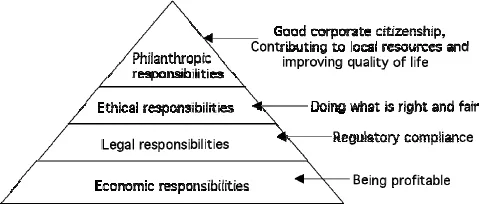
A. Caroll, a noted author in the field, suggests a reasonably assimilated inclusive approach using a pyramid made up of four levels of responsibility: economic, legal, ethical and philanthropic or discretionary [CAR 79]. The first two levels are requirements, the third is expected and the last is desirable.
Figure 1.1.The different responsibilities of busines, per Archie Carroll’s perspective [CAR 79]
This definition shows the importance of distinguishing between the various levels of corporate responsibility. However, it bypasses the interactions between the different levels and the complexity resulting therefrom. Furthermore, from an opportunistic perspective it immediately puts the economic dimension first.
In actual fact, the majority of authors agree in thinking that CSR is a vague concept based upon weak theoretical foundations. Faced with this limitation, some researchers even advocate a proper assimilation of CSR as part of business strategy. They warn against disparate and uncoordinated initiatives, which fit with the most common business practices. Only such an integrated approach will allow business performance and community benevolence to flourish in the long run as, after all, society and businesses are interdependent.
Nowadays CSR is often associated with the concept of sustainable development, another concept which is considered comparatively vague. This notion of sustainable development was made famous in 1987 by the World Commission on Environment and Development (WCED), through its report “Our common future”, known as the Brundtland report. It is this definition which we suggest is worth bearing in mind:
“Sustainable development “meets the needs of the present without compromising the ability of future generations to meet their own needs.”
The Brundtland report then mentions the needs of “the world’s poorest....to whom it agrees to give the greatest priority.”
Sustainable development is thus defined as finding a balance between respect for the environment, economic prosperity and social fairness.
According to the European Commission, CSR is also defined as “a concept whereby businesses integrate social and environmental concerns into their business operations and in their interaction with their stakeholders on a voluntary basis”, elaborating further saying that it is “the contribution of businesses to sustainable development” (European Union, 2001).
The Commission further states that “Being socially responsible means not only fulfilling applicable legal expectations, but also going beyond compliance and investing ‘more’ into human capital, the environment and relations with stakeholders.”
CSR and sustainable development are unquestioningly a focus for businesses, or at least for big business, a point evidenced by reports on sustainable development, businesses offering services of the same name and the proliferation of business initiatives. Indeed, businesses are assimilating to a greater or lesser defensive or proactive extent, a social expectation and an increased regulatory framework to implement CSR. We know the causes: ethical debates, the economic and financial crises and an awareness through public opinion of environmental challenges. Confidence in businesses has been damaged. Institutional pressures have increased on the latter.
These various definitions and the fundamental question which underpins this research lead us to suggest our definition of CSR which we have chosen to link to the concept of sustainable development:
A business exhibits societally responsible behaviors if, beyond respecting laws and rules, it aims to reduce significantly its negative environmental and social impact, indeed seeks to create positive impacts, thus contributing to sustainable development, as defined by the Brundtland Commission (compare the definition above).
1.1.2. The question “why?”: why should businesses adopt socially responsible behavior?
As we have explained, the study of business change, when faced with the major societal challenges, constantly returns to the question of “why”: why should business play a social role and find answers to the present challenges?
Before deploying some of the arguments developed by the publications in this field to justify businesses taking a socially responsible approach, it is important to remember the radical challenges to the concept of CSR, expressed by notable authors, and whose theories have widely permeated minds. In part, it includes Milton Friedman’s theories, which harshly warn against the subversive nature of CSR approaches:
“Few trends could so thoroughly undermine the very foundations of our free society as the acceptance by corporate officials of a social responsibility other than to make as much money for their stockholders as possible. This is a fundamentally subversive doctrine. If businessmen have a responsibility other than maximizing stockholder profits, how can they know what it is? Can self-appointed individuals decide what is in society’s interests?” and “It is neither permissible nor prudent to allocate business resources to social causes; this would entail subjecting stockholders, customers and employees to a type of tax, having no respect for democratic principles.”
More recently supporters of the economic approach have asserted that it is in maximizing not jus...
Table of contents
Cover
Table of Contents
Title
Copyright
Foreword
Preface
Introduction
PART 1: Review of Publications
PART 2: Empirical Part of the Research
PART 3: Discussion
Conclusion
Appendix: Societal Projects for Access to Goods and Services, by Danone, Examined in the Book
Bibliography
Index
End User License Agreement
Trusted by 375,005 students
Access to over 1.5 million titles for a fair monthly price.
Study more efficiently using our study tools.
Frequently asked questions
Yes, you can cancel anytime from the Subscription tab in your account settings on the Perlego website. Your subscription will stay active until the end of your current billing period. Learn how to cancel your subscription
No, books cannot be downloaded as external files, such as PDFs, for use outside of Perlego. However, you can download books within the Perlego app for offline reading on mobile or tablet. Learn how to download books offline
We are an online textbook subscription service, where you can get access to an entire online library for less than the price of a single book per month. With over 1.5 million books across 990+ topics, we’ve got you covered! Learn about our mission
Look out for the read-aloud symbol on your next book to see if you can listen to it. The read-aloud tool reads text aloud for you, highlighting the text as it is being read. You can pause it, speed it up and slow it down. Learn more about Read Aloud
Yes! You can use the Perlego app on both iOS and Android devices to read anytime, anywhere — even offline. Perfect for commutes or when you’re on the go. Please note we cannot support devices running on iOS 13 and Android 7 or earlier. Learn more about using the app
Yes, you can access Social Business and Base of the Pyramid by Bénédicte Faivre-Tavignot in PDF and/or ePUB format, as well as other popular books in Business & Business General. We have over 1.5 million books available in our catalogue for you to explore.