A clear, practical guide to implementing Open Innovation for new product development
Open Innovation: New Product Development Essentials from the PDMA is a comprehensive guide to the theory and practice of the Open Innovation method. Written by experts from the Product Development and Management Association, the book packages a collection of Open Innovation tools in a digestible and actionable format. Real-world case studies drawn from the authors' own successes and failures illustrate the concepts presented, providing accurate representation of the opportunities and challenges of Open Innovation implementation. Key tools are presented with a focus on immediate applications for business, allowing NPD professionals to easily discern where this cutting edge development method can push innovation forward.
Open Innovation assumes that companies can and should use both internal and external ideas and paths to market, permeating the boundaries between firm and environment. Innovations transfer outward and inward through purchase, licensing, joint ventures, and spin-offs, allowing companies to expand beyond their own research and dramatically improve productivity through collaboration. PDMA Essentials provides practical guidance on exploiting the Open Innovation model to these ends, with clear guidance on all aspects of the new product development process. Topics include:
Product platforming and idea competitions
Customer immersion and interaction
Collaborative product design and development
Innovation networks, rewards, and incentives
Many practitioners charged with innovation have only a vague understanding of the specific tools available for Open Innovation, and how they might be applied. As the marketplace shifts dramatically to keep pace with changing consumer behaviors, remaining relevant increasingly means ramping up innovation processes. PDMA Essentials provides the tools NPD practitioners need to implement a leading innovation method, and drive continued growth.
The fuzzy front end of innovation is that messy, chaotic part of the innovation process before a product concept has been ideated or developed. This part of the process seeks new opportunities for the firm—whether they derive from a technology capability, a specific market insight, or changing trends in customer needs or competitors. The goal for this stage is to find an interesting problem to solve, invent the solution, or find someone else who already has invented that solution, and eliminate the technical, market, and competitive unknowns sufficiently to move the project forward into the firm's formal development process. Part 1 contains two chapters, which provide information that will allow you to spot opportunities that arise from technology, market, and general trends.
Manfred Stadlbauer and Gerhard Drexler focus on finding and using sources of technology capabilities that are external to the firm in Chapter 1. This chapter shows how to use the patent literature and social network analysis to find areas of technology in the early stages of development, uncover interconnections between those new technologies and other technologies, locate firms and individuals active in those technologies, and map their geographic location to help determine who might make appropriate technology development partners.
Christiane Rau, Fiona Schweitzer and Oliver Gassmann present methods for using open foresight workshops to identify new opportunities for the firm. Rather than being merely technology-driven opportunities, these methods allow the firm to investigate at the overall market and general trends level. Chapter 2 shows firms how they can implement these types of workshops in “closed” or internally executed forms, but then also shows firms how to move step-by-step to using them in more and more open ways.
1 DE-BOTTLENECKING OPEN INNOVATION: TURNING PATENT-BASED TECHNOLOGY NETWORK ANALYSIS INTO VALUE
Manfred Stadlbauer
Techmeter
Gerhard Drexler
Mondi Uncoated Fine Paper
1.1 Methods of Patent Analysis and Data Mining
Open Innovation is a paradigm that combines internal and external ideas into processes whose requirements are defined by specific business models. Firms spend significant effort sourcing and integrating external knowledge and ideas from customers, suppliers, universities, and research organizations, and also competitors. Thus, competitive intelligence and technology forecasts are high on the agenda of leading-edge enterprises. Furthermore, in the fast-paced and complex world we face, the need to solve problems and develop new products as quickly and efficiently as possible is of paramount importance.
One of the challenges of starting new innovation initiatives is the need to see beyond the current time horizon in order to identify the most promising future technologies and products. In addition, acquiring the tangible and intangible assets required for meeting these challenges often exceeds a company's resources, and successful product development is usually realized through the joint contribution of several disciplines, including engineering, marketing, design, and manufacturing.
The practice-oriented approach we present in this chapter is about the application of novel tools and techniques for the support of some of the most crucial steps in Open Innovation, namely the identification of both new opportunities and prospective internal and external partners. Starting from the exploration of ideas and enriching them with quantitative data derived from internal and external networks and competence maps, this chapter describes how promising new technologies and best-in-class candidates for co-development can be identified.
The first part reviews extant methods of patent analysis and data mining. Classical methods of patent monitoring are time consuming and only reveal what someone is definitively looking for. More sophisticated approaches involve a number of analytical methods that have been made possible by recent progress in information technology.
Subsequently, the second part of the chapter provides an insight into novel methods for patent analytics with a special focus on Open Innovation. It covers topics such as patent dynamics, emerging technology analysis, geographic proximity, and collaboration networks. Each example is described briefly and supported by flow charts and special graphics. This second section shows how state-of-the-art patent analysis holds the potential to assist throughout the whole innovation chain.
Finally, the third part of the chapter is a case study from the nanotechnology industry. Depicting a number of real-case results demonstrates how the emerging landscape of nanotechnology can be evaluated by means of advanced patent analysis, how the most dynamic technologies are identified, and how collaboration networks are visualized and utilized for identifying prospective external collaboration partners.
Patents as a Lead Indicator of Innovation
In the search for cutting-edge global innovation trends, one may consider a variety of different information sources, each of them having advantages and disadvantages. Among the most important sources are scientific publications such as the academic literature and conference papers as well as interview panels, direct conversations and workshops with internal experts, consumers, or experts from customers and suppliers. Another important source for trend scouting is the patent literature.
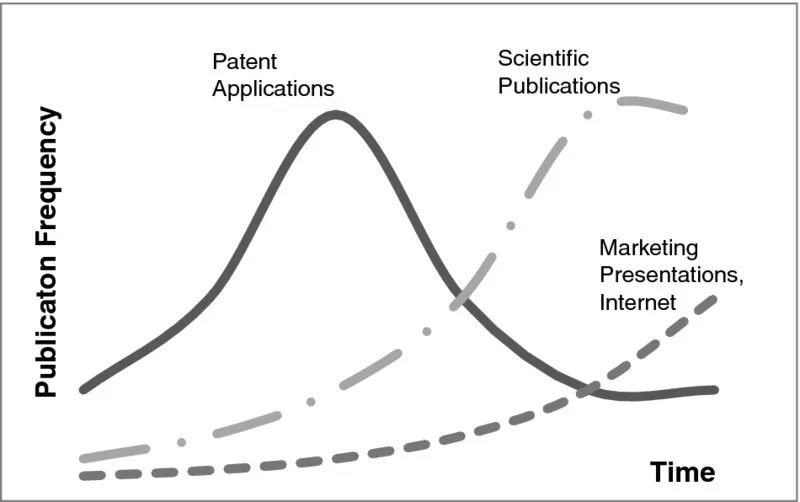
Compared to alternatives for deriving information about technology trends, the patent literature offers a range of specific benefits that makes it a preferred source. For example, the patent literature is indisputably very current and accurate. Earlier than other publications such as scientific publications from the academic literature, or marketing communications such as Internet appearance or sales brochures, patent applications provide signals of emerging technology trends. This is because of a patent's requirement of novelty at the point of filing. Any other earlier publication would prohibit the granting of a patent. For that reason, patent applications are always filed substantially earlier than scientific publications and even well before any marketing communication is put in place. Consequently, patent applications are a very early indicator of technology changes. Figure 1.1 illustrates patents as the lead trend indicator compared to scientific publications.
Figure 1.1: Information from Patent Literature as Lead Trend Indicator
In addition to the lead time gained, patent...
Table of contents
Cover
Titlepage
Copyright
Dedication
INTRODUCTION THE JOURNEY INTO OPEN INNOVATION
ABOUT THE EDITORS
PART 1 OPEN INNOVATION IN THE FUZZY FRONT END
PART 2 OPEN INNOVATION IN THE DEVELOPMENT STAGE
PART 3 OPEN INNOVATION WITH UNIVERSITIES
PART 4 OPEN INNOVATION FOR REALLY BIG INITIATIVES
PART 5 BEST PRACTICES AND ADVICE FOR OPEN INNOVATION
INDEX
END USER LICENSE AGREEMENT
Trusted by 375,005 students
Access to over 1.5 million titles for a fair monthly price.
Study more efficiently using our study tools.
Frequently asked questions
Yes, you can cancel anytime from the Subscription tab in your account settings on the Perlego website. Your subscription will stay active until the end of your current billing period. Learn how to cancel your subscription
No, books cannot be downloaded as external files, such as PDFs, for use outside of Perlego. However, you can download books within the Perlego app for offline reading on mobile or tablet. Learn how to download books offline
Perlego offers two plans: Essential and Complete
Essential is ideal for learners and professionals who enjoy exploring a wide range of subjects. Access the Essential Library with 800,000+ trusted titles and best-sellers across business, personal growth, and the humanities. Includes unlimited reading time and Standard Read Aloud voice.
Complete: Perfect for advanced learners and researchers needing full, unrestricted access. Unlock 1.5M+ books across hundreds of subjects, including academic and specialized titles. The Complete Plan also includes advanced features like Premium Read Aloud and Research Assistant.
Both plans are available with monthly, semester, or annual billing cycles.
We are an online textbook subscription service, where you can get access to an entire online library for less than the price of a single book per month. With over 1.5 million books across 990+ topics, we’ve got you covered! Learn about our mission
Look out for the read-aloud symbol on your next book to see if you can listen to it. The read-aloud tool reads text aloud for you, highlighting the text as it is being read. You can pause it, speed it up and slow it down. Learn more about Read Aloud
Yes! You can use the Perlego app on both iOS and Android devices to read anytime, anywhere — even offline. Perfect for commutes or when you’re on the go. Please note we cannot support devices running on iOS 13 and Android 7 or earlier. Learn more about using the app
Yes, you can access Open Innovation by Abbie Griffin,Charles H. Noble,Serdar S. Durmusoglu in PDF and/or ePUB format, as well as other popular books in Business & Management. We have over 1.5 million books available in our catalogue for you to explore.