Fixed Income Markets
eBook - ePub

Fixed Income Markets

Management, Trading and Hedging

  1. English
  2. ePUB (mobile friendly)
  3. Available on iOS & Android
eBook - ePub

Fixed Income Markets

Management, Trading and Hedging

About this book

A comprehensive, in-depth look at global debt capital markets in the post-crisis world

Fully updated with comprehensive coverage of the post-crisis debt markets and their impact on key industry issues, Fixed Income Markets: Management, Trading, and Hedging, Second Edition offers insights into derivative pricing, cross-currency hedging, and new liquidity legislation. Written by Choudhry, Moskovic, and Wong, Fixed Income Markets is an indispensable read for anyone working in bond markets, interest-rate markets, and credit derivatives markets looking to better understand today's debt markets.

This acclaimed book takes a unique look into the leading practices in bond markets as well as post-credit-crunch impacts on pricing that are rarely captured in textbooks. The new edition provides expanded coverage on a wide range of topics within hedging, derivatives, bonds, rebalancing, and global debt capital markets. New topics include:

  • Dynamic hedging practices and cross-currency hedging
  • Collateralized and uncollateralized derivatives, and their impact on valuation
  • Callable bonds, pricing, trading, and regulatory aspects related to liquidity
  • Rebalancing as a method for capturing contingencies and other complex imbedded risks

As a bonus, the book includes reference information for statistical concepts and fixed income pricing, as well as a full glossary and index. Written in Choudhry's usual accessible style, Fixed Income Markets is a comprehensive and in-depth account of the global debt capital markets in today's post-crisis world.
Frequently asked questions

Yes, you can cancel anytime from the Subscription tab in your account settings on the Perlego website. Your subscription will stay active until the end of your current billing period. Learn how to cancel your subscription.
No, books cannot be downloaded as external files, such as PDFs, for use outside of Perlego. However, you can download books within the Perlego app for offline reading on mobile or tablet. Learn more here.
Perlego offers two plans: Essential and Complete
  • Essential is ideal for learners and professionals who enjoy exploring a wide range of subjects. Access the Essential Library with 800,000+ trusted titles and best-sellers across business, personal growth, and the humanities. Includes unlimited reading time and Standard Read Aloud voice.
  • Complete: Perfect for advanced learners and researchers needing full, unrestricted access. Unlock 1.4M+ books across hundreds of subjects, including academic and specialized titles. The Complete Plan also includes advanced features like Premium Read Aloud and Research Assistant.
Both plans are available with monthly, semester, or annual billing cycles.
We are an online textbook subscription service, where you can get access to an entire online library for less than the price of a single book per month. With over 1 million books across 1000+ topics, we’ve got you covered! Learn more here.
Look out for the read-aloud symbol on your next book to see if you can listen to it. The read-aloud tool reads text aloud for you, highlighting the text as it is being read. You can pause it, speed it up and slow it down. Learn more here.
Yes! You can use the Perlego app on both iOS or Android devices to read anytime, anywhere — even offline. Perfect for commutes or when you’re on the go.
Please note we cannot support devices running on iOS 13 and Android 7 or earlier. Learn more about using the app.
Yes, you can access Fixed Income Markets by Moorad Choudhry,David Moskovic,Max Wong in PDF and/or ePUB format, as well as other popular books in Business & Investments & Securities. We have over one million books available in our catalogue for you to explore.

Information

Publisher
Wiley
Year
2014
Print ISBN
9781118171721
eBook ISBN
9781118171752

PART One
Introduction to Bonds

In Part One, we describe the key concepts in fixed-income market analysis, which cover the basics of the bond instrument. The building blocks described here are generic and are applicable in any market. The analysis is simplest when restricted to plain-vanilla default-free bonds; as the instruments become more complex, we are required to introduce additional techniques and assumptions. Part One comprises five chapters. We begin with bond pricing and yield, followed by traditional interest-rate risk measures such as modified duration and convexity. This is followed by a look at spot and forward rates, the derivation of such rates from market yields, and the concept of the yield curve. Yield-curve analysis and the modelling of the term structure of interest rates is one of the most heavily researched areas of financial economics. The treatment here is kept as concise as possible, which sacrifices some detail, but bibliographies at the end of each chapter will direct interested readers to what are the most accessible and readable references in this area.
While we do not describe specifics of particular markets, it is important to remember that the general concepts discussed here are pertinent to debt markets in every jurisdiction.

CHAPTER 1
The Bond Instrument

Bonds are debt-capital market instruments that represent a cash flow payable during a specified time period heading into the future. This cash flow represents the interest payable on the loan and the loan redemption. So, essentially, a bond is a loan, albeit one that is tradable in a secondary market. This differentiates bond-market securities from commercial bank loans.
In the analysis that follows, bonds are assumed to be default-free, which means that there is no possibility that the interest payments and principal repayment will not be made. Such an assumption is reasonable when one is referring to government bonds such as U.S. Treasuries, UK gilts, Japanese JGBs, and so on. However, it is unreasonable when applied to bonds issued by corporates or lower-rated sovereign borrowers. Nevertheless, it is still relevant to understand the valuation and analysis of bonds that are default-free, as the pricing of bonds that carry default risk is based on the price of risk-free securities. Essentially, the price investors charge borrowers that are not of risk-free credit standing is the price of government securities plus some credit risk premium.

BOND-MARKET BASICS

All bonds are described in terms of their issuer, maturity date, and coupon. For a default-free conventional, or plain-vanilla, bond, this will be the essential information required. Nonvanilla bonds are defined by further characteristics such as their interest basis, flexibilities in their maturity date, credit risk, and so on.
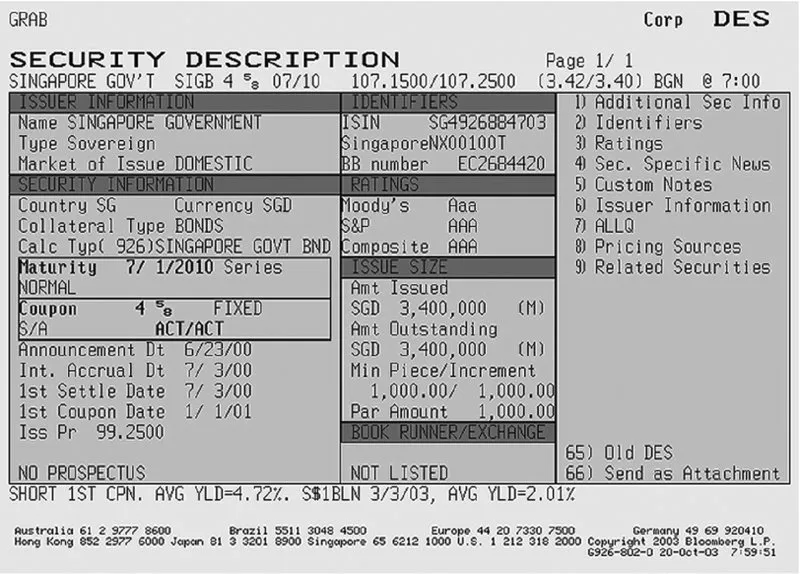
Figure 1.1 shows screen DES from the Bloomberg system. This page describes the key characteristics of a bond. From Figure 1.1, we see a description of a bond issued by the Singapore government, the 4.625% of 2010. This tells us the following bond characteristics:
Issue date July 2000
Coupon 4.625%
Maturity date 1 July 2010
Issue currency Singapore dollars
Issue size SGD 3.4 million
Credit rating AAA/Aaa
images
FIGURE 1.1 Bloomberg Screen DES Showing Details of
% 2010 Issued by Republic of Singapore as of 20 October 2003
Used with permission of Bloomberg L.P. Copyright© 2014. All rights reserved.
Calling up screen DES for any bond, provided it is supported by Bloomberg, will provide us with its key details. Later on, we will see how nonvanilla bonds include special features that investors take into consideration in their analysis.
We will consider the essential characteristics of bonds later in this chapter. First, we rev...

Table of contents

  1. Cover
  2. Series
  3. Titlepage
  4. Copyright
  5. Author Disclaimer
  6. Dedication
  7. Foreword
  8. Preface
  9. About the Authors
  10. PART ONE Introduction to Bonds
  11. PART TWO Selected Market Instruments
  12. PART THREE Derivative Instruments
  13. PART FOUR Bond Trading and Hedging
  14. APPENDIX A Statistical Concepts
  15. APPENDIX B Basic Tools
  16. APPENDIX C Introduction to the Mathematics of Fixed-Income Pricing
  17. APPENDIX D About the Companion Website
  18. Glossary
  19. Index
  20. End User License Agreement