As the state-of-the-art imaging technologies became more and more advanced, yielding scientific data at unprecedented detail and volume, the need to process and interpret all the data has made image processing and computer vision increasingly important. Sources of data that have to be routinely dealt with today's applications include video transmission, wireless communication, automatic fingerprint processing, massive databanks, non-weary and accurate automatic airport screening, robust night vision, just to name a few. Multidisciplinary inputs from other disciplines such as physics, computational neuroscience, cognitive science, mathematics, and biology will have a fundamental impact in the progress of imaging and vision sciences. One of the advantages of the study of biological organisms is to devise very different type of computational paradigms by implementing a neural network with a high degree of local connectivity.
This is a comprehensive and rigorous reference in the area of biologically motivated vision sensors. The study of biologically visual systems can be considered as a two way avenue. On the one hand, biological organisms can provide a source of inspiration for new computational efficient and robust vision models and on the other hand machine vision approaches can provide new insights for understanding biological visual systems. Along the different chapters, this book covers a wide range of topics from fundamental to more specialized topics, including visual analysis based on a computational level, hardware implementation, and the design of new more advanced vision sensors. The last two sections of the book provide an overview of a few representative applications and current state of the art of the research in this area. This makes it a valuable book for graduate, Master, PhD students and also researchers in the field.
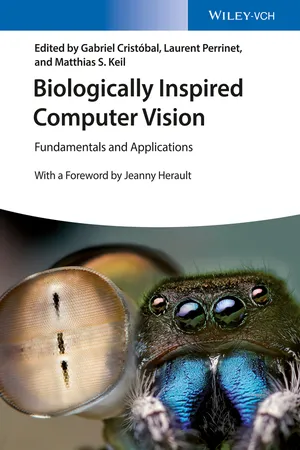
eBook - ePub
Biologically Inspired Computer Vision
Fundamentals and Applications
- English
- ePUB (mobile friendly)
- Available on iOS & Android
eBook - ePub
Biologically Inspired Computer Vision
Fundamentals and Applications
About this book
Information
Part I
Fundamentals
Chapter 1
Introduction
Gabriel Cristóbal, Laurent U. Perrinet and Matthias S. Keil
And first he will see the shadows best, next the reflections of men and other objects in the water, and then the objects themselves; then he will gaze upon the light of the moon and the stars and the spangled heaven; and he will see the sky and the stars by night better than the sun or the light of the sun by day?Plato, The Republic, Book VII
As state-of-the-art imaging technologies become more and more advanced, yielding scientific data of unprecedented detail and volume, the need to process and interpret all this data has made image processing and computer vision also increasingly important. Sources of data that have to be routinely dealt with for today's applications include video transmission, wireless communication, automatic fingerprint processing, massive databanks, non-weary and accurate automatic airport screening, and robust night vision to name a few. These technological advances were closely followed by the increase in computer power of traditional, von-Neumann architectures. However, a major concern is that such architectures are efficient only for specific computations such as retrieving an item in a database or to apply a precise sequence of operations. These usually fail when the application comes closer to biological vision, such as the categorization of images independently of changes in lighting, movements, and the environment or the imaging device. Surprisingly, while computers can handle most complex tasks (such as computing hash numbers, logarithms, and linear algebra), most of the time, the “simpler” the task is for humans (such as “find the animal in the image”), the more complex it becomes to implement on a computing device. Multidisciplinary inputs from other disciplines such as computational neuroscience, cognitive science, mathematics, physics, and biology have had, and will have, a fundamental impact on the progress of imaging and vision sciences. One main advantage of the study of biological organisms is to devise very different types of computational paradigms beyond the usual von Neumann architecture, for example, by implementing a neural network with a high degree of local connectivity, which may be more easily adapted to solve the problems of modern imaging.
This book serves as a comprehensive but rigorous reference in the area of biologically inspired computer vision modeling. Biologically inspired vision, that is, the study of visual systems of living beings, can be considered as a two-way process. On the one hand, living organisms can provide a source of inspiration for new computationally efficient and robust vision models, and on the other hand, machine vision approaches can provide new insights into understanding biological visual systems. Over the different chapters, this book covers a wide range from the fundamental to the more specialized topics. This book often follows Marr's classical, three-level approach to vision (computational, algorithmic, and hardware implementation) [1], but also goes beyond Marr's approach in the design of novel and more advanced vision sensors. In particular, the last section of the book provides an overview of a few representative applications and current state of the art of the research in this area.
The scope of this book somewhat overlaps that of a few other books published in this area, most of them corresponding to conference proceedings, for example, Refs [2, 3]. More recently, several special sessions on this same topic were organized at different workshops such as the ones on “Biologically consistent vision” in conjunction with the 2011 Computer Vision and Pattern Recognition Conference and “Biological and Computer Vision Interfaces” in conjunction with the 2012 European Conference on Computer Vision. The first monograph on this topic was published more than 20 years ago [4] and therefore does not reflect the latest advances in the field. A very good reference in the field is the book by Frisby and Stone [5] that provides the foundation for computational and physiological research on vision. Another relevant reference is the book by Petrou and Bharath although it is more focused toward specialized hardware both at low power and high speed [6]. A more recent reference in the area is the book by Pomplun and Suzuki [7] which is more focused on specific aspects of visual function such as attention, binocularity, or cortical structures. At the time of writing, it is worth mentioning a special issue on bioinspired imaging which highlights recent progress in the domain of vision and biological optics [8]. As a consequence, this book is valuable for both undergraduate and graduate students and also for specialized researchers as it presents information that is usually spread out over different sources into a single and comprehensive monograph.
1.1 Why Should We Be Inspired by Biology?
A central question in this area is to understand why and how is it useful to build technical systems with a biological inspiration. Or, in other words, why should biologically-motivated studies be useful for constructing artificial systems? One answer is that living systems are engineered to perfection by evolution, and thus they provide a seemingly inexhaustible source of inspiration for engineering. In this book, to cover few examples of how such biological findings will be of direct benefit, for example, for engineering new devices and sensors. More generally, one objective of this book is to cover “two-way process” analogy previously mentioned. On the one hand, we have chapters where findings from biology, neurobiology, or psychophysics guide the development of computer vision algorithms. On the other hand, we have more technical chapters that are motivated by bi...
Table of contents
- Cover
- Related Titles
- Title Page
- Copyright
- Table of Contents
- List of Contributors
- Foreword
- Part I: Fundamentals
- Part II: Sensing
- Part III: Modelling
- Part IV: Applications
- Index
- End User License Agreement
Trusted by 375,005 students
Access to over 1.5 million titles for a fair monthly price.
Study more efficiently using our study tools.
Frequently asked questions
Yes, you can cancel anytime from the Subscription tab in your account settings on the Perlego website. Your subscription will stay active until the end of your current billing period. Learn how to cancel your subscription
No, books cannot be downloaded as external files, such as PDFs, for use outside of Perlego. However, you can download books within the Perlego app for offline reading on mobile or tablet. Learn how to download books offline
Perlego offers two plans: Essential and Complete
- Essential is ideal for learners and professionals who enjoy exploring a wide range of subjects. Access the Essential Library with 800,000+ trusted titles and best-sellers across business, personal growth, and the humanities. Includes unlimited reading time and Standard Read Aloud voice.
- Complete: Perfect for advanced learners and researchers needing full, unrestricted access. Unlock 1.5M+ books across hundreds of subjects, including academic and specialized titles. The Complete Plan also includes advanced features like Premium Read Aloud and Research Assistant.
We are an online textbook subscription service, where you can get access to an entire online library for less than the price of a single book per month. With over 1.5 million books across 990+ topics, we’ve got you covered! Learn about our mission
Look out for the read-aloud symbol on your next book to see if you can listen to it. The read-aloud tool reads text aloud for you, highlighting the text as it is being read. You can pause it, speed it up and slow it down. Learn more about Read Aloud
Yes! You can use the Perlego app on both iOS and Android devices to read anytime, anywhere — even offline. Perfect for commutes or when you’re on the go.
Please note we cannot support devices running on iOS 13 and Android 7 or earlier. Learn more about using the app
Please note we cannot support devices running on iOS 13 and Android 7 or earlier. Learn more about using the app
Yes, you can access Biologically Inspired Computer Vision by Gabriel Cristobal, Laurent Perrinet, Matthias S. Keil, Gabriel Cristobal,Laurent Perrinet,Matthias S. Keil in PDF and/or ePUB format, as well as other popular books in Technology & Engineering & Civil Engineering. We have over 1.5 million books available in our catalogue for you to explore.