A must-have compendium on biomedical telemetry for all biomedical professional engineers, researchers, and graduate students in the field
Handbook of Biomedical Telemetry describes the main components of a typical biomedical telemetry system, as well as its technical challenges. Written by a diverse group of experts in the field, it is filled with overviews, highly-detailed scientific analyses, and example applications of biomedical telemetry. The book also addresses technologies for biomedical sensing and design of biomedical telemetry devices with special emphasis on powering/integration issues and materials for biomedical telemetry applications.
Handbook of Biomedical Telemetry:
Describes the main components of a typical biomedical telemetry system, along with the technical challenges
Discusses issues of spectrum regulations, standards, and interoperability—while major technical challenges related to advanced materials, miniaturization, and biocompatibility issues are also included
Covers body area electromagnetics, inductive coupling, antennas for biomedical telemetry, intra-body communications, non-RF communication links for biomedical telemetry (optical biotelemetry), as well as safety issues, human phantoms, and exposure assessment to high-frequency biotelemetry fields
Presents biosensor network topologies and standards; context-aware sensing and multi-sensor fusion; security and privacy issues in biomedical telemetry; and the connection between biomedical telemetry and telemedicine
Introduces clinical applications of Body Sensor Networks (BSNs) in addition to selected examples of wearable, implantable, ingestible devices, stimulator and integrated mobile healthcare system paradigms for monitoring and therapeutic intervention
Covering biomedical telemetry devices, biosensor network topologies and standards, clinical applications, wearable and implantable devices, and the effects on the mobile healthcare system, this compendium is a must-have for professional engineers, researchers, and graduate students.
School of Electrical and Computer Engineering, National Technical University of Athens, Athens, Greece
1.1 What Is Biomedical Telemetry?
The word telemetry is derived from the Greek words tele = “remote” and metron = “measure” and allows data measurements to be made at a distance. In other words, data are measured in situ and further transmitted remotely to a receiving station. Typically, telemetry systems have been used in the testing of moving vehicles such as cars, aircraft, and missiles.
Biomedical telemetry permits the measurement of physiological signals at a distance. Physiological signals are obtained by means of appropriate transducers, postprocessed, and eventually transmitted to an exterior monitoring and/or control device. The exterior device can be placed onto the patient's body or at a close distance next to the patient but can also further communicate with a distant hospital or physicians' station with the help of telemedicine technologies and infrastructure.
The principal purpose of biomedical telemetry is to take advantage of the recent advances in wired and wireless communication technologies in order to address the growing demands of the health care community. The goal is to take advantage of the recent improvements in electronics and communications in order to develop a new generation of medical devices with incorporated biomedical telemetry functionalities. Medical devices can be defined as any physical device which is useful for preventive, diagnostic, monitoring, or therapeutic functions. Such devices are expected to support an expanding variety of medical applications and have the potential to revolutionize medicine. Even though prevention is perhaps the most desirable goal for medical devices, early diagnosis, effective treatment, and accurate monitoring of diseases can also be considered as the cornerstones of an effective biomedical telemetry system.
There exist three categories of medical devices, according to their location on or inside the patient's body:
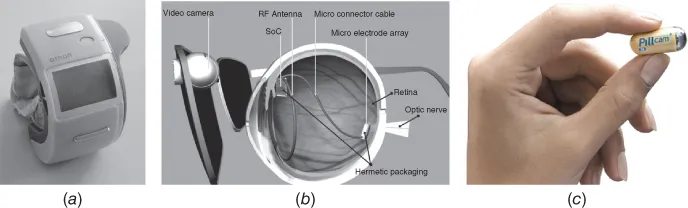
Wearable devices can be worn by the patient as an accessory or embedded into clothing with the help of textile and flexible technologies (e.g., Figure 1.1a). They can be used to monitor several physiological parameters (e.g., glucose or cardiac events), assist the movement of artificial limbs, and work as receivers for the collection and retransmission of various vital signals.
Implantable devices can be implanted inside the patient's human body by means of a surgical operation (e.g., Figure 1.1b) (Kiourti and Nikita, 2012a,b, 2013). Example applications are heart rate control, artificial retina, cardiac pacemakers, cochlear implants, hypertension monitoring, functional electrical stimulation, and intracranial pressure monitoring.
Ingestible devices are integrated into capsules or pills and can be swallowed by the patient (e.g., Figure 1.1c). Main focus is on their use for gastrointestinal track and drug use monitoring.
Figure 1.1 (a) Wearable [advanced care and alert portable telemedical monitor, AMON (Anliker et al., 2004)], (b) implantable [epiretinal prosthesis (Sivaprakasam et al., 2005)], and (c) ingestible [PillCam (Mc Caffrey et al., 2008)] medical devices.
Since medical devices are used on human beings, with at least a theoretical potential for misuse or harmful side effects, they must first meet the criteria established by government-operated regulations before they can be designated as medical devices and enter the market. For example, in the United States, medical devices are primarily regulated via the Department of Health and Human Services (HHS) of the Food and Drug Administration (FDA).
Historically, wired links have been the most prevalent method of biomedical telemetry. To overcome the inherent drawbacks of restricted communication range as well as patient discomfort and limited activity level, research is nowadays mostly oriented toward wireless technologies. Wireless biomedical telemetry offers the advantage of obtaining accurate physiological signal measurements from freely moving patients and has significantly risen in the last decades thanks to the explosive growth in Internet traffic, the commercial success of digital cellular communication systems, and the scaling of integrated circuits (ICs) at a manageable cost, power, and size (Rappaport et al., 2002).
Recent global focus on health care issues has stimulated research and development of innovative technologies which address many unsustainabilities of the current health care provision models. Several health care organizations are seeking new techniques to deliver quality health care in a timely, cost-effective, and efficient manner. Biomedical telemetry can be considered as an important technological innovation toward freeing hospital resources, improving patient care, and rendering health care affordable for all. The utmost aim is to enhance the patients' quality of life by encouraging and maintaining their independence. With rising health care costs, an increasing average age of populations in the occidental world, a significant presence of wireless communications in our daily lives, and recent advances in electronics and information and communication technologies (ICTs), biomedical telemetry devices are attracting significant scientific interest in both academia and industry.
1.2 Significance of Area
Exploitation of ICT assists in a fundamental redesign of the health care processes based on the use and integration of communication technologies at all levels. Recent advances in ICT enable cost-effective and efficient health care delivery in home, hospital, assisted-living, and nursing home settings to promote disease management and wellness (Nikita et al., 2012).
Disease management programs aim to support patient-specific care plans and the provider–patient relationship via evidence-based guidelines while focusing on prevention of deteriorations and/or complications. Aiming at citizen empowerment, the paradigm of disease management can be extended to wellness management, where the focus is on disease prevention, maintenance, and improvement of the health status of any individual.
Continuous and remote monitoring of patients in the comfort of their own home rather than inside a hospital or clinic environment offers a number of benefits, including continuous medical monitoring of the disease progression or fluctuation, patient convenience, sophisticated monitoring capabilities, and lower health care costs (Lin and Nikita, 2010; Nikita et al., 2011). Example applications are:
Monitoring of patients with chronic diseases (e.g., diabetes or hypertension) by means of a single medical device
Development of “smart” body sensor networks where physiological data are collected from multiple on/in body sensors, preferably with context-aware sensing capabilities
Drug delivery feedback loops which continuously monitor a drug's effect and adjust its delivery from drug pumps
Rehabilitation for the elderly
Measuring medical parameters at the scene of an accident and providing surveillance during transport to the hospital
A top 10 list for conditions and diseases that are already benefiting from wireless health services or soon will is shown (in alphabetical order) in Table 1.1 (Topol, 2012).
Table 1.1 Ten Targets for Wireless Medicine
Disease
Number Affected (millions)
Monitoring
Alzheimer's
5
Vital signs, location, activity, balance
Asthma
23
Respiratory rate (RR), peak-flow br...
Table of contents
Cover
Series
Title Page
Copyright
Dedication
Preface
Acknowledgments
Contributors
Chapter 1: Introduction to Biomedical Telemetry
Part I: Biomedical Telemetry Devices
Part II: Propagation and Communication Issues for Biomedical Telemetry
Part III: Example Applications of Biomedical Telemetry
Index
Series
End User License Agreement
Trusted by 375,005 students
Access to over 1.5 million titles for a fair monthly price.
Study more efficiently using our study tools.
Frequently asked questions
Yes, you can cancel anytime from the Subscription tab in your account settings on the Perlego website. Your subscription will stay active until the end of your current billing period. Learn how to cancel your subscription
No, books cannot be downloaded as external files, such as PDFs, for use outside of Perlego. However, you can download books within the Perlego app for offline reading on mobile or tablet. Learn how to download books offline
Perlego offers two plans: Essential and Complete
Essential is ideal for learners and professionals who enjoy exploring a wide range of subjects. Access the Essential Library with 800,000+ trusted titles and best-sellers across business, personal growth, and the humanities. Includes unlimited reading time and Standard Read Aloud voice.
Complete: Perfect for advanced learners and researchers needing full, unrestricted access. Unlock 1.5M+ books across hundreds of subjects, including academic and specialized titles. The Complete Plan also includes advanced features like Premium Read Aloud and Research Assistant.
Both plans are available with monthly, semester, or annual billing cycles.
We are an online textbook subscription service, where you can get access to an entire online library for less than the price of a single book per month. With over 1.5 million books across 990+ topics, we’ve got you covered! Learn about our mission
Look out for the read-aloud symbol on your next book to see if you can listen to it. The read-aloud tool reads text aloud for you, highlighting the text as it is being read. You can pause it, speed it up and slow it down. Learn more about Read Aloud
Yes! You can use the Perlego app on both iOS and Android devices to read anytime, anywhere — even offline. Perfect for commutes or when you’re on the go. Please note we cannot support devices running on iOS 13 and Android 7 or earlier. Learn more about using the app
Yes, you can access Handbook of Biomedical Telemetry by Konstantina S. Nikita in PDF and/or ePUB format, as well as other popular books in Biological Sciences & Biotechnology. We have over 1.5 million books available in our catalogue for you to explore.