![]()
Chapter 1
Introducing the Cell to Society Framework
Solving major social problems and making positive changes in the lives of individuals, groups, communities, and societies is a complex task. Humans are a highly social species whose behavior is impacted by biological, psychological, and broad environmental factors. People in the helping professions have the enormously difficult task of intervening across a multitude of levels through a range of practices and policies. To do so effectively, social workers, counselors, public health workers, and other helping professionals require a deep understanding and appreciation of human behavior. Although it has been recognized in social work and related professions that human behavior is a biopsychosocial phenomenon and that people interact within environments, a stronger elaboration of these principles for the benefit of social work is needed. We use the term cell to society to denote that human behavior is impacted by processes ranging from those occurring at the smallest levels of biological organization to the largest levels of social and physical environmental systems. Concomitant with this task is the need to root these theoretical principles in the best scientifically available data. This book combines these two major tasks within an overarching framework to advance the overall effectiveness of helping others.
Many years ago, esteemed scholar Kurt Lewin (1936) wrote a simple equation, B = f(I, E), that simply means behavior (B) is a function (f) of the interaction between the individual (I) and the environment (E). Although the equation is simple, what it entails about the individual and the environment is not. There are many layers to the individual (e.g., biological and psychological) and environment (e.g., climate and political) that are very difficult to apprehend without a map or blueprint to guide the effort. The cell to society framework demonstrates how multiple units of analysis and disciplinary perspectives can be brought to bear for understanding and intervening in human behavior across levels of analysis. From molecular genetics to neuropsychological functioning to psychological traits and conditions to behavior within the modifying effects of technology and environment, the cell to society approach incorporates research from the natural and biological sciences and the social sciences to produce a comprehensive and scientifically accurate account of empirical phenomena for the helping professions.
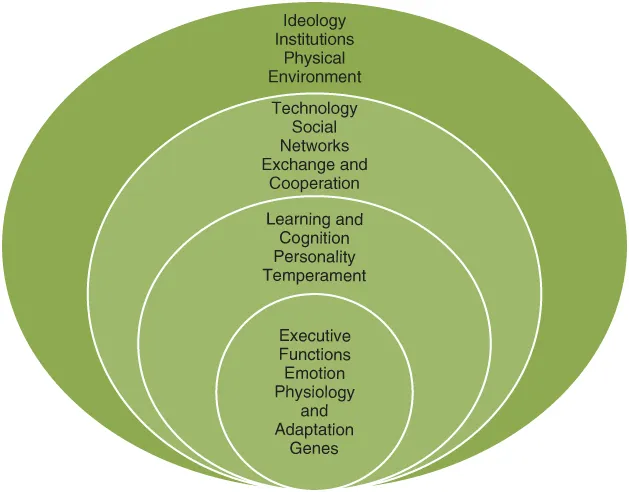
The cell to society framework is broad and expansive, beginning with genes and moving to larger levels of physiological organization that impact human behavior such as stress, emotion, and executive functions in the human brain. We order these domains to reflect their evolutionary development. For example, emotional centers of the human brain evolved prior to development of rational thinking areas (MacLean, 1990; Massey, 2002). These biologically based domains influence the development of temperament, personality and micro-level social exchanges. However, it should be kept in mind that human development and behavior are plastic, meaning that external input from the environment molds and shapes us in myriad ways. Therefore, the cell to society framework goes beyond individual, biologically based domains to address successive levels of macro-level environmental influences that surround the individual. These levels include the nature of exchange and cooperation between individuals, social networks and psychosocial relations, technology, the physical environment, and belief systems and ideologies. These components are very necessary for collective survival, as every society must produce for itself (and reproduce itself), doing so using technology, institutions, and associated belief systems and ideologies that interact with specific environments.
The cell to society framework we are proposing is justified by virtue of the multidimensional nature of human behavior and the need for a general synthesis that incorporates biological and sociocultural science in a coherent fashion. The cell to society approach is therefore a conceptual strategy designed to integrate cutting-edge developments from multiple disciplines within a biological and cultural evolutionary framework for guiding and advancing knowledge for the helping professions (e.g., social work and public health). As a synthesis, the cell to society framework is ultimately based on seminal research and numerous empirical studies drawn from such diverse fields as anthropology, behavior genetics, neurobiology, cultural geography, economics, psychology, primatology, and macrosociology. The cell to society framework begins at smaller units at the person level (e.g., genes) and builds outward to larger units such as the physical environment and institutions (see Figure 1.1). Unlike many models, the cell to society approach is of broad scope and can inform clinical, individual, community, and global level frameworks.
In this chapter, we delineate the major conceptual and theoretical underpinnings of the cell to society framework. Namely, we discuss the importance of employing theories and research from multiple disciplines, incorporating biological and cultural evolution, embracing systems thinking and complexity, utilizing science and the scientific method, and taking a life-course perspective. We then provide an overview of the domains that represent the major areas of the cell to society approach, which will be the focus of subsequent chapters: genes and behavior, stress and adaptation, emotion, executive functions, temperament, personality, cognition and learning, exchange and cooperation, social networks and psychosocial relations, technology, the physical environment, and belief systems and ideology.
Case Study: Malia's Different Abilities
Malia is 52 years old and has a spinal cord injury—well, technically, amyotrophic lateral sclerosis (ALS), or Lou Gehrig's disease.1 All Malia really cares about, though, is walking normally again (without so much tripping and stumbling), and ceasing to be such a burden to her family. Although Malia's speech is becoming slurred and she is progressively finding it difficult to swallow, frequent visits to her nutritionist have helped her by adjusting her diet. She does find the muscle weakness and cramps, fatigue, and pain intolerable at times, but her care team works together to help her when she has flare-ups like this. Although she has difficulty managing the small motor movements required for getting dressed, she winnowed out her wardrobe, retaining only the easiest styles. She has replaced the fancier garments of her recent past, those with buttons, zippers, or fancy fasteners, with simple pull-on shirts and sweaters that help her maintain independence in dressing herself, at least for now. So far, Malia has not lost any cognitive functioning; she is aware of everything that is going on with her bodily functions and has not suffered any memory deterioration or thinking problems. However, when you ask her how she's feeling, she will tell you that she feels increasingly isolated and “down” much of the time. She is not sure if it is depression, but she knows her motivation has decreased and her sense of pleasure in life and relationships is not as full as it once was. At one point recently, when she returned home from a doctor's visit, she expressed the frustration and disappointment of her progressive illness like this: “I feel like I'm the manager of a losing baseball team. You have to show up, but you know you're going to lose.” Some days just mustering the motivation to get up and out of bed can be almost too much for her to bear. Other days, she says, she has a “sunnier disposition” and better perspective on managing her illness.
What helps her, you might ask? Malia says it helps to avoid thinking about the tube feeding and respiratory failure that's bound to come, and to “distract herself from the inevitability” of this incurable illness. She also says lots and lots of support has been very helpful. And she doesn't mean the kind of support that well-intentioned people often give her: help with the door, sympathetic looks, trying to talk for her as she slurs her speech, or underestimating and overlooking the functional capacities she still has. The kind of support that Malia says really helps her is the genuine, silent patience that comes from those friends who slow down and take their time with her. Malia likes best the kind of support that does not underestimate her functional capacity, but does not overlook her functional limitations, either; the kind that balances both, takes time for the relational connections, not just the tasks at hand, and appreciates her continued contributions as a partner in the friendship, as opposed to a dependent to be pitied and cared for. Of course, other, more concrete and tangible levels of support that come from her multidisciplinary care team, like medication to help control her pain, and a computer-based communication aid to help when her speech becomes increasingly difficult to manage, are also helpful to her. Malia has experienced some physical and mental success (muscle management and improved nighttime sleep, respectively) by engaging in physical therapy–directed exercises, such as simple walking and swimming regimens and range of motion and stretching exercises. She has authorized the occupational therapist to make some limited structural alterations to her home, such as a ramp to her door in anticipation of the day she will become reliant on a wheelchair for her mobility, but she is reluctant to do much more than that right now, to keep the environment as a space that reminds her of her independence and, as she puts it, so that the place doesn't end up looking like “the home of a dying disabled person!”
Malia says the social workers she has come in contact with have been very helpful. They have helped her and her family members better understand the medical, emotional, and financial dimensions of the disease, and as she says, they have helped her plan for her future while still helping her live in the moment, day to day, with dignity and purpose. She said her social workers constantly work with her toward her goal of living interdependently and taking what she needs from those who can help, while acknowledging and maximizing what she still has control over. Her social workers have worked with legal counsel in helping her draft a durable power of attorney and a living will, and have located ALS support groups for her caregivers. Her care team has told her about complex rehabilitation technology (CRT): medically necessary customized technology, typically customized mobility devices and services used by people with disabilities, which often require continuous technology assessment, evaluation, and adjustment to tailor the products to individual needs. These are the type of mobility devices she will need in the near future, and they are different than other types of standard medical devices in their specialization and individualized fit requirements. The customized process of product alignment, a...