- Focuses for the most part on the pre-school years, the period during which the foundations for language development are laid
- Uses a problem-based approach, designed to motivate students to find the information they need to identify and explore learning issues that a particular speech or language issue raises
- Examines the development of a child's phonological system, the growth of vocabulary, the development of grammar, and issues related to conversational and narrative competence
- Integrates information on typical and atypical language development
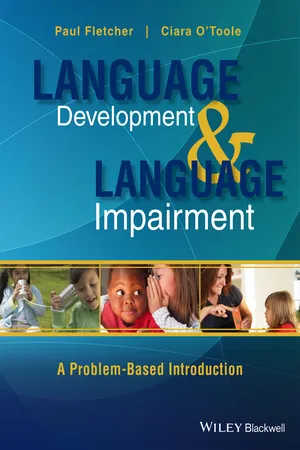
eBook - ePub
Language Development and Language Impairment
A Problem-Based Introduction
- English
- ePUB (mobile friendly)
- Available on iOS & Android
eBook - ePub
Language Development and Language Impairment
A Problem-Based Introduction
About this book
Language Development and Language Impairment offers a problem-based introduction to the assessment and treatment of a wide variety of childhood language developmental disorders.
Information
1
Overview
Learning Areas
- The educational and social effects of language impairment.
- The child’s language environment:
- Learning more than one language
- Accents and dialects of English.
- Typical language development:
- Variation in rate of language development
- External factors influencing variation
- Intrinsic factors influencing variation.
- Speech and language impairment:
- Speech and language impairment associated with identifiable conditions
- Speech and language problems whose causes remain unexplained.
1.1 The Effects of Preschool Language Impairment
The ability to speak and understand is something we take completely for granted. Conversing with friends or partners, listening to the radio, talking on the phone, or telling stories to the children at bedtime are no more remarkable or reflected on than walking or eating, for most of us. We have engaged in these various linguistic activities for a long time – a good part of the competence that underpins our linguistic ability was in place by 5 years of age. After a few short years of childhood, at the time of school entry, each of us had a vocabulary of several thousand words. We could pronounce most of these accurately. We were able to organize words into coherent sentences, and deploy these sentences in conversations with parents, grandparents, siblings, and others, at the same time understanding what our interlocutors were saying to us. We were ready at that point to begin the long educational haul into literacy and numeracy, the skills on which full participation in our culture depends. And as we stepped outside the family unit into the wider society for the first time, we were able to use the language we had learned to make friends in school, and later in life to embark on relationships. What we learn about language in that first five years of our lives is an indispensable foundation for social well-being and educational progress. And for the vast majority it is acquired effortlessly. But if the process of language learning is constrained or restricted in any way in the preschool years, and delay or impairment results, the effects on educational advancement, and on socialization in childhood and beyond, can be severely inhibiting on life chances.
Research points to the continuing influence of slow or atypical oral language development on educational attainment, and on social facility. A long-term UK study of a group of children identified with language difficulties at the age of 4;0 years makes this clear. (The usual way of indicating age in the child population is illustrated here, by separating months from years with a semicolon.) Bishop and Edmundson (1987) identified a group of 87 4 year olds in the north-east of England who were language-impaired, and tested them on a range of linguistic abilities. The same children were retested 18 months later. At age 4, the children were classified as having impaired speech and language skills and normal nonverbal intelligence (the group with specific language impairment (SLI) – see Section 1.4) or having impaired speech and language skills, with verbal IQ at least two standard deviations below the mean (general delay group). The language impairment in 37% of the children had resolved when they were retested at age 5;6. These children were then studied again as teenagers, when 71 of the original group were contacted (Stothard et al., 1998). Children whose language problems had apparently resolved (at 5;6) did not differ from their peers on tests of vocabulary and language comprehension. Where they performed less well, however, was on tests of phonological processing and literacy skill. Those children who had continued to show significant language difficulties at the age of 5;6 in the original study had significant impairments in all aspects of spoken and written language functioning as adolescents. This was also true of children classified as having a general delay. These children fell further and further behind their peers in the development of their vocabularies over time.
It is apparent from these results that early language impairment can have serious long-term consequences educationally. Language impairment can also impact socially, with affected individuals prone to having poorer social skills and more limited peer relationships than their age-matched classmates in primary schools (Fujiki, Brinton, and Todd, 1996). Children with language impairment may also be at some risk of psychological problems: Snowling et al. (2006) reported on the rate of psychosocial difficulties in the sample identified by Bishop and Edmundson. They found that children whose language delay had resolved by 5;6 years tended to be free of problems. But for those whose language difficulties persisted through the school years, there was a raised incidence of attentional and social difficulties, associated with distinct language profiles. Attention problems were associated with a profile of expressive language difficulties; social difficulties were found in children with receptive and expressive language difficulties; and the group of children with both attention and social difficulties had low IQ as well as global language difficulties. Similarly, a follow-up study in early adult life of 17 individuals, who had been identified with a severe receptive language disorder in childhood, showed persisting language and literacy problems along with significant social difficulties and increased risk of psychiatric disorder, compared to controls (Clegg et al., 2005; see also St. Clair et al., 2011). At the extreme, limitations in language ability may be at least part of the reason young men find themselves in court or in prison. Bryan (2004) found that there was a much higher than expected prevalence of low linguistic ability in a cohort of young offenders in the United Kingdom. In a further study, of juvenile offenders (15–17 year olds; Bryan, Freer, and Furlong, 2007), 46–67% scored within the poor or very poor categories on sub-tests of the Test of Adult and Adolescent Language (TOAL-3; Hammill et al., 1994), as compared with 9% of the typical adolescent population. And of 100 young offenders completing custodial sentences in Victoria, Australia, 46 were classified as language-impaired (Snow and Powell, 2011).
These long-term educational and psychosocial consequences of preschool language impairment enjoin us to look more closely at the process of language development in typically developing (TD) children, and at the factors that can inhibit that development in their peers with language impairment, in the important period between birth and the age of 5. The last four decades have seen a burgeoning of research interest in children’s language learning and there is no shortage of material to draw on in relation to typical or atypical development. In this volume we examine preschool language impairment in the light of typical language development, from an avowedly linguistic perspective. Children’s language impairment is a topic that is rightly of interest to a number of disciplines besides linguistics, but we take the view here that it is linguistic description that is crucial in providing us with the basic anatomy of children’s language behavior.
Throughout this text, we use typical language development in English as the standard against which the limitations of the child with language impairment are measured. The performance of TD children is taken as the benchmark against which the performance of the child with an impairment is assessed. Given that more than 90% of the world’s children learn the speech and language (or languages) of their environment successfully by the time they go to school, there are two obvious questions to ask. How different from the linguistic progress of TD young children is that of individuals who are impaired? And what is it about children with language impairment that prevents them from making a success of language acquisition in the same time frame as the vast majority of their peers? We address these issues throughout th...
Table of contents
- Cover
- Title page
- Table of Contents
- Companion Website
- Preface
- 1 Overview
- 2 The First Year of Life
- 3 Sounds
- 4 Words
- 5 Combining Words
- 6 Beyond the Sentence
- Appendix 1: The International Phonetic Alphabet
- Appendix 2: Reliability and Validity
- Appendix 3: Sensitivity and Specificity
- Appendix 4: Techniques for Exploring Speech Perception in Infants
- Appendix 5: Grammatical Analysis Using the LARSP Profile
- Index
- End User License Agreement
Trusted by 375,005 students
Access to over 1.5 million titles for a fair monthly price.
Study more efficiently using our study tools.
Frequently asked questions
Yes, you can cancel anytime from the Subscription tab in your account settings on the Perlego website. Your subscription will stay active until the end of your current billing period. Learn how to cancel your subscription
No, books cannot be downloaded as external files, such as PDFs, for use outside of Perlego. However, you can download books within the Perlego app for offline reading on mobile or tablet. Learn how to download books offline
Perlego offers two plans: Essential and Complete
- Essential is ideal for learners and professionals who enjoy exploring a wide range of subjects. Access the Essential Library with 800,000+ trusted titles and best-sellers across business, personal growth, and the humanities. Includes unlimited reading time and Standard Read Aloud voice.
- Complete: Perfect for advanced learners and researchers needing full, unrestricted access. Unlock 1.5M+ books across hundreds of subjects, including academic and specialized titles. The Complete Plan also includes advanced features like Premium Read Aloud and Research Assistant.
We are an online textbook subscription service, where you can get access to an entire online library for less than the price of a single book per month. With over 1.5 million books across 990+ topics, we’ve got you covered! Learn about our mission
Look out for the read-aloud symbol on your next book to see if you can listen to it. The read-aloud tool reads text aloud for you, highlighting the text as it is being read. You can pause it, speed it up and slow it down. Learn more about Read Aloud
Yes! You can use the Perlego app on both iOS and Android devices to read anytime, anywhere — even offline. Perfect for commutes or when you’re on the go.
Please note we cannot support devices running on iOS 13 and Android 7 or earlier. Learn more about using the app
Please note we cannot support devices running on iOS 13 and Android 7 or earlier. Learn more about using the app
Yes, you can access Language Development and Language Impairment by Paul Fletcher,Ciara O'Toole in PDF and/or ePUB format, as well as other popular books in Languages & Linguistics & Linguistics. We have over 1.5 million books available in our catalogue for you to explore.