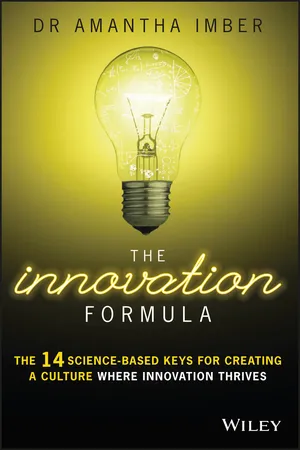
A practical guide to innovation strategies based on fact, not feeling
The Innovation Formula delivers strategies for building a culture where innovation can thrive, based on actual scientific research. Author Amantha Imber holds a PhD in organisational psychology, and has been called upon by a multinational roster of forward-thinking companies—such as Google, Disney, LEGO and Virgin—to improve innovation at all levels. In this book, she shares her strategies and helps you tap into a substantial body of scientific research to help further innovative practice within your own company. For example, rewarding failed innovations can actually be a critical aspect of building an innovation culture. It's rarely done, but it fosters creative thought by signaling to people that failure is tolerated and is a necessary ingredient in the pursuit of innovation. This kind of practical, easily implemented strategy is the lynchpin of cultural change. This guide shares fourteen separate, yet interconnected strategies for improving your company's innovation culture, and provides illustrative examples of real-world companies who are putting these plans into action.
Business innovation guides tend to focus on how one company does it. But it's not your company, and just because it worked for Google or Apple doesn't mean that it's right for you. This book is different; these techniques are based on science, not gut feeling, and can apply to any organisation, at any level.
Delve into the science behind successful culture shift
For best results, reward innovation, whether or not it succeeds
Learn the critical elements that foster organisation-wide creativity
Implement practical strategies based on evidence, not anecdotes
Fostering a culture of innovation means making your company a safe space for new ideas. Over 95% of business leaders surveyed get it wrong, because intuition cannot compete with data. The Innovation Formula gives you a science-based framework for turning your organisation into one where innovation survives and thrives.
While many people think of cultural change as something that needs to happen at an organisation-wide level, research has actually revealed that there is much that can be influenced at the individual level — especially when it comes to driving innovation. If you are a manager reading this book, the chapters in this section will provide you with plenty of advice on how to structure tasks and projects in your team, and suggest initiatives that you could consider implementing to help drive a culture of innovation for the individuals in your team.
If you are an individual without direct managerial responsibility, then this section will probably be the most important one you read. The suggestions and ideas contained over the next three chapters are strategies that you will be able to implement readily — for both yourself and your peers.
We start with the challenge of challenge. One of the most important factors in creating a strong innovation culture is that individuals need to feel significantly challenged by what they do. Chapter 1 explores what it means to be challenged, what is the ‘right' level of challenge to aim for, and gives examples of how other organisations are setting challenges for individuals.
Chapter 2 examines the topic of autonomy. Ensuring people feel a sense of freedom and control over what they do and how they solve problems is a significant driver of innovation. The need to give individuals autonomy in their roles comes up over and over again in the innovation literature. This chapter will provide examples of what it actually means to give autonomy and how to implement these ideas within your organisation.
Providing recognition to individuals is the final individual-level driver that will be explored. Chapter 3 describes what it means to provide recognition and the different ways that organisations can approach this. The chapter will provide you with inspiration and examples of how other organisations approach the topic of recognition, and also answer the question of whether financial rewards actually serve as an effective motivator of innovation.
CHAPTER 1 CHALLENGE The Goldilocks factor — finding the level that's just right
Jeff Immelt took over from Jack Welch as the CEO of General Electric (GE) on Friday 7 September 2001, four days before two planes flew into the World Trade Center towers. It is an understatement to say that his timing was rough. Welch had delivered GE's shareholders average returns of 23 per cent per annum during his two decades as the company's leader. Welch's success had come from clever acquisitions and improving efficiencies, but Immelt felt he needed to take a different tack. In his first two years he focused on investments in R&D and leadership and on identifying new growth opportunities for the business. However, by the end of his second year, income and revenue were at levels similar to where they were back in 2000.
Immelt knew he had to go even further in his pursuit of organic growth. He created an initiative that is still front and centre at GE today. Immelt brought together his top marketing directors from across GE's varying businesses in September 2003 and asked them each to develop five Imagination Breakthroughs. These were defined as new business proposals that would deliver new growth to GE. And they had to be delivered within two months. In November 2003, 50 Imagination Breakthroughs were presented to Immelt and 35 were green-lighted.
Imagination Breakthroughs (or IBs, as they are called within the organisation) are now a core part of business leaders' roles at GE. Every year leaders are challenged to come up with three IBs, which are defined as new projects that can deliver $100 million of incremental growth within three years.
IBs are incredibly high-profile at GE. If you are asked to work on or contribute to an IB project, you re-prioritise everything else to accommodate it. This means that while the leaders feel a huge sense of challenge in presenting three IBs each year, they also have the resources at their disposal to rise up to and meet the challenge.
Within five years of the program's inception, IBs had generated $3 billion in incremental revenues for GE, and the company had hit its growth targets for 14 continuous quarters.
***
It's important to feel challenged by your work, and this is borne out by many studies that link challenge to increased creativity and innovation. In the 2007 meta-analysis ‘Climate for creativity: A quantitative review', Samuel Hunter and his colleagues found that employees feeling a strong sense of challenge in their work is one of the strongest drivers of a culture of innovation. They defined challenge as the ‘perception that jobs and/or tasks are challenging, complex and interesting — yet at the same time not overly taxing or unduly overwhelming'. It is important that you don't simply think about how to give people the biggest possible challenge. Instead you should ensure that the level of challenge you set is one that is achievable. On the flip side, setting tasks that people are able to complete with their eyes closed will not breed a culture where innovation thrives.
So why is challenge so necessary for innovation? The answer lies in the work of Mihaly Csikszentmihalyi, a professor of psychology and management at Claremont Graduate University. Csikszentmihalyi is best-known for researching a concept called ‘flow'. Flow, or ‘being in the zone', is the state of complete absorption in a task. If you have ever been working intensely on a project and suddenly realised that an hour, or several, have flown by, you were probably in a state of flow.
In a nutshell, there are two preconditions for flow. The first one is a high degree of skill in the task you are doing. The second precondition is challenge — that is, working on a task that you would define as challenging or difficult. Csikszentmihalyi found that employees experience flow 44 per cent of the time, and experience boredom 20 per cent of the time. The rest of the time — 36 per cent — is filled with anxiety. Finding tasks and projects that challenge you (or your team) will help to increase the percentage of time spent in flow — just so long as you have the skills and abilities to rise to the challenge. If you don't, it will simply result in increased anxiety.
GE's Imagination Breakthrough program is a great example of how to ensure people feel an optimal level of challenge. The challenge set is a big one — finding new business ideas that will contribute $100 million of incremental growth — but leaders are given an entire year to develop three new growth ideas. The challenge is big, but the resources made available to leaders make it a challenge that they can meet.
***
The U-shaped relationship between challenge and performance — or, more specifically, innovation — has long been recognised by academics and researchers. Back in 1908, a couple of psychologists, Robert Yerkes and John Dodson, published a paper that challenged the way people thought about mental arousal and performance. They found that a high level of arousal enhances performance on simple tasks. That is, it is a simple linear relationship: the more alert and focused people are, the better their performance. However, they found that a high level of arousal actually decreases performance on complex tasks. In fact what they found was that an intermediate level of arousal was best for task performance. This ‘inverted U' relationship became known as the Yerkes–Dodson law (see figure 1.1).
Figure 1.1 Yerkes–Dodson law
Surprisingly, the Yerkes–Dodson law is often misinterpreted by researchers and members of the public alike. Many people completely ignore the very important finding that the inverted U-shape applies only to complex tasks — not simple ones. For simpler tasks, the U-shaped curve is much flatter, as we can deal with a greater range of arousal when completing basic tasks such as brushing our teeth.
This brings us to the topic of how the Yerkes–Dodson law applies to innovation. One of the things that characterises an innovation project or challenge is that it is far from simple. If it were simple, many other companies would have already cracked the problem and moved on. Instead, projects requiring innovation are always complex. So it is critical that innovation projects are matched with people who have the appropriate skill sets for the task, and that those people also have the resources available to rise to the challenge.
At Circus Oz, Australia's leading international circus troupe, Artistic Director and joint CEO Mike Finch describes having a sense of challenge as being built into the DNA of the art form. ‘Every single action is a challenge — and quite often, life-threatening. If you lose concentration, you can't achieve it. It's a challenge even just to do the most basic act that you've done for ten years.'
While rising to the challenge is somewhat easier in front of ‘Doctor Footlights', as live performance is referred to by the team, the sense of challenge can be harder to foster during the long rehearsal period between shows. One of the ways Finch tries to encourage his team to challenge themselves and to be disruptive is to find a skill they can do really well, and ask them to change one element of it.
‘We had a performer called Michael Ling', says Finch, ‘who was with the company for 28 years as a performer. One of the skills he had was going up a sway-pole, which is a 6-metre tall, bendy steel pole. One of the things we used to do is dress the pole like a lamppost and have his character, a cleaner, climb to the top to clean the post. He would then do a handstand on top and the whole thing would sway left to right and front and back. He'd lean out over the audience.
‘Michael also had another character he developed which was an elderly man. Michael was in his forties, but he could jump instantly from being a boy to being an 80-year-old character. Both of these characters and skills were right in his comfort zone.
‘One of the ways we challenged him was by getting him to put these two completely disparate things together. I asked, “What would the old man be like up on the sway-pole?” So with this challenge in mind, Ling created something completely different.'
This challenge resulted in the stunning final act of the season they were in rehearsals for. Ling had established himself as the old man, in a wheelchair on the ground. Thanks to some clever illusions, he was suddenly transported to the top of a sway-pole (which was dressed as a palm tree), on his wheelchair. ‘There was a whole lot of disruption but it was him on top of this tall pole and playing this old man and finding a brand-new way to put those two things together. All this brand-new material came from asking, “What does a geriatric do when they're 6 metres up in the air, swaying around and on a wheelchair?''
‘For me, challenge is not taking people so far out of their comfort zone that they're terrified', says Finch. ‘It can actually be just doing something you already know well, but doing it in a completely different way.'
***
There is a lot of research to support the relationship between individuals having challenging work and producing significantly more innovative outcomes. In their study ‘Assessing the work environment for creativity', Professor Teresa Amabile, from Harvard University, and her colleagues investigated the impact of challenging work on a group of middle managers working at a large American electronics company. The study first required each manager to nominate their ‘highest creativity' project from the last three years, and also their ‘lowest creativity' project. Managers were instructed to choose only projects where creativity was the desired outcome. This process led to a total of 306 projects being nominated, and each project was then assessed by an independent judge to validate that it was indeed a creative or non-creative outcome.
The final stage of the study involved finding people who had worked on these projects and asking them about their experiences. One of the questions asked team members how challenging they found the project in terms of the work they were asked to contribute. Amabile and her colleagues found that those working on ...
Table of contents
COVER
EPIGRAPH
TITLE PAGE
COPYRIGHT
DEDICATION
ABOUT THE AUTHOR
ACKNOWLEDGEMENTS
INTRODUCTION
INNOVATION CULTURE AUDIT
PART I INDIVIDUAL-LEVEL FACTORS
PART II TEAM-LEVEL FACTORS
PART III LEADER-LEVEL FACTORS
PART IV ORGANISATION-LEVEL FACTORS
WHAT NOW?
REFERENCES
INDEX
ADVERT
EULA
Trusted by 375,005 students
Access to over 1.5 million titles for a fair monthly price.
Study more efficiently using our study tools.
Frequently asked questions
Yes, you can cancel anytime from the Subscription tab in your account settings on the Perlego website. Your subscription will stay active until the end of your current billing period. Learn how to cancel your subscription
No, books cannot be downloaded as external files, such as PDFs, for use outside of Perlego. However, you can download books within the Perlego app for offline reading on mobile or tablet. Learn how to download books offline
Perlego offers two plans: Essential and Complete
Essential is ideal for learners and professionals who enjoy exploring a wide range of subjects. Access the Essential Library with 800,000+ trusted titles and best-sellers across business, personal growth, and the humanities. Includes unlimited reading time and Standard Read Aloud voice.
Complete: Perfect for advanced learners and researchers needing full, unrestricted access. Unlock 1.5M+ books across hundreds of subjects, including academic and specialized titles. The Complete Plan also includes advanced features like Premium Read Aloud and Research Assistant.
Both plans are available with monthly, semester, or annual billing cycles.
We are an online textbook subscription service, where you can get access to an entire online library for less than the price of a single book per month. With over 1.5 million books across 990+ topics, we’ve got you covered! Learn about our mission
Look out for the read-aloud symbol on your next book to see if you can listen to it. The read-aloud tool reads text aloud for you, highlighting the text as it is being read. You can pause it, speed it up and slow it down. Learn more about Read Aloud
Yes! You can use the Perlego app on both iOS and Android devices to read anytime, anywhere — even offline. Perfect for commutes or when you’re on the go. Please note we cannot support devices running on iOS 13 and Android 7 or earlier. Learn more about using the app
Yes, you can access The Innovation Formula by Dr. Amantha Imber in PDF and/or ePUB format, as well as other popular books in Business & Business Development. We have over 1.5 million books available in our catalogue for you to explore.