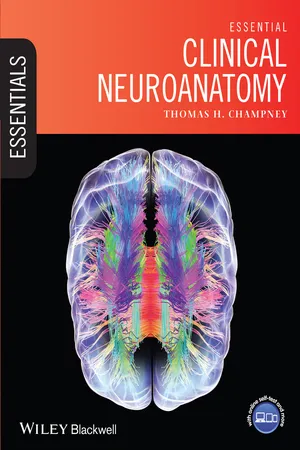
Essential Clinical Neuroanatomy
eBook - ePub

Essential Clinical Neuroanatomy

  1. English
  2. ePUB (mobile friendly)
  3. Available on iOS & Android
eBook - ePub

Essential Clinical Neuroanatomy

About this book

Essential Clinical Neuroanatomy is an accessible introduction to regional and functional neuroanatomy, which cuts through the jargon to help you engage with the key concepts. Beautifully presented in full color, with hundreds of annotated illustrations and images,Β Essential Clinical Neuroanatomy begins with an introductory section on the regional aspects of the topic, then discusses each structure in detail in relation to function. Clinical examples are provided throughout, to reinforce the concepts learned and highlight their clinical relevance.

Essential Clinical Neuroanatomy:Β 

  • Features a dedicated chapter on the use of imaging studies used in clinical neuroanatomy, including how to evaluate these images
  • Highlights topics important to clinical medicine, but often neglected in other neuroanatomy texts, such as trauma, infection and congenital considerations
  • All illustrations and images are oriented in the clinical view, so the correlation between drawings, photomicrographs and clinical imaging is standardized and there is a seamless transition between illustrations containing basic neuroanatomical information and the relevant clinical imaging
  • The functional aspects of neuroanatomical structures are color-coded (green = sensory; red = motor; purple = autonomic), so that structure to function relationships can be more easily learned and retained
  • Includes self-assessment and thought questions in every chapter
  • Supported by a companion website at wileyessential.com/neuroanatomy featuring fully downloadable images, flashcards, and a self-assessment question bank with USMLE-compatible multiple-choice questions

Essential Clinical Neuroanatomy is the perfect resource for medical and health science students taking a course on neuroanatomy, as part of USMLE teaching and as an on-going companion during those first steps in clinical practice.

Frequently asked questions

Yes, you can cancel anytime from the Subscription tab in your account settings on the Perlego website. Your subscription will stay active until the end of your current billing period. Learn how to cancel your subscription.
No, books cannot be downloaded as external files, such as PDFs, for use outside of Perlego. However, you can download books within the Perlego app for offline reading on mobile or tablet. Learn more here.
Perlego offers two plans: Essential and Complete
  • Essential is ideal for learners and professionals who enjoy exploring a wide range of subjects. Access the Essential Library with 800,000+ trusted titles and best-sellers across business, personal growth, and the humanities. Includes unlimited reading time and Standard Read Aloud voice.
  • Complete: Perfect for advanced learners and researchers needing full, unrestricted access. Unlock 1.4M+ books across hundreds of subjects, including academic and specialized titles. The Complete Plan also includes advanced features like Premium Read Aloud and Research Assistant.
Both plans are available with monthly, semester, or annual billing cycles.
We are an online textbook subscription service, where you can get access to an entire online library for less than the price of a single book per month. With over 1 million books across 1000+ topics, we’ve got you covered! Learn more here.
Look out for the read-aloud symbol on your next book to see if you can listen to it. The read-aloud tool reads text aloud for you, highlighting the text as it is being read. You can pause it, speed it up and slow it down. Learn more here.
Yes! You can use the Perlego app on both iOS or Android devices to read anytime, anywhere β€” even offline. Perfect for commutes or when you’re on the go.
Please note we cannot support devices running on iOS 13 and Android 7 or earlier. Learn more about using the app.
Yes, you can access Essential Clinical Neuroanatomy by Thomas H. Champney in PDF and/or ePUB format, as well as other popular books in Biological Sciences & Neuroscience. We have over one million books available in our catalogue for you to explore.

Information

Part 1
Neuroanatomy of the Central Nervous System

CHAPTER 1
Overview of the nervous system

Learning objectives
  1. Describe the basic subdivisions of the human nervous system.
  2. Understand basic neuroanatomical terminology.
  3. Identify the major structures on the external surface of the gross brain.
  4. Identify the major structures on the midsagittal surface of the brain.
  5. Identify the cranial nerves.

Divisions of the nervous system

Anatomic
  1. Central nervous system (CNS)
    1. Brain and spinal cord
    2. Collection of nerve cell bodies = nucleus
  2. Peripheral nervous system (PNS)
    1. Peripheral nerves
    2. Collection of nerve cell bodies = ganglia
Functional
  1. Sensory (afferent)
    1. General – touch
    2. Special senses – sight, sound, taste, smell, balance
  2. Motor (efferent)
    1. Voluntary (somatic) – skeletal muscle
    2. Involuntary (autonomic) – smooth and cardiac muscle
      1. Parasympathetic – craniosacral (III, VII, IX, X, S2–S4)
      2. Sympathetic – thoracolumbar (T1–L2)
  3. Integrative – interneurons within the CNS

Components of the nervous system

Neurons
  1. Highly specialized, excitable cells
  2. Morphologic diversity
Glia – supporting cells
  1. Schwann cells (neurolemmocytes) – myelin producing
  2. Oligodendrocytes – myelin producing
  3. Astrocytes – nutritional support
  4. Microglia – macrophages (immune support)

Neurons

Cellular structure
  1. Dendrites
  2. Axon
    1. Axon hillock
    2. Terminal arborization/terminal boutons
    3. Synapse/synaptic vesicles
    4. Anterograde/retrograde flow
  3. Soma (perikaryon, cell body)
    1. Nucleus/nucleolus
    2. Nissl bodies (rough endoplasmic reticulum and polyribosomes)
    3. Lipofuscin
  4. Cell membrane (plasmalemma, neurolemma)
  5. Types: unipolar, bipolar, multipolar, pseudounipolar

Glia – central nervous system

Oligodendrocytes – myelin production; one oligodendrocyte for many axons
Astrocytes – support cells, glial fibrillary acid protein (GFAP), end feet
  1. Fibrous astrocytes – white matter
  2. Protoplasmic astrocytes – gray matter
Microglia – macrophage-like, scavenging cells
Ependymal cells – columnar, ciliated cells lining the ventricles

Central nervous system

Gray matter
  1. Nerve cell bodies (nuclei)
  2. Dendrites and axons
  3. Glia
White matter
  1. Nerve fibers (axons) – myelinated
  2. Glia

Brain neuroanatomy

Orientation of the brain – 90 degree rotation at midbrain flexure
  1. Superior – inferior
  2. Anterior – posterior
  3. Dorsal – ventral
  4. Rostral – caudal
Planes of the brain
  1. Sagittal plane
    1. Midsagittal
    2. Parasagittal
  2. Horizontal plane (transverse, axial)
  3. Frontal plane (coronal)
Views of the brain
  1. Superior
    1. Interhemispheric fissure (sagittal)
    2. Precentral gyrus (primary motor)
    3. Central sulcus
    4. Postcentral gyrus (primary somatosensory)
  2. Inferior
    1. Interhemispheric fissure (sagittal)
    2. Lateral fissure (Sylvian)
    3. Midbrain – cerebral peduncles
    4. Pons
    5. Medulla oblongata – pyramids, inferior olives
    6. Cerebellum
    7. Olfactory bulb and tract
    8. Optic chiasm and tract
    9. Infundibulum (pituitary stalk)
    10. Mammillary bodies
    11. Cranial nerves (12)
      1. Olfactory nerve (I)
      2. Optic nerve (II)
      3. Occulomotor nerve (III)
      4. Trochlear nerve (IV)
      5. Trigeminal nerve (V)
      6. Abducens nerve (VI)
      7. Facial nerve (VII)
      8. Vestibulocochlear nerve (VIII)
      9. Glossopharyngeal nerve (IX)
      10. Vagus nerve (X)
      11. Spinal accessory nerve (XI)
      12. Hypoglossal nerve (XII)
  3. Lateral
    1. Lateral fissure (Sylvian)
    2. Brain stem (midbrain, pons, and medulla)
    3. Cerebellum
    4. Central sulcus
    5. Precentral gyrus (primary motor)
    6. Postcentral gyrus (primary sensory)
    7. Lobes of the brain
      1. Frontal lobe
      2. Parietal lobe
      3. Occipital lobe (vision)
      4. Temporal lobe (auditory)
    8. Insular cortex
    9. Superior temporal gyrus (auditory)
  4. Midsagittal
    1. Frontal cortex
    2. Parietal cortex
    3. Occipital cortex
    4. Cerebellum
    5. Corpus callosum
    6. Hypothalamus
    7. Thalamus
    8. Pineal gland
    9. Midbrain
    10. Pons
    11. Medulla oblongata
    12. Cingulate gyrus
    13. Fornix
    14. Amygdala
    15. Hippocampus
Subdivisions of the brain and spinal cord
  1. Spinal cord
    1. Central grey matter
      1. Posterior (dorsal) horn – sensory (afferent)
      2. Lateral horn – autonomic
      3. Anterior (ventral) horn – motor (efferent) – alpha motor neurons
    2. Peripheral white matter
    3. Reflexes and basic integration
    4. Cervical (8 nerves)
    5. Thoracic (12 nerves)
    6. Lumbar (5 nerves)
    7. Sacral (5 nerves)
    8. Coccygeal (1 nerve)
  2. Brain stem
    1. Midbrain
    2. Pons
    3. Medulla oblongata
  3. Diencephalon
    1. Thalamus
    2. Hypothalamus
    3. Epithalamus – pineal gland
  4. Cerebrum – cerebral hemispheres – telencephalon
    1. Frontal lobe
    2. Parietal lobe
    3. Temporal lobe
    4. Occipital lobe
    5. Six histological layers
    6. Integration of afferent and efferent information
  5. Cerebellum
    1. Three histological layers
      1. Molecular layer
      2. Purkinje cell layer
      3. Granule cell layer
    2. Coordinates balance and muscle tone
  6. Cranial nerves (12)
    1. Olfactory nerve (I)
    2. Optic nerve (...

Table of contents

  1. Cover
  2. Title page
  3. Table of Contents
  4. Preface
  5. Acknowledgments
  6. About the companion website
  7. Part 1: Neuroanatomy of the Central Nervous System
  8. Part 2: The Sensory, Motor, and Integration Systems
  9. Answers to study questions
  10. Answers to figures
  11. Glossary
  12. Index
  13. End User License Agreement