Medicines Management for Nurses at a Glance
eBook - ePub

Medicines Management for Nurses at a Glance

  1. English
  2. ePUB (mobile friendly)
  3. Available on iOS & Android
eBook - ePub

Medicines Management for Nurses at a Glance

About this book

Medicines Management for Nurses at a Glance is the perfect companion for study and revision for pre-registration nursing and healthcare students.Ā  Combining superb full colour illustrations with accessible and informative text, it provides an easy-to-read and supportive guide to the key pharmacological knowledge nursing students and registered nurses need to know.

Divided into three sections, the first introduces key topics within clinical pharmacology and medicines management including, numeracy, pharmacokinetics, routes of administration, and pharmacodynamics.Ā  The second and final sections cover the management of medicines for common medical conditions, drug interactions, side effects, and safe and effective prescribing.

  • Written specifically for nurses, it covers the fundamentals of pharmacology as they apply to nursing practice.
  • Breaks down complex concepts in an accessible way, providing helpful overviews of all key pharmacological topics.Ā 
  • Includes practical issues relating to practice, and is written to support the Essential Skills Cluster of the NMC, and the content of the BNF.
  • Includes content relevant to each of the four fields of nursing, and covers drugs for specific groups such as children, pregnant and breastfeeding women, and the elderly.

A companion website is available at www.ataglanceseries.com/nursing/medicinesmanagement featuring interactive multiple choice questions.

Trusted byĀ 375,005 students

Access to over 1.5 million titles for a fair monthly price.

Study more efficiently using our study tools.

Information

Year
2015
Print ISBN
9781118840726
eBook ISBN
9781118840672
Edition
1
Subtopic
Nursing

Introduction to pharmacology and medicines management

Chapters

  1. 1 Why is managing medicines important in nursing?
  2. 2 Keeping up to date with medicines management
  3. 3 What is a medicine?
  4. 4 Medicines nomenclature: what’s in a name?
  5. 5 Numeracy and medicines management
  6. 6 Clinical pharmacokinetics I
  7. 7 Clinical pharmacokinetics II
  8. 8 Routes of administration I
  9. 9 Routes of administration II
  10. 10 Pharmacodynamics I
  11. 11 Pharmacodynamics II

Why is managing medicines important in nursing?

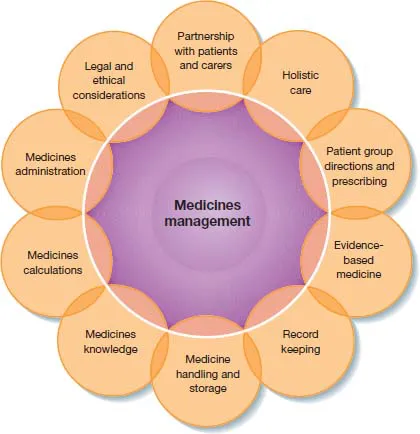
Overlapping Venn diagram depicts elements of medicines management which are:
Partnership with patients and carers 
Holistic care 
Patient group directions and prescribing
Evidence-based medicine
Record keeping
Medicine handling and storage 
Medicines knowledge
Medicines calculations
Medicines administration
Legal and ethical considerations.
Figure 1.1 An overlapping Venn diagram illustrating the Nursing and Midwifery Council’s elements of the medicines management skills cluster

Medicines management and nursing

Nursing is a multifaceted profession. A wide variety of knowledge and skills is required to become a safe and effective nurse in modern healthcare practice. The essential skills clusters (ESCs) of the Nursing and Midwifery Council (NMC) define and illustrate the essential skills that are to be developed by the pre-Ā­registration nurse to make that nurse fit for registration. The NMC has developed five clusters of knowledge and skills related to nursing competence:
  • Care, compassion and communication.
  • Organisational aspects of care.
  • Infection prevention and control.
  • Nutrition and fluid management.
  • Medicines management.
This book will focus on the medicines management cluster and explore the important medicines-related knowledge required by a nurse. Whenever possible, the ESC will be referenced so that you may consider your knowledge and skill development in that area of medicines management as you work through the book.

Defining medicines management

The Audit Commission report, ā€˜A Spoonful of Sugar: Medicines Management in NHS Hospitals’ (2001), was designed to highlight the importance of the effective use of medication as a part of the nurse’s role. While nurses’ involvement with medicines management varies according to the context of care (e.g. community based, hospital based), the report highlights that up to ā€˜7,000 individual doses are administered daily in a ā€œtypicalā€ hospital; and up to 40 per cent of nurses’ time is spent administering medicines’ (http://www.eprescribingtoolkit.com/wp-content/uploads/2013/11/nrspoonfulsugar1.pdf, point 11, p.9, last accessed 6 August, 2015).
The report defined medicines management as:
Medicines management in hospitals encompasses the entire way that medicines are selected, procured, delivered, prescribed, administered and reviewed to optimise the contribution that medicines make to producing informed and desired outcomes of patient care.
(www.eprescribingtoolkit.com/wp-content/uploads/2013/11/nrspoonfulsugar1.pdf, Box A, p.5, last accessed 6 August, 2015)
This definition illustrates that managing medicines is not just the responsibility of pharmacists and doctors. It is the collective responsibility of those who work for a healthcare organisation. When working in the NHS, it is easy to find examples of nurses who undertake every facet of medicines management (Figure 1.1). Nurses commonly prescribe, dispense, administer and review patient medication on a day-to-day basis.
The report continues by identifying the main reasons why medicines management needs to continually improve. Medication errors are unacceptably common, the efficacy of medicines is increasing, the costs of medicines are rising and the administration of medicines is becoming more complex. In addition, there is a need to review medicines management across whole health economies as the distinction between primary and secondary care becomes increasingly blurred.
Managing medicines is more than just clinical pharmacology. Clinical pharmacological knowledge is an essential element of safe and efficacious patient care along with the other core skills.
Figure 1.1 is not hierarchical but attempts to illustrate the interconnected nature of the ESCs that make up the medicines management process. Understanding how medicines work (their fundamental pharmacology) is significant knowledge in, for example, medicines administration. Understanding fundamental pharmacokinetics (Chapters 6 and 7) and fundamental pharmacodynamics (Chapters 10 and 11) allow the nurse undertaking medication administration to explain the dose of medication prescribed, its clinical indication, its likely beneficial effects and any potentially important adverse effects such as side effects (Chapter 48) and drug interactions (Chapter 47).
Traditionally, doctors prescribe, pharmacists dispense and nurses administer medication. Modern healthcare practice incorporates increasingly diverse means of supplying medicine: there are growing numbers of prescribers from a range of professional backgrounds (nurses, pharmacists and physiotherapists) and additional ways for patients to access medication – for example, patient group directions (PGDs), which are written instructions for the supply or administration of medicines to groups of patients according to a set of predetermined criteria. The competent nurse needs to understand their role in supporting these mechanisms of medicine supply and in facilitating patient access to increasingly complex treatments as part of evidence-based interventions.
Economic predictions of the cost ...
Table of contents

  1. Cover
  2. FrontMatter
  3. TitlePage
  4. Copyright
  5. Content
  6. Preface
  7. About the Companion website
  8. Part 1: Introduction to pharmacology and medicines management
  9. Part 2: Managing medicines
  10. Part 3: Safe and effective medicines management
  11. Index
  12. Eula

Frequently asked questions

Yes, you can cancel anytime from the Subscription tab in your account settings on the Perlego website. Your subscription will stay active until the end of your current billing period. Learn how to cancel your subscription
No, books cannot be downloaded as external files, such as PDFs, for use outside of Perlego. However, you can download books within the Perlego app for offline reading on mobile or tablet. Learn how to download books offline
Perlego offers two plans: Essential and Complete
  • Essential is ideal for learners and professionals who enjoy exploring a wide range of subjects. Access the Essential Library with 800,000+ trusted titles and best-sellers across business, personal growth, and the humanities. Includes unlimited reading time and Standard Read Aloud voice.
  • Complete: Perfect for advanced learners and researchers needing full, unrestricted access. Unlock 1.5M+ books across hundreds of subjects, including academic and specialized titles. The Complete Plan also includes advanced features like Premium Read Aloud and Research Assistant.
Both plans are available with monthly, semester, or annual billing cycles.
We are an online textbook subscription service, where you can get access to an entire online library for less than the price of a single book per month. With over 1.5 million books across 990+ topics, we’ve got you covered! Learn about our mission
Look out for the read-aloud symbol on your next book to see if you can listen to it. The read-aloud tool reads text aloud for you, highlighting the text as it is being read. You can pause it, speed it up and slow it down. Learn more about Read Aloud
Yes! You can use the Perlego app on both iOS and Android devices to read anytime, anywhere — even offline. Perfect for commutes or when you’re on the go.
Please note we cannot support devices running on iOS 13 and Android 7 or earlier. Learn more about using the app
Yes, you can access Medicines Management for Nurses at a Glance by Simon Young,Ben Pitcher in PDF and/or ePUB format, as well as other popular books in Medicine & Nursing. We have over 1.5 million books available in our catalogue for you to explore.