Survey's the issues typically raised in discussions of sustainability and plastics
Discusses current issues not covered in detail previously such as ocean litter, migration of additives into food products and the recovery of plastics
Covers post-consumer fate of plastics on land and in the oceans, highlighting the environmental impacts of disposal methods
Details toxicity of plastics, particularly as it applies to human health
Presents a clear analysis of the key plastic-related issues including numerous citations of the research base that supports and contradicts the popularly held notions
We, the Homo sapiens sapiens, have enjoyed a relatively short but illustrious history of about 100,000 years on Earth, adapting remarkably well to its diverse range of geographical conditions and proliferating at an impressive pace across the globe. Easily displacing the competing relatives of the genus, we emerged the sole human species to claim the planet. It is a commendable feat indeed, considering the relatively low fertility and the high incidence of reproductive failures in humans compared to other mammals. A good metric of this success is the current world population that has increased exponentially over the decades and now standing at slightly over seven billion. It is estimated to grow to about 10 billion by 2100, given the increasing longevity worldwide. At this growth rate, the number of people added to the global community next year will now be equal to about the population of a small country (such as England or France) (Steck et al., 2013). The world population increased1 by 26% just in the past two decades! The plethora of environmental issues we face today and the more severe ones yet to be encountered tomorrow are a direct consequence of this dominant human monoculture striving to survive on a limited base of resources on the planet. As we approach the carrying capacity2 of the planet, competition for space and scarce resources, as well as rampant pollution, will increase to unmanageable levels, unless the human race carefully plans for its future.3 However, no global planning strategies have been agreed upon even at this late hour when irrefutable evidence of anthropogenic climate change, deforestation, and ocean pollution is steadily accumulating. Incredibly, no clear agreements are there on whether the looming major environmental problems are real or imaginary.
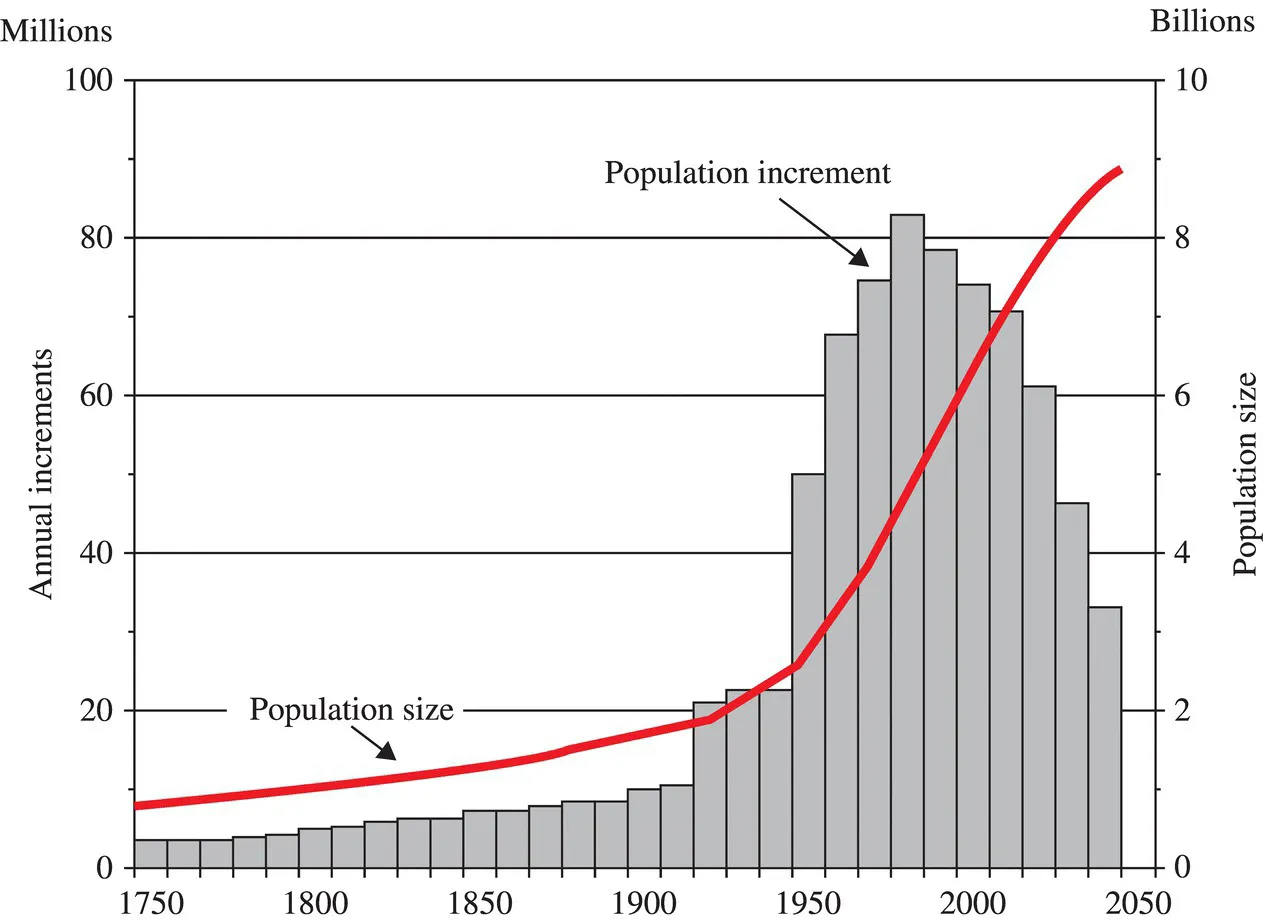
Though it did happen on Earth, the simultaneous occurrence of the conditions that support life as we know it is a very unlikely event, and even here, it is certainly a transient phenomenon. Life on Earth exists over the brief respite (in geological timeline) thanks to a cooling trend between the cauldron of molten metal the Earth was a few billion years back and the sun-scorched inhospitable terrain will turn into a few billion years from now. Even so, life spluttered on intermittently with a series of ice ages, geological upheavals, and mysterious mass extinctions regularly taking their toll on biodiversity. The last of these that occurred some 200 million years ago wiped out over 75% of the species! The resilient barren earth fought back for tens of millions of years to repopulate and reach the present level of biodiversity. Thankfully, the conditions are again just right to sustain life on Earth, with ample liquid water, enough solar energy to allow autotrophs to spin out a food web, a stratospheric ozone layer that shields life from harmful solar UV radiation, enough CO2 to ensure a warm climate, and oxygen to keep the biota alive. We owe life on Earth to these natural cycles in complex equilibrium. However, the apparent resilience of the biosphere to human interference can often be misleading as the dire consequences of human abuse of the ecosystem might only be realized in the long term. Figure 1.1 shows the growth in world population along with 10-year population increments.
Figure 1.1 Projected world population and population increments.
Source: Published with permission from UN Population Division. Reproduced with permission from World at Six Billion. UN Populations Division. ESA/P/WP.154 1999.
Clearly, human populations have already taken liberties with the ecosystem leaving deep footprints on the pristine fabric of nature. Biodiversity, a key metric of the health of the biosphere, is in serious decline; biodiversity fell by 30% globally within the last two decades alone (WWF, 2012). The current extinction rate is two to three orders of magnitude higher than the natural or background rate typical of Earth’s history (Mace et al., 2005). Arable land for agriculture is shrinking (on a per capita basis) as more of the fertile land is urbanized.4 Millions of hectares of land are lost to erosion and degradation; each year, a land area as large as Greece is estimated to be lost to desertification. Increasing global affluence also shifts food preferences into higher levels of the food pyramid. Though Earth is a watery planet, only 3% of the water on Earth is freshwater, most of that too remains frozen in icecaps and glaciers. Freshwater is a finite critical resource, and 70% of it is used globally for agriculture to produce food. Future possible shortage of freshwater is already speculated to spark off conflicts in arid regions of Africa. Evidence of global warming is mounting, there is growing urban air pollution where most live, and the oceans are clearly increasing in acidity due to CO2 absorption. Phytoplankton and marine biota are particularly sensitive to changes in the pH of seawater (Riebesell et al., 2000), and both the ocean productivity as well as its carbon-sink function might be seriously compromised by acidification. Some have suggested this is in fact the next mass extinction since the dinosaurs’ die-off, poised to wipe out the species all over again.5 Is it too late for the human organism to revert back to a sustainable mode of living to save itself from extinction in time before the geological life of the planet ends?
A driving force behind human success as a species is innovation. Starting with Bronze Age toolmaking, humans have steadily advanced their skills to achieve engineering in outer space, building supercomputers and now have arrived at the frontier of human cloning. Human innovative zest has grown exponentially and is now at an all-time high based on the number of patents filed worldwide. Recent inventions such as the incandescent light bulb, printing press, internal combustion engine, antibiotics, stem-cell manipulation, and the microchip have radically redefined human lifestyle.
A singularly important development in recent years is the invention of the ubiquitous plastic material. It was about 60 years back when science yielded the first commodity thermoplastic material. It was an immediate and astounding success with increasing quantities of plastics manufactured each subsequent year to meet the demands of an expanding base of practical applications. There is no argument that plastics have made our lives interesting, convenient, and safe. But like any other material or technology, the use of plastics comes with a very definite price tag.
Mining anything out of the earth creates enormous amounts of waste; about 30% of waste produced globally is in fact attributed to mining for materials. In 2008, 43% of the toxic material released to the environment was due to mining (US Environmental Protection Agency, 2009). For instance, the ...
Table of contents
COVER
TITLE PAGE
TABLE OF CONTENTS
PREFACE
ACKNOWLEDGMENTS
LIST OF PLASTIC MATERIALS
1 THE ANTHROPOCENE
2 A SUSTAINABILITY PRIMER
3 AN INTRODUCTION TO PLASTICS
4 PLASTIC PRODUCTS
5 SOCIETAL BENEFITS OF PLASTICS
6 DEGRADATION OF PLASTICS IN THE ENVIRONMENT
7 ENDOCRINE DISRUPTOR CHEMICALS
8 PLASTICS AND HEALTH IMPACTS
9 MANAGING PLASTIC WASTE
10 PLASTICS IN THE OCEANS
INDEX
END USER LICENSE AGREEMENT
Trusted by 375,005 students
Access to over 1.5 million titles for a fair monthly price.
Study more efficiently using our study tools.
Frequently asked questions
Yes, you can cancel anytime from the Subscription tab in your account settings on the Perlego website. Your subscription will stay active until the end of your current billing period. Learn how to cancel your subscription
No, books cannot be downloaded as external files, such as PDFs, for use outside of Perlego. However, you can download books within the Perlego app for offline reading on mobile or tablet. Learn how to download books offline
Perlego offers two plans: Essential and Complete
Essential is ideal for learners and professionals who enjoy exploring a wide range of subjects. Access the Essential Library with 800,000+ trusted titles and best-sellers across business, personal growth, and the humanities. Includes unlimited reading time and Standard Read Aloud voice.
Complete: Perfect for advanced learners and researchers needing full, unrestricted access. Unlock 1.5M+ books across hundreds of subjects, including academic and specialized titles. The Complete Plan also includes advanced features like Premium Read Aloud and Research Assistant.
Both plans are available with monthly, semester, or annual billing cycles.
We are an online textbook subscription service, where you can get access to an entire online library for less than the price of a single book per month. With over 1.5 million books across 990+ topics, we’ve got you covered! Learn about our mission
Look out for the read-aloud symbol on your next book to see if you can listen to it. The read-aloud tool reads text aloud for you, highlighting the text as it is being read. You can pause it, speed it up and slow it down. Learn more about Read Aloud
Yes! You can use the Perlego app on both iOS and Android devices to read anytime, anywhere — even offline. Perfect for commutes or when you’re on the go. Please note we cannot support devices running on iOS 13 and Android 7 or earlier. Learn more about using the app
Yes, you can access Plastics and Environmental Sustainability by Anthony L. Andrady in PDF and/or ePUB format, as well as other popular books in Technology & Engineering & Chemical & Biochemical Engineering. We have over 1.5 million books available in our catalogue for you to explore.