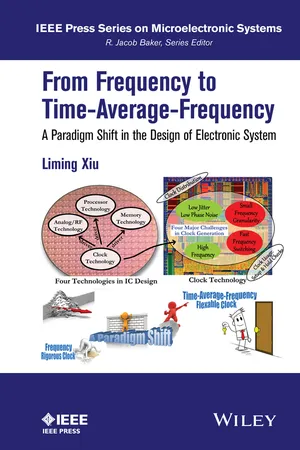
Written in a simple, easy to understand style, this book will teach PLL users how to use new clock technology in their work in order to create innovative applications.
Investigates the clock frequency concept from a different perspective--at an application level
Teaches engineers to use this new clocking technology to create innovations in chip/system level, through real examples extracted from commercial products
Trusted by 375,005 students
Access to over 1.5 million titles for a fair monthly price.
1 IMPORTANCE OF CLOCK SIGNAL IN MODERN MICROELECTRONIC SYSTEMS
1.1 CLOCK TECHNOLOGY: ONE OF THE FOUR FUNDAMENTAL TECHNOLOGIES IN IC DESIGN
Today's typical electronic systems contain millions of electrical signals. They make the system perform what it is designed to do. Among these, the most important one is the clock signal. From an operational perspective, the clock is the timekeeper of the electrical world in a chip/system. From a structural perspective, the clock generator is the heart of a chip; the clock pulse is the heart beat; the clock signal is the blood; and the clock distribution network is the vessel.
The timekeeper has played and is playing a critical role in human life. History shows that the progressive advancement of our civilization is only made possible by the steady refinement of the timekeeper: the clock [Fra11]. The same is true for electronic systems. The purpose of electronic systems is for processing information. The efficiency of performing this task is highly dependent on the time scale used. This time scale is controlled by the clock signal. It has two key aspects: its size (the absolute clock frequency) and its resolution (the capability of differentiating nearby frequencies; resolution can also be viewed as frequency granularity and/or time granularity). In addition, another characteristic is important in the electronic system: the speed at which the time scale can be switched from one to another (the clock frequency switching speed).
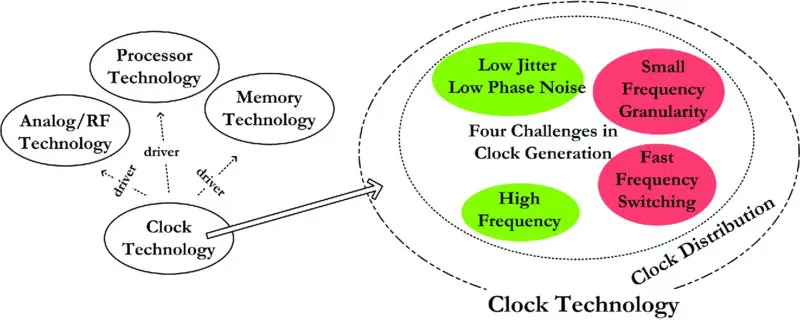
From the day of Robert Noyce [Noy61] and Jack Kirby's [Kil64] first integrated circuit in 1959 to today's systems of billions of transistors on a chip, the art of integrated circuit (IC) design can be roughly individualized into three key areas: processor technology, memory technology, and analog technology. Processor technology focuses its attention on how to build efficient circuits to process information. Using transistors to do logic and arithmetic operations with high efficiency is its highest priority. Memory technology is the study of storing information in a circuit. Its aim is to store and retrieve information in large amounts and at high speed. Analog technology squares its effort at circuits that interface electrical systems with humans (or the world of physical phenomena). Inside electronic systems, information is processed in binary fashion. Once outside, information is used by us in proportional style since our five senses are built upon proportional relationships. The analog circuit is the bridge in between. During the past several decades, advancements in these three circuit technologies have made today's electronic systems very powerful. However, the driver of these three technologies, the clock, has not seen fundamental breakthroughs. The time scale is not flexible: The available clock frequencies are limited and the switching between frequencies is slow. To improve the electronic system's information processing efficiency further, the next opportunity is with the method of clocking: (1) We need a flexible on-chip clock source and (2) and it needs to be available to chip designers at a reasonable cost. Now is the time for clock to be recognized as a technology, as illustrated in Figure 1.1.
Figure 1.1 Clock as a technology.
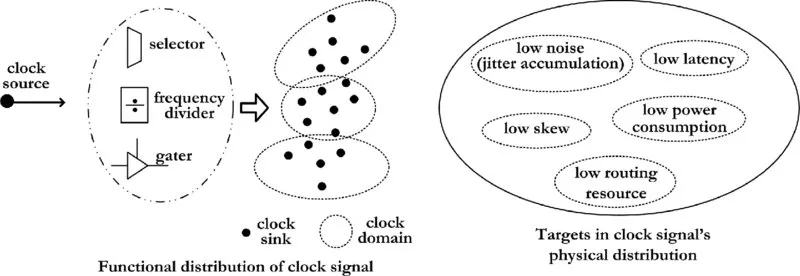
There are four key challenges in the generation of a clock signal: high clock frequency, low noise, small frequency granularity (also loosely referred to as arbitrary frequency generation), and fast frequency switching (also loosely referred to as instantaneous frequency switching). The first two have been studied intensively by researchers. The last two have not drawn much attention. Another challenge lies in distributing the generated clock signal to all the places that require a clock. Clock distribution is a difficult problem both functionally and physically. From a functional perspective, a cell requiring a driving clock might need the clock signal to come from different sources in different operating modes. The logical path from a source to any destination (clock sink) is controlled by the selector, frequency divider, and gater, as illustrated on the left in Figure 1.2. These elements ensure that a clock sink sees the appropriate clock signal at the appropriate time. From a physical point of view, a clock signal from a source might need to be delivered to cells that are spread in a large area. The task of physical distribution has to be carried out with high fidelity (low noise, low skew), small delay (low latency), and low cost (in terms of routing resource and power consumption). These goals are presented on the right-hand side of Figure 1.2.
Figure 1.2 Clock distribution.
Clocking is an important and challenging topic in both academic research and engineering practice. IC clocking is closely tied to the two functions in modern chip design: communication and computation. IC clocking also plays an important role in determining the amount of energy consumed in performing these tasks. There are countless papers dedicated to its study in scientific journals and conference proceedings. It is perhaps the most studied topic in electrical engineering. There are also many books devoted to this area of study; most of them focus on the phase-locked loop (PLL) [Gar05, Bes07, Ega07, Raz03, Fri95]. For those reasons, it is fair to recognize IC clocking as one of the four fundamental circuit design technologies. This book is not focused purely on the PLL, which is only part of the clock story (that of clock signal generation). It addresses the IC clocking issue in a much larger scope: clock frequency, clock generation, clock distribution, and clock application. The essence of this book is to influence the landscape of IC design from the clocking side, starting from the fundamental concept of clock frequency.
1.2 CLOCK SIGNAL GENERATOR: THE KNOWLEDGE-AND-SKILL GAP BETWEEN ITS CREATOR AND ITS USER
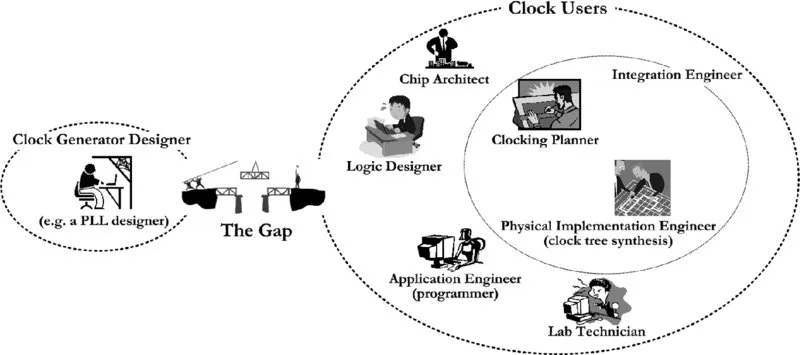
When a clock signal is used in an electronic system, it involves two groups of engineers: designers of the clock generator and users of the clock signal. This scenario is illustrated in Figure 1.3. These two groups possess different knowledge-and-skill sets. The clock generator designer (usually a PLL designer) focuses his or her attention on creating a circuit that produces an electrical pulse train. The main interest in this task is the quality of the pulse train: the available frequency range, the granularity of its frequency, the frequency switching speed, and the amount of noise embedded in the pulses. The key skill required lies in the area of analog circuit design. Understanding the noise generation mechanism in semiconductor devices is also important.
Figure 1.3 Clock signal generator: the gap between its creator and its users.
Clock users can be divided into several subgroups. The chip architect is responsible for designing the chip system. Communication between various parts of the chip, as well as the task of computation, is controlled by the clock signals. Thus, the chip architect must have a solid understanding of how the various clock signals are used to perform the computation and communication tasks in the chip. In some design cases, it is possible to have over 100 clock domains in a large system. All have to be carefully designed by the chip architect. A logic designer helps the chip architect realize the chip functional specifications using hardware description language [such as very high speed integrated circuit (VHSIC) Hardware Description Language (VHDL) and verilog] or higher level system languages. A large amount of simulation must be performed by the logic designer to ensure the correctness of the chip functionality. In such simulations, among perhaps millions of on-chip signals, the clock signal is the most studied one. When something unexpected happens in a simulation, the first signal that the designer turns his or her attention to is usually the clock signal.
Integration engineers receive the chip design in a words-and-diagrams description and turn it into a functioning system represented by metals and semiconductor devices. In this process, clock implementation is a crucial part. Where chip clocking is concerned, the clocking planners take the instructions of the chip architect and turn them into an implementable plan. In this task, the clocking planner needs not only to fulfill functional requirements but also to pay attention to a variety of chip testing concerns. The physical implementation engineer (also called a place-and-route engineer) takes the logical plan from the clocking planner and realizes it using metals and standard cells. This work is commonly termed clock tree synthesis. Finally, the application engineer needs to have a firm grip of the chip's clock structure so that the bare chip ca...
Table of contents
COVER
IEEE PRESS
TITLE PAGE
COPYRIGHT
FOREWORD
PREFACE
ACKNOWLEDGMENT
1 IMPORTANCE OF CLOCK SIGNAL IN MODERN MICROELECTRONIC SYSTEMS
2 EVERYTHING ABOUT THE CLOCK
3 A DIFFERENT WAY OF CONSTRUCTING A CLOCK SIGNAL: TIME-AVERAGE-FREQUENCY
4 TIME-AVERAGE-FREQUENCY AND SPECIAL CLOCKING TECHNIQUES: GAPPED CLOCK, STRETCHABLE CLOCK, AND PAUSIBLE CLOCK
5 MICROELECTRONIC SYSTEM DESIGN IN THE FIELD OF TIME-AVERAGE-FREQUENCY: A PARADIGM SHIFT
6 TAF-DPS CLOCK GENERATOR AND ON-CHIP CLOCK DISTRIBUTION
7 DIGITAL-TO-FREQUENCY CONVERTER: A COMPONENT ENABLING NEW APPLICATION FIELDS
8 CONCLUSION: EVOLUTION OF TIMEKEEPER IN ELECTRICAL WORLD
INDEX
IEEE PRESS SERIES ON MICROELECTRONIC SYSTEMS
EULA
Frequently asked questions
Yes, you can cancel anytime from the Subscription tab in your account settings on the Perlego website. Your subscription will stay active until the end of your current billing period. Learn how to cancel your subscription
No, books cannot be downloaded as external files, such as PDFs, for use outside of Perlego. However, you can download books within the Perlego app for offline reading on mobile or tablet. Learn how to download books offline
Perlego offers two plans: Essential and Complete
Essential is ideal for learners and professionals who enjoy exploring a wide range of subjects. Access the Essential Library with 800,000+ trusted titles and best-sellers across business, personal growth, and the humanities. Includes unlimited reading time and Standard Read Aloud voice.
Complete: Perfect for advanced learners and researchers needing full, unrestricted access. Unlock 1.5M+ books across hundreds of subjects, including academic and specialized titles. The Complete Plan also includes advanced features like Premium Read Aloud and Research Assistant.
Both plans are available with monthly, semester, or annual billing cycles.
We are an online textbook subscription service, where you can get access to an entire online library for less than the price of a single book per month. With over 1.5 million books across 990+ topics, we’ve got you covered! Learn about our mission
Look out for the read-aloud symbol on your next book to see if you can listen to it. The read-aloud tool reads text aloud for you, highlighting the text as it is being read. You can pause it, speed it up and slow it down. Learn more about Read Aloud
Yes! You can use the Perlego app on both iOS and Android devices to read anytime, anywhere — even offline. Perfect for commutes or when you’re on the go. Please note we cannot support devices running on iOS 13 and Android 7 or earlier. Learn more about using the app
Yes, you can access From Frequency to Time-Average-Frequency by Liming Xiu, R. Jacob Baker in PDF and/or ePUB format, as well as other popular books in Technology & Engineering & Electrical Engineering & Telecommunications. We have over 1.5 million books available in our catalogue for you to explore.