- Summarizes for each drug: respective disease area, important properties and SAR (structure-activity relationship), and chemical synthesis routes / options
- Includes case studies in each chapter
- Illustrates how chemistry, biology, pharmacokinetics, and a host of disciplines come together to produce successful medicines
- Explains the advantages of process synthesis versus the synthetic route for drug discovery
- English
- ePUB (mobile friendly)
- Available on iOS & Android
eBook - ePub
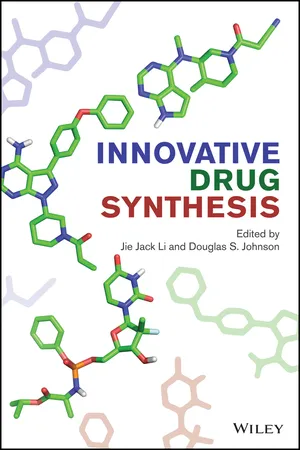
Innovative Drug Synthesis
About this book
This book covers all aspects of the medicinal chemistry of the latest drugs, and the cutting-edge science associated with them. Following the editors' 3 successful drug synthesis books, this provides expert analysis of the pros and cons of different synthetic routes and demystifies the process of modern drug discovery for practitioners and researchers.
Information
Part I
Infectious Diseases
Chapter 1
Entecavir (Baraclude): A Carbocyclic Nucleoside for the Treatment for Chronic Hepatitis B
Jie Jack Li

1 Background
Chronic hepatitis B virus (HBV) infection is a major global cause of morbidity and mortality. An estimated 400 million people worldwide have chronic HBV infection and more than half a million people die every year because of complications from HBV-related chronic liver disease such as liver failure and hepatocellular carcinoma (HCC). In the United States, 12 million people have been infected at some time in their lives with HBV. Of those individuals, more than 1 million people have subsequently developed chronic hepatitis B infection. These chronically infected persons are at highest risk of death from liver scarring (cirrhosis) and liver cancer. In fact, more than five thousand Americans die from hepatitis B-related liver complications each year. In many Asian and African countries where the HBV is endemic, up to 20% of the population may be carriers, and transmission occurs primarily through perinatal or early childhood infection. In some of these areas, the perinatal transmission rate may be as high as 90%!1–4
During the last 10 years, hepatitis B treatment has made significant progresses. For example, two biologics have been approved by the FDA, namely, interferon-α (IFN-α) and Pegylated-interferon-α (PEG-IFN-α). Also on the market are five small molecule antiviral agents for the treatment of chronic HBV, namely, entecavir (1), lamivudine (2), telbivudine (3), adefovir dipivoxil (4), and tenofovir (5).

As a biologic, INF-α is effective only in a subset of patients, is often poorly tolerated, requires parenteral administration, and is expensive. Hence, there is a need for alternative therapies for chronic hepatitis B. The introduction of lamivudine (2) in 1995, the first oral treatment for chronic HBV, ushered in a new era in the treatment of chronic hepatitis B when safe, effective, and well-tolerated oral medications were made available. It is a nucleoside reverse transcriptase inhibitor (NRTI) with activity against both human immunodeficiency virus type 1 (HIV-1) and HBV. It has been used for the treatment of chronic hepatitis B at a lower dose than for the treatment of HIV, and it improves the seroconversion of e-antigen-positive hepatitis B and also improves histology staging of the liver. Unfortunately, long-term use of lamivudine (2) leads to emergence of a resistant HBV mutant (Tyr-Met-Asp-Asp, YMDD). Despite this fact, lamivudine (2) is still used widely as it is well tolerated.5
Telbivudine (3), a synthetic thymidine nucleoside analog, is the unmodified L-enantiomer of the naturally occurring D-thymidine. It prevents HBV DNA synthesis by acting as an HBV polymerase inhibitor. Within hepatocytes, telbivudine (3) is phosphorylated by host cell kinase to telbivudine-5′-triphosphate which, once incorporated into HBV DNA, causes DNA chain termination, thus inhibiting HBV replication. In this sense, telbivudine (3), like most nucleotide antiviral drugs, is a prodrug. Clinical trials have shown telbivudine (3) to be significantly more effective than lamivudine (2) or adefovir dipivoxil (4) and less likely to cause resistance.6
Adefovir dipivoxil (4) was initially developed as a treatment for HIV, but the FDA in 1999 rejected the drug due to concerns about the severity and frequency of kidney toxicity when dosed at 60 or 120 mg, respectively. However, 4 was effective at a much lower dose of 10 mg for the treatment of chronic hepatitis B in adults with evidence of active viral replication and either evidence of persistent elevations in serum alanine aminotransferases (primarily ALT) or histologically active disease. It works by blocking reverse transcriptase, an enzyme that is crucial for the HBV to reproduce in the body. Overall, the efficacy of 4 against wild-type and lamivudine (2)-resistant HBV and the delayed emergence of 4-resistance during monotherapy contribute to the durable safety and efficacy observed in a wide range of chronic hepatitis B patients.7
Tenofovir (5), a nucleotide analog closely related to adefovir dipivoxil (4) has been approved for the treatment of HBV in 2008, subsequent to its approval for the treatment of HIV infection in 2006. In vitro studies showed that it has activity against HBV with equimolar potency to 4. Clinical studies confirmed the efficacy of 5 in suppressing HBV replication, and it appears to be equally effective against both wild-type and lamivudine (2)-resistant HBV. The role of 5 in the rapidly expanding armamentarium of hepatitis B treatments will depend on the demonstration of long-term safety (renal and skeletal) and efficacy against wild-type HBV and HBV mutants that involve substitution of methionine within the YMDD motif, as well as a very low rate of resistance in NA-naïve as well as NA-experienced patients.8–10 NA stands for nucleos(t)ide analog.
The approval of the nucleotide and nucleoside analogs 1–5 marked a significant advance in the treatment of chronic hepatitis B. In comparison to compounds 2–5, entecavir (1) is a nove...
Table of contents
- Cover
- Title Page
- Copyright
- Table of Contents
- Preface
- Contributors
- Part I: Infectious Diseases
- Part II: Cancer
- Part III: Cardiovascular Diseases
- Part IV: CNS Drugs
- Part V: Anti-Inflammatory Drugs
- Part VI: Miscellaneous Drugs
- Index
- End User License Agreement
Trusted by 375,005 students
Access to over 1.5 million titles for a fair monthly price.
Study more efficiently using our study tools.
Frequently asked questions
Yes, you can cancel anytime from the Subscription tab in your account settings on the Perlego website. Your subscription will stay active until the end of your current billing period. Learn how to cancel your subscription
No, books cannot be downloaded as external files, such as PDFs, for use outside of Perlego. However, you can download books within the Perlego app for offline reading on mobile or tablet. Learn how to download books offline
Perlego offers two plans: Essential and Complete
- Essential is ideal for learners and professionals who enjoy exploring a wide range of subjects. Access the Essential Library with 800,000+ trusted titles and best-sellers across business, personal growth, and the humanities. Includes unlimited reading time and Standard Read Aloud voice.
- Complete: Perfect for advanced learners and researchers needing full, unrestricted access. Unlock 1.5M+ books across hundreds of subjects, including academic and specialized titles. The Complete Plan also includes advanced features like Premium Read Aloud and Research Assistant.
We are an online textbook subscription service, where you can get access to an entire online library for less than the price of a single book per month. With over 1.5 million books across 990+ topics, we’ve got you covered! Learn about our mission
Look out for the read-aloud symbol on your next book to see if you can listen to it. The read-aloud tool reads text aloud for you, highlighting the text as it is being read. You can pause it, speed it up and slow it down. Learn more about Read Aloud
Yes! You can use the Perlego app on both iOS and Android devices to read anytime, anywhere — even offline. Perfect for commutes or when you’re on the go.
Please note we cannot support devices running on iOS 13 and Android 7 or earlier. Learn more about using the app
Please note we cannot support devices running on iOS 13 and Android 7 or earlier. Learn more about using the app
Yes, you can access Innovative Drug Synthesis by Jie Jack Li, Douglas S. Johnson, Jie Jack Li,Douglas S. Johnson in PDF and/or ePUB format, as well as other popular books in Physical Sciences & Organic Chemistry. We have over 1.5 million books available in our catalogue for you to explore.