Electrochemical Power Sources (EPS) provides in a concise way the operational features, major types, and applications of batteries, fuel cells, and supercapacitors • Details the design, operational features, and applications of batteries, fuel cells, and supercapacitors • Covers improvements of existing EPSs and the development of new kinds of EPS as the results of intense R&D work • Provides outlook for future trends in fuel cells and batteries • Covers the most typical battery types, fuel cells and supercapacitors; such as zinc-carbon batteries, alkaline manganese dioxide batteries, mercury-zinc cells, lead-acid batteries, cadmium storage batteries, silver-zinc batteries and modern lithium batteries
Batteries are a variety of galvanic cells, that is, devices containing two (identical or different) electron-conducting electrodes, which contact an ion-conducting electrolyte. Batteries are destined to convert the energy of a chemical reaction between solid electrode components into electrical energy providing an electric current (when the circuit is closed) between two not-identical electrodes having different values of the electrode potential (positive and negative terminals). A battery comprises one or several single galvanic cells. In each such cell a comparatively low voltage is generated, typically 0.5–4 V for different classes of cells. Where higher voltages are required, the necessary number of cells is connected in series to form a galvanic battery. Colloquially, the term “battery” is often used to denote single galvanic cells acting as electrochemical power sources as well as groups of single cells. This is retained in this book. Some battery types retain the term “cell” even for groups of single cells (e.g., fuel cell, not fuel battery). The term “cell” is also used when it is necessary to compare different aspects of single-cell and multicell batteries.
1.2 Current-Producing Chemical Reaction
Reactions in batteries are chemical reactions between an oxidizer and a reducer. In reactions of this type, the reducer being oxidized releases electrons while the oxidizer being reduced accepts electrons. An example of such a redox reaction is the reaction between silver oxide (the oxidizer) and metallic zinc (the reducer):
1.1
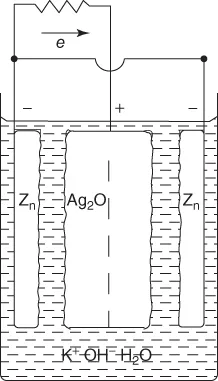
in which electrons are transferred from zinc atoms of metallic zinc to silver ions in the crystal lattice of silver oxide. When reaction (1.1) is allowed to proceed in a jar in which silver oxide is thoroughly mixed with fine zinc powder, no electrical energy is produced in spite of all the electron transfers at grain boundaries. This is because these transfers occur randomly in space and the reaction energy is liberated as heat that can raise the temperature of the reaction mixture to dangerous levels. The same reaction does occur in batteries, but in an ordered manner in two partial reactions separated in space and accompanied by electric current flow (Fig. 1.1).
Figure 1.1 Schematic of a silver–zinc battery.
In the simple case a battery (cell) consists of two electrodes made of different materials immersed in an electrolyte. The electrodes are conducting metal plates or grids covered by reactants (active mass); the oxidizer is present on one electrode, the reducer on the other. In silver–zinc cells the electrodes are metal grids, one covered with silver oxide and the other with zinc. An aqueous solution of KOH serves as electrolyte. Schematically, this system can be written as
1.2
When these electrodes are placed into the common electrolyte enabling electrolytic contact between them, an open circuit voltage (OCV) ε develops between them (here ε = 1.6 V), zinc being the negative electrode. When they are additionally connected by an electronically conducting external circuit, the OCV causes electrons to flow through it from the negative to the positive electrode. This is equivalent to an electric current I in the opposite direction. This current is the result of reactions occurring at the surfaces of the electrodes immersed into the electrolyte: zinc being oxidized at the negative electrode (anode)1
1.3
and silver oxide being reduced at the positive electrode (cathode)
1.4
These electrode reactions sustain a continuous flow of electrons in the external circuit. The OH− ions produced by reaction (1.4) in the vicinity of the positive electrode are transported through the electrolyte toward the negative electrode to replace OH− ions consumed in reaction (1.3). Thus, the electric circuit as a whole is closed. Apart from the OCV, the current depends on the cell's internal resistance and the ohmic resistance present in the external circuit. Current flow will stop as soon as at least one of the reactants is consumed.
In contrast to what occurred in the jar, in the batteries, the overall chemical reaction occurs in the form of two spatially separated partial electrochemical reactions. Electric current is generated because the random transfer of electrons is replaced by a spatially ordered overall process (current-producing reaction).
1.3 Classification
By their principles of functioning, batteries can be classified as follows:
Primary (single-discharge) batteries. A primary battery contains a finite quantity of the reactants participating in the reaction; once this quantity is consumed (on completion of discharge), a primary battery cannot be used again (“throw-away batteries”).
Storage (multiple-cycle) batteries (also called secondary or rechargeable batteries). On the completion of discharge, a storage battery can be recharged by forcing an electric current through it in the opposite direction; this will regenerate the original reactants from the reaction (or discharge) products. Therefore, electric energy supplied by an external power source (such as the grid) is stored in the battery in the form of chemical energy. During the discharge phase this energy is delivered to a consumer independent of the grid. During the charging phase the electrode reactions and the overall current-producing reaction occur in the direction opposite to that during discharge. Thus, these reactions must be chemically reversible (the notion of chemical reversibility must not be confused with that of thermodynamic reversibility). Good rechargeable batteries will sustain a large number of such charge–discharge cycles (hundreds or even thousands). The classification into primary and storage batteries is not rigorous because under certain conditions some primary battery may be recharged and storage batteries after a single use are sometimes discarded.
The silver–zinc battery is a storage battery: after discharge, it can be recharged by forcing through it an electric current in the reverse direction. In this process the two ...
Table of contents
Cover
Series
Title Page
Copyright
Dedication
Foreword
Acknowledgements
Preface
Symbols
Abbrevations
Introduction
Part I: Batteries With Aqueous Electrolytes
Part II: Batteries with Nonaqueous Electrolytes
Part III: Fuel Cells
Part IV: Supercapacitors
Author Index
Subject Index
Series
End User License Agreement
Trusted by 375,005 students
Access to over 1.5 million titles for a fair monthly price.
Study more efficiently using our study tools.
Frequently asked questions
Yes, you can cancel anytime from the Subscription tab in your account settings on the Perlego website. Your subscription will stay active until the end of your current billing period. Learn how to cancel your subscription
No, books cannot be downloaded as external files, such as PDFs, for use outside of Perlego. However, you can download books within the Perlego app for offline reading on mobile or tablet. Learn how to download books offline
Perlego offers two plans: Essential and Complete
Essential is ideal for learners and professionals who enjoy exploring a wide range of subjects. Access the Essential Library with 800,000+ trusted titles and best-sellers across business, personal growth, and the humanities. Includes unlimited reading time and Standard Read Aloud voice.
Complete: Perfect for advanced learners and researchers needing full, unrestricted access. Unlock 1.5M+ books across hundreds of subjects, including academic and specialized titles. The Complete Plan also includes advanced features like Premium Read Aloud and Research Assistant.
Both plans are available with monthly, semester, or annual billing cycles.
We are an online textbook subscription service, where you can get access to an entire online library for less than the price of a single book per month. With over 1.5 million books across 990+ topics, we’ve got you covered! Learn about our mission
Look out for the read-aloud symbol on your next book to see if you can listen to it. The read-aloud tool reads text aloud for you, highlighting the text as it is being read. You can pause it, speed it up and slow it down. Learn more about Read Aloud
Yes! You can use the Perlego app on both iOS and Android devices to read anytime, anywhere — even offline. Perfect for commutes or when you’re on the go. Please note we cannot support devices running on iOS 13 and Android 7 or earlier. Learn more about using the app
Yes, you can access Electrochemical Power Sources by Vladimir S. Bagotsky,Alexander M. Skundin,Yurij M. Volfkovich in PDF and/or ePUB format, as well as other popular books in Technology & Engineering & Power Resources. We have over 1.5 million books available in our catalogue for you to explore.