Addresses a variety of challenges and solutions within the transportation security sphere in order to protect our transportation systems
• Provides innovative solutions to improved communication and creating joint operations centers to manage response to threats
• Details technological measures to protect our transportation infrastructure, and explains their feasibility and economic costs
• Discusses changes in travel behavior as a response to terrorism and natural disaster
• Explains the role of transportation systems in supporting response operations in large disasters
• Written with a worldwide scope
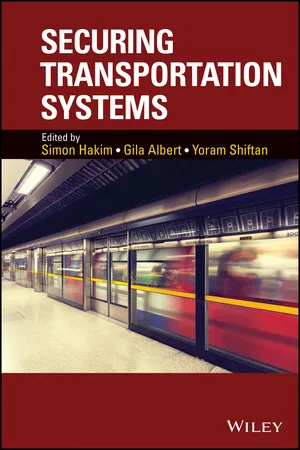
eBook - ePub
Securing Transportation Systems
- English
- ePUB (mobile friendly)
- Available on iOS & Android
eBook - ePub
Securing Transportation Systems
About this book
Information
1
INTRODUCTION
GILA ALBERT1,2, ERWIN A. BLACKSTONE3, SIMON HAKIM3, AND YORAM SHIFTAN4
1 The Ran Naor Foundation for the Advancement of Road Safety Research, Hod Hasharon, Israel
2 Faculty of Technology Management, HIT – Holon Institute of Technology, Holon, Israel
3 Center for Competitive Government, Fox School of Business & Management, Temple University, Philadelphia, PA, USA
4 Transportation Research Institute, Technion – Israel Institute of Technology, Haifa, Israel
1.1 OVERVIEW
Transportation systems are essential infrastructures for economic vitality, growth, and well-being throughout a country. These systems including airports, water ports, highways, tunnels and bridges, rail, and mass transit are inherently vulnerable to terrorist attacks, which dreadfully became an agonizing reality in the post-9/11 era. They might face various threats, namely, biological, chemical, nuclear (dirty bombs), cyber, and natural disaster. In fact, transportation systems continue to be a prime terrorist target (Carafano 2012).
Surface transportation is a soft target, offering terrorists relatively uncomplicated access and easily penetrable security measures. In addition, the large crowds at surface transportation facilities guarantee the attackers effectiveness and anonymity and facilitate their escape (Jenkins 2003; Potoglou et al. 2010). Therefore, terrorist attacks on various transportation systems are perceived an “efficient” means to hurt any civilization at its “soft belly.”
Transportation systems are also essential for evacuation when a natural disaster, a terrorist attack, or a man-made failure occurs. All types of emergency response depend on the availability of functional roads and transportation assets (Edwards and Goodrich 2014). Efficient and effective evacuation can significantly mitigate the catastrophe consequences and therefore serves as one of the most promising means for response and recovery from such destructive incidents.
Terrorist attacks could lead to immediate and long-term catastrophic consequences. Terror, like other forms of disaster, could trigger adaptive behavior that reduces the risk of being involved in such a tragedy (Elias et al. 2013; Floyd et al. 2004; Kirschenbaum 2006). However, the changes in travel behavior may have broad and short- and long-term effects. In the short run, travelers may adopt new behavior, including changes in travel mode, routes, and destinations and even canceling some activities and postponing others (Elias et al. 2013; Exel and Rietveld 2001; Floyd et al. 2004; Holguin-Veras et al. 2003; Kirschenbaum 2006; Potoglou et al. 2010). Long-term effects may include a decrease in the market share of specific travel modes that are perceived as less secure (e.g., public bus transportation) and thereby may indirectly affect land-use patterns (Exel and Rietveld 2001; Holguin-Veras et al. 2003; Polzin 2002). Such changes can also impact ancillary industries dependent upon the affected modes of travel.
Security considerations may result in a multitude of changes in the planning, design, implementation, and operation of transportation systems (Holguin-Veras et al. 2003; Polzin 2002; Potoglou et al. 2010). In addition, they may affect financing and investments in transportation system security, which are an important tool available to decision- and policy makers in response to terrorist incidents (Polzin 2002; Sandler and Enders 2004). In this regard, the aviation security model and its security procedure in the post-9/11 era are not applicable to surface transportation, which cannot be protected in the way commercial aviation is protected. Trains and buses must remain readily accessible, convenient, and inexpensive (Jenkins 2001; Potoglou et al. 2010).
The objective of security procedures is to reach the level of security that will maximize net social benefits from the use of each transportation mode. It is recognized that various security procedures that relate to surface transportation may affect travelers’ privacy and freedom (Potoglou et al. 2010). Therefore, transit agencies and security authorities have to consider the trade-off between security, mobility, and freedom and the expected negative effects of an attack. Policy-maker should evaluate the overall costs of security precautions, the decline in service, and the adverse privacy consequences in comparison to the expected damage of an attack. The latter may be evaluated by the cost of various potential attacks multiplied by their probability of occurrence. No doubt, planning for prevention, deterring, response, and recovery of transportation infrastructures as well as resource allocation and priority setting is a major consideration of professionals and decision makers.
This chapter provides a comprehensive assessment of timely and challenging issues in securing transportation systems against various types of terror attacks and deals with the role of transportation networks in evacuation. It presents “state-of-the-art” efforts to improve technological and managerial security during and after natural disasters and incorporates some insights from this book.
The chapter reviews recent terror incidents targeting transportation modes and infrastructure. It also incorporates research findings on terrorist motivation and response to terrorist attacks. Then, the chapter discusses the role of efficient transportation in large-scale evacuation. The following section presents potential solutions, mainly technological and managerial improvements of how to deter, prevent, and detect these attacks and recover from severe consequences. Then, we discuss the role of not-for-profit volunteers and the private sector in securing transportation systems. The chapter concludes with evaluation issues and policy implications.
1.2 MAJOR TERRORIST ATTACKS TARGETING TRANSPORTATION SYSTEMS
Terror threats to transport systems and related infrastructure have become an agonizing reality. Before 9/11, isolated incidents all over the world may have appeared to be random: major terrorist attacks between the years 1920 and 2000 targeted surface transportation, mainly trains and buses, with bombing being the most common tactic (Jenkins 2003 ). This trend significantly increased after 9/11.
Lethal terror attacks on public transportation facilities occurred in the post-9/11 era in various countries. The March 2004 Madrid train bombing, the July 2005 London Underground and double-decker bus bombing, the July 2006 Mumbai train bombing, and the Moscow Metro bombing in March 2010 are all examples of the vulnerability of public transportation system and the catastrophic consequences of these attacks. At the end of 2013, three bomb attacks targeting mass transportation occurred in the city of Volgograd in southern Russia. In October 2013, suicide bombing took place on a bus; on December 29, 2013, at a railway station; and a day later, on a trolley bus. Overall, at least 40 innocent people were killed in these three attacks on Russian transportation.
Fortunately, some terrorist plots targeting subways and trains were averted: London in 2002 and 2003, Sydney in 2005, Milan in 2006, and Barcelona in 2008. New York City prevented two alleged terror attempts in recent years. In July 2006, the FBI announced that it had foiled a plot by foreign militants that was in its “talking phase” to detonate explosives in tunnels connecting New Jersey and Manhattan; and on May 1, 2010, a car bomb was discovered in Times Square. Indeed, New York’s subway system, which is uniquely attractive to terrorists, has repeatedly been the focus of briefings by counterterrorism agencies.
Israel’s surface transportation has continuously been a main target of terror attacks since the establishment of the state in 1948. In the period 1994–2006, 17 severe terror attacks occurred on Israeli public buses and such related infrastructures as bus stations, with each attack resulting in 10 or more fatalities and dozens of injuries (Butterworth et al. 2012; Johnston 2010). In Jerusalem, the capital of Israel, 117 citizens were killed in transportation-related terror attacks, and more than 770 were injured between 2001 and 2003. However, the Israeli experience especially during the Second Uprising (Intifada), which started in September 2000 and lasted through the end of 2006, enabled training drivers and employees in preventing disasters and minimizing damages and caused changes in traveler behavior. Damages were also mitigated because the terrorists employed poor tactics and lacked professional bomb-making skills (Butterworth et al. 2012).
1.2.1 Terrorist Ideology and Tactics
Review of major terror attacks suggests that certain types of attacks are “preferred” by terrorists since they are considered “more fit” or “more legal.” Conventional wisdom asserts that terror acts stem from political, social, and economics causes. However, as Bar (2004 ) stated, it cannot be ignored that most devastating global terrorist attacks have been perpetrated in the name of Islam (Bar 2004). Moreover, as Bar further discusses in Chapter 2, the body of Islamic rulings relating to justification of modern mass killing of civilians serves as the guideline for many Islamic terror acts.
The Islamic terrorism takes into account its religious roots, the rulings of Islamic law (shari’ah), and the outline of Islamic legal experts (fatwas). The history of Islamic terrorism involved various tactics, while terrorists choose the course of action very carefully. Agonizingly somehow, the 9/11 terror attacks seem to indicate the end of the of aircraft hijackings, most probably due to the rigorous and robust changes in security practices at airports.
The maritime terrorism threat, although low in volume, is a worrisome contingency due to its vast and largely global, unregulated, and opaque nature (Szylionwicz and Zamparini 2013). Between the years 1967 and 2007, only 0.9% of terrorist attacks in the United States involved maritime transport (Nowacki 2014) and in the past 15 years only 2% of all terrorist attacks around the world (Roell 2009). These attacks target both passenger vessels and containerized shipping (RAND Database of Worldwide Terrorism Incidents 2014) or “choke points” and mega harbors (Roell 2009). Several initiatives and regulations have been developed in the United States post-9/11 including “Automated Targeting System” (ATM), “Container Security Initiative” (CSI), and “Security and Accountability for Every Port Act” (SAFE) as described in Chapter 12 of this book by Price and Hashemi. Many initiatives have been adopted worldwide, such as the Proliferation Security Initiative (launched by the United States in 2003), a global effort to stop the trafficking of weapons of mass destruction that was endorsed by over 100 nations (Bureau of International Security and Nonproliferation 2014).
The suicide attacks targeting surface transportation, mainly trains, subways, and train stations, seem to be an increasing tactic in the post-9/11 era. The improved explosive devices used by terrorists lead to greater lethality (MIPT 2007; RAND Database of Worldwide Terrorism Incidents 2014). Shmuel Bar concludes in his chapter in this book that to combat the radical trend in Islam what may be necessary is a “Kulturkampf” of the orthodoxy against the radicals, but in the short run, the Western political and legal arsenal needs to adapt itself to the existence of a religious war.
Transportation, and especially surface transportation, need to be highly accessible and will remain a soft target for terrorists. These systems may face various additional threats, namely, biological, chemical, nuclear (dirty bombs), and cyber.
The main challenge is therefore to evaluate and develop a long-term strategy to cope with potential, rather than current, threats. In this regard, special consideration should be given to the threat of cyber.
1.2.2 Cyberterrorism
Cybersecurity, a concept that was first used by computer scientists in the early 1990s to underline a series of insecurities related to networked computers, has moved beyond to threats arising from digital technologies, innovations, and changing geopolitical conditions (Nissenbaum 2005 ; Nissenbaum and Hansen 2009).
Although terrorists still employ the traditional tactics, they may target information technology and networking by creating damages to their applications and respective infrastructures (Janczewski and Colarik 2008). Cyberterrorism can be defined as the intentional use of computer, networks, and the Internet to cause destruction and harm (Matusitz 2005). Terrorists can convey encrypted messages, recruit supporters, acquire targets, gather intelligence, camouflage activity, etc., with only limited risk to the attacker. This limited risk is a function of difficulties in distinguishing between a simple malfunction and an attack, in connecting an event with a result, in tracking the source of the attack, and in identifying the attacker; the widespread use of in...
Table of contents
- COVER
- TITLE PAGE
- TABLE OF CONTENTS
- CONTRIBUTORS LIST
- FOREWORD
- PREFACE
- 1 INTRODUCTION
- SECTION I: MOTIVATION AND CHALLENGES
- SECTION II: SECURITY CONSIDERATION FOR MODES OF TRANSPORTATION
- SECTION III: THE ROLE OF TRANSPORTATION IN EVACUATION
- INDEX
- END USER LICENSE AGREEMENT
Trusted by 375,005 students
Access to over 1.5 million titles for a fair monthly price.
Study more efficiently using our study tools.
Frequently asked questions
Yes, you can cancel anytime from the Subscription tab in your account settings on the Perlego website. Your subscription will stay active until the end of your current billing period. Learn how to cancel your subscription
No, books cannot be downloaded as external files, such as PDFs, for use outside of Perlego. However, you can download books within the Perlego app for offline reading on mobile or tablet. Learn how to download books offline
Perlego offers two plans: Essential and Complete
- Essential is ideal for learners and professionals who enjoy exploring a wide range of subjects. Access the Essential Library with 800,000+ trusted titles and best-sellers across business, personal growth, and the humanities. Includes unlimited reading time and Standard Read Aloud voice.
- Complete: Perfect for advanced learners and researchers needing full, unrestricted access. Unlock 1.5M+ books across hundreds of subjects, including academic and specialized titles. The Complete Plan also includes advanced features like Premium Read Aloud and Research Assistant.
We are an online textbook subscription service, where you can get access to an entire online library for less than the price of a single book per month. With over 1.5 million books across 990+ topics, we’ve got you covered! Learn about our mission
Look out for the read-aloud symbol on your next book to see if you can listen to it. The read-aloud tool reads text aloud for you, highlighting the text as it is being read. You can pause it, speed it up and slow it down. Learn more about Read Aloud
Yes! You can use the Perlego app on both iOS and Android devices to read anytime, anywhere — even offline. Perfect for commutes or when you’re on the go.
Please note we cannot support devices running on iOS 13 and Android 7 or earlier. Learn more about using the app
Please note we cannot support devices running on iOS 13 and Android 7 or earlier. Learn more about using the app
Yes, you can access Securing Transportation Systems by Simon Hakim, Gila Albert, Yoram Shiftan, Simon Hakim,Gila Albert,Yoram Shiftan in PDF and/or ePUB format, as well as other popular books in Politics & International Relations & Terrorism. We have over 1.5 million books available in our catalogue for you to explore.