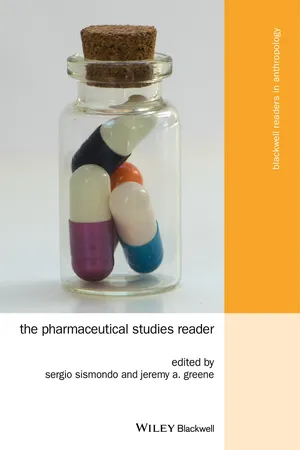
Why Study Pharmaceuticals?
The evolution of the modern pharmaceutical industry over the 20th century—from its early intersection with the image and later the structure of scientific research, to its dramatic post-WWII expansion and late-century saturation of medical and marketing media—has implications stretching far beyond medicine and business. That evolution has involved and affected much broader social, cultural, economic, and political developments. Pharmaceuticals are not merely used by doctors to control objective diseases, by patients to control subjective symptoms, or by manufacturers and marketers to control lucrative markets. Their uses and meanings are fluid and take shape at the intersection of many interests and disciplines.
Prescription drugs embody our ardent hopes in biomedical futures (for relief of suffering and prevention of morbidity and mortality) and also great fears (of medicalization, medical control, and side effects). Lurking in every capsule or tablet is a version of the pharmakon analyzed by Jacques Derrida—a thing that is both cure and poison.1 But the pharmaceutical does not simply collapse into this binary alone. Drugs take on value because they simultaneously alter the chemistry and biology of our bodies, the expectations and categorization of our experiences, and the potentialities and networks of our social relations.
In the past decade, a number of ethnographic and historical studies, speaking to very different audiences, have framed pharmaceuticals as an ideal “sampling device” to study the interactions of medical science, clinical practice, consumerism, culture, industry, and the marketplace in the 20th and early 21st centuries. This volume draws together seventeen important works from this field over the past decade to give an introduction to this robust and vital new field of study.
We use the term “pharmaceutical studies” to encompass these humanistic and social scientific studies of prescription drugs.2 From the point of view of the anthropologist, historian, sociologist or philosopher, a pharmaceutical can serve as a narrative device for exploring the politics, economics, cultures, and beliefs that potentiate and sustain its use. It can serve as a tracer tool that can be used to elaborate complex global flows of knowledge, capital, and people. Any pharmaceutical on the market today has been the focus of intense research and marketing efforts, expert regulation, and vernacular interest. It is an object that mediates borders between medical science and popular belief, health and disease, and spheres of licit and illicit. It is also—unlike other interesting biomedical matters such as research protocols, standards, or ethical codes—always a thing, a part of the material world invested with specific forms of value and stamped with highly regulated forms of knowledge. In their varied approaches to studying such “informed materials,” scholars working in the area of pharmaceutical studies both demonstrate the interdisciplinarity of science and technology studies (STS) and illustrate some of the field’s broader problematics.3
This volume cannot claim to present a synthesis of all of the important new research in the expanding field of pharmaceutical studies. On the one hand, economic analyses of pharmaceutical markets, ethics, adverse effects, or speculative innovations continue to fill pages in a number of dedicated and general journals on a monthly basis. On the other hand, a steady stream of exposé journalism—some highly nuanced, some crude—documents the role of the pharmaceutical industry in gouging consumers, selling sickness, exploiting research subjects, and selling life-saving drugs at prices that are inaccessible to many who would benefit from them. In selecting the contributions to this volume, however, we have chosen research that highlights social relations often obscured by conventional narratives of triumph and tragedy, of assumed biomedical realism, or conversely of the fabrication of disease by pharmaceutical marketing. We wish to show the value of an STS approach to describing important transformations of biological and social worlds brought about by developments in the field of pharmaceuticals.4 The STS approach opens the door for analyses of drugs in both social and biological environments, by situating the scientific, organizational, and rhetorical work to produce a successful (or failed) pharmaceutical in these contexts. There can be no pharmaceuticals without that work: bare molecules do not become pharmaceuticals without ties to health concerns, scientific knowledge, appropriate regulation, effective marketing, and receptive prescribers and publics. Therefore, while there are many potential fields and areas of pharmaceutical studies, this volume focuses on those that draw from close empirical attention to key social contexts. We have chosen some exemplary articles that illuminate the multiple and complex social connections that pharmaceutical studies can make visible.
A Prehistory of Pharmaceutical Studies
It is not a new thing to argue that one can learn much about a society by studying how it tries to cure what ails it. Critical writings about Western therapeutics have been connected to broader forms of social critique for centuries. When, in June of 1527, the young Phillippus Aureolus Theophrastus Bombastus von Hohenheim, later known as Paracelsus, publicized his critique of the Galenic pharmacopoeia in favor of the more rational therapeutics of chemical pharmacy, he burned books of Galen and Avicenna on the front steps of the University of Basel, just as Martin Luther had burned a papal bull a few years earlier on the front steps of the Elster Gate of Wittenberg. Likewise, the acerbic pen of the mid-19th century Boston physician and social commentator Oliver Wendell Holmes was appealing to broader popular critiques of orthodoxy when he stated that “I firmly believe that if the whole materia medica, as now used, could be sunk to the bottom of the sea, it would be all the better for mankind, and all the worse for the fishes.”
The popular genre of therapeutic skepticism grew in size and scope over the 20th century, coincident with the growth of the principal firms that now constitute the global pharmaceutical industry. The work of investigative journalists Samuel Hopkins Adams and Ida Tarbell helped build popular support for the passage of what became the 1906 Pure Food and Drugs Act, which founded the US Food and Drug Administration and the modern age of pharmaceutical regulation in the United States. This lineage of pharmaceutical muckraking can be traced through the middle of the 20th century to a burgeoning genre of literature in the early 21st century and is closely related to the growth of the consumer movements in Europe, North America, Latin America, and Southeast Asia.5 Such critical accounts have been matched by an equally popular series of paeans to medical progress, including a host of popular works that continue to celebrate the forward march of the pharmaceutical industry.6 Already by the middle of the 20th century, much popular and scholarly literature on the role of pharmaceuticals in society was heavily polarized between triumphalist and muckraker accounts. One might switch from one ideological position to another—as did journalist Milton Silverman somewhere between his rose tinted Magic in a Bottle (1943) and his much darker Prescriptions for Death (1982) —but relatively few authors found suitable space between the two camps.7
Into this highly polarized field, a few islands of nuanced empirical scholarship on the role of pharmaceuticals in society have developed in the past 50 years. In 1959, the young sociologist Renée Fox—a student of Talcott Parsons who would go on to become perhaps the leading medical sociologist of her generation—published her first book, Experiment Perilous: Physicians and Patients Facing the Unknown, a multilayered account of uncertainty in the ethics and practice of innovative pharmaceutical rese...