There has never been so much pressure on nonprofit boards of directors to achieve a level of accountability that meets public and stakeholder expectations. Member-serving association boards may be especially challenged by their more complex affiliate structures and a greater emphasis on representative governance. But what does the journey to good governance look like? Markedly different from existing board development books, this modern approach focuses less on the behaviors and qualities of "high-performing boards" and more on the stages and processes that directors and their staff used to transform their boards. Based on research funded by the ASAE Foundation, the book fills a gap in the governance literature by emphasizing diagnosis and problem solving, using the actual tools and activities implemented by 85 transformed associations. Combining the credibility of scholarly research with lively and compelling stories, tools, and teachable moments, this book is designed to help associations and other nonprofit organizations achieve the entire journey to good governance, from first to last steps.
eBook - ePub
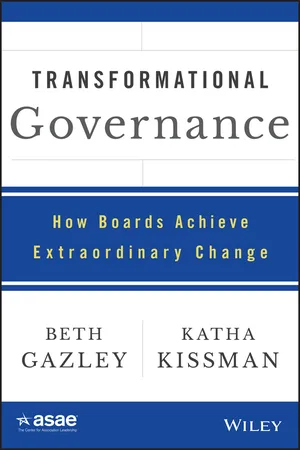
Transformational Governance
How Boards Achieve Extraordinary Change
- English
- ePUB (mobile friendly)
- Available on iOS & Android
eBook - ePub
About this book
Information
1
Where Does Board Change Begin?
The path to our destination is not always a straight one.We go down the wrong road, we get lost, we turn back.Maybe it doesn't matter which road we embark on.Maybe what matters is that we embark.—Barbara Hall, writer and producer
Every change starts with a thought, and very often, the thought is framed as a question:
- Why isn't this working?
- How can we make something better?
- What if we did this differently?
In nonprofit governance, the critical point when change begins can arise out of challenges—situational or chronic—to a board's performance. A board member may think:
- “Something is not right on this board.”
- “Why can't we get more done?”
- “I like serving on this board except for _____________.”
- “I'm not making a difference. Perhaps I should resign.”
- “Why do my ideas seem so out of place?”
- “Everyone keeps telling me, ‘We've always done it this way….’”
Our interviews found that association CEOs and board members shared similar thoughts to these. Even when the cause was hard to pin down, expressing the thought helped get the conversation started:
- “There were problems. You would hear things.”
- “When I was hiring, prospective staff would ask specific questions about board involvement.”
- “It had been brewing under the surface.”
- “We had organizational misalignment.”
- “The board was not able to make decisions.”
- “We were losing members.”
- “The board was exhausted.”
In other instances, our interview subjects clearly knew where problems resided:
- “All the decisions were being made in the back room.”
- “The board was spending all its time on ‘administrivia.’”
- “In learned societies the board chair is the highest person in the field at the time and it's an honorific.”
- “The board spent a lot of time discussing issues that weren't really in their purview.”
- “There was no direction. We were living in the past. We were the world's largest association of x—and we were stuck.”
- “It was an operational board. We had budget meetings that lasted eight to 12 hours. We had board discussions about how to price a manual.”
From the awareness that something is not right comes intention to do something about it. Researcher and lecturer Joe Dispenza observes, “Intention involves directing the mind, with purpose and efficacy, toward some object or outcome.” Moving from awareness of a need to a plan of action—to planned change—is important to successful change because it's the only way to maintain control over the outcome. This book, after all, is about creating the change we want by taking action, avoiding the change we don't want by simply letting it happen.
Concepts and Application
What kind of change can happen at the board level when problems are not addressed? What are the risks of passivity, of thinking these problems will work themselves out on their own, perhaps through board member turnover? One probable outcome is that the most valuable people, who recognize the problems, get frustrated and quit.
Comparing responses from ASAE's 2013 Governance Survey, we find that the cost of doing nothing is pretty scary. Association executive directors were much more likely to consider quitting when they worked for associations with boards they judged to be low performing (Gazley and Bowers 2013). The lowest-ranked associations also had twice the turnover in other executive staff compared to associations with high-performing boards.
Like staff, board members also vote with their feet. High-performing association boards had more stable board memberships. But associations with low-performing boards were three times as likely to report either greater or less-than-optimal board member turnover. They were twice as likely to report difficulty in recruiting new board members. And these associations had much weaker membership and fiscal health.
Table 1.1 Comparison of High- and Low-Performing Boards (2013 ASAE Governance Survey)
| Top 25% of Ranked Association Boards, Based on CEO Board Performance Rating | Bottom 25% of Ranked Association Boards, Based on CEO Board Performance Rating | Total Average of All Boards (n = 1,585) | |
| CEO intends to leave | 37% | 54% | 44% |
| High staff turnover, affecting more than half of key positions | 8% | 18% | 12% |
| Board has greater turnover than optimal | 3% | 10% | 6% |
| Board has less turnover than optimal | 9% | 31% | 17% |
| Difficult to recruit board members | 49% | 85% | 66% |
| Association membership is growing | 48% | 24% | 36% |
| Association budget is growing | 55% | 33% | 46% |
| Association membership is shrinking | 16% | 38% | 25% |
| Association budget is shrinking | 16% | 30% | 21% |
These data also suggest that the first sign of a need for board change may not be self-evident, but may emerge as something entirely different. Without initially connecting the problem to leadership, the organization may recognize that it is not healthy financially, or that internal processes don't seem to be working. From our interviews, we heard:
- “Membership was flat; programs were not growing.”
- “I met with the board chair, and we both expressed dissatisfaction with my annual review process. So we began to have this discussion….”
- “There had been a number of short-term strategic plans. It was easy to kick the can down the road. We would take markers, not hit them, and then do a new strategic plan. There was frustration at not being able to grow.”
- “Our industry was at a crossroads.”
- “It was clear to me that one of the reasons for the financial crisis was rooted in the structure and function of the board of directors. The organization was basically not doing anything but spinning in a circle, depending on who was pulling the hardest.”
- “We did not have productive relationships with our colleague associations.”
- “There was growing member concern about _____________” [safety, growth, professionalization, fiscal health, relevancy, etc.].
Understanding the Nature of Change
As Tom Peters so succinctly put it, “Innovate or die.” Governance leaders can benefit from understanding theories of change generally, which can then be applied to the context of boards and governance systems. Todd Jick writes in Managing Change (1993) that there are no surefire instructions for successful change. But the process of change has some common characteristics—and that's where theo...
Table of contents
- Cover
- Title Page
- Copyright
- Foreword
- Acknowledgments
- Introduction and Study Design
- Chapter 1: Where Does Board Change Begin?
- Chapter 2: Change and People
- Chapter 3: Catalysts and Watersheds
- Chapter 4: Implementing Change
- Chapter 5: Leading Sideways: Influencing Change within the Board
- Chapter 6: Leading Up: The CEO’s Opportunity
- Chapter 7: Leading Forward: The Board Chair's Opportunity
- Chapter 8: Working with External Consultants
- Chapter 9: Getting the Most from Assessment and Evaluation
- Conclusion: Strategies and Resources for Success
- Appendix: Tools and Resources
- References
- About the Authors
- Index
- End User License Agreement
Trusted by 375,005 students
Access to over 1.5 million titles for a fair monthly price.
Study more efficiently using our study tools.
Frequently asked questions
Yes, you can cancel anytime from the Subscription tab in your account settings on the Perlego website. Your subscription will stay active until the end of your current billing period. Learn how to cancel your subscription
No, books cannot be downloaded as external files, such as PDFs, for use outside of Perlego. However, you can download books within the Perlego app for offline reading on mobile or tablet. Learn how to download books offline
Perlego offers two plans: Essential and Complete
- Essential is ideal for learners and professionals who enjoy exploring a wide range of subjects. Access the Essential Library with 800,000+ trusted titles and best-sellers across business, personal growth, and the humanities. Includes unlimited reading time and Standard Read Aloud voice.
- Complete: Perfect for advanced learners and researchers needing full, unrestricted access. Unlock 1.5M+ books across hundreds of subjects, including academic and specialized titles. The Complete Plan also includes advanced features like Premium Read Aloud and Research Assistant.
We are an online textbook subscription service, where you can get access to an entire online library for less than the price of a single book per month. With over 1.5 million books across 990+ topics, we’ve got you covered! Learn about our mission
Look out for the read-aloud symbol on your next book to see if you can listen to it. The read-aloud tool reads text aloud for you, highlighting the text as it is being read. You can pause it, speed it up and slow it down. Learn more about Read Aloud
Yes! You can use the Perlego app on both iOS and Android devices to read anytime, anywhere — even offline. Perfect for commutes or when you’re on the go.
Please note we cannot support devices running on iOS 13 and Android 7 or earlier. Learn more about using the app
Please note we cannot support devices running on iOS 13 and Android 7 or earlier. Learn more about using the app
Yes, you can access Transformational Governance by Beth Gazley,Katha Kissman in PDF and/or ePUB format, as well as other popular books in Business & Nonprofit Organizations & Charities. We have over 1.5 million books available in our catalogue for you to explore.