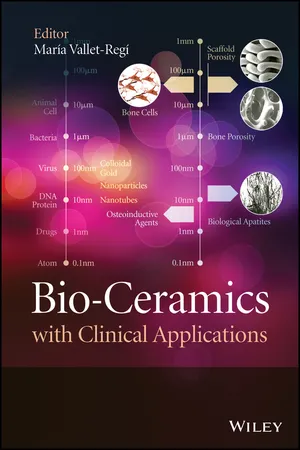
This publication offers a unique approach that links the materials science of bioceramics to clinical needs and applications.
Providing a structured account of this highly active area of research, the book reviews the clinical applications in bone tissue engineering, bone regeneration, joint replacement, drug-delivery systems and biomimetism, this book is an ideal resource for materials scientists and engineers, as well as for clinicians.
From the contents:
Part I Introduction
1. Bioceramics 2. Biomimetics
Part II Materials
3. Calcium Phosphate Bioceramics 4. Silica-based Ceramics: Glasses 5. Silica-based Ceramics: Mesoporous Silica 6. Alumina, Zirconia, and Other Non-oxide Inert Bioceramics 7. Carbon-based Materials in Biomedicine
Part III Material Shaping
8. Cements 9. Bioceramic Coatings for Medical Implants 10. Scaffold Designing
Part IV Research on Future Ceramics
11. Bone Biology and Regeneration 12. Ceramics for Drug Delivery 13. Ceramics for Gene Transfection 14. Ceramic Nanoparticles for Cancer Treatment
Departamento de Química Inorgánica y Bioinorgánica, Facultad de Farmacia, Universidad Complutense de Madrid, CIBER de Bioingeniería, Biomateriales y Nanomedicina (CIBER-BBN), Spain
1.1 Introduction
Ceramic materials are important sources of biomaterials for applications in biomedical engineering. Those ceramics intended to be in contact with living tissues are called bioceramics, and have experienced great development in the last 50 years. The medical needs of an increasingly aging population have driven a great deal of research work looking for new materials for the manufacture of implants. These are used to regenerate and repair living tissues damaged by disease or trauma. For specific clinical applications, mainly in orthopedics and dentistry, bioceramics are playing a key role.
In general, ceramics are inorganic materials with a combination of ionic and covalent bonding. The use of new ceramic materials represents an evolution of many aspects of mankind history. Many millennia ago, the possibility to store grains in ceramic receptacles allowed man to become a settler instead of a nomad hunter. Some centuries ago, the use of structural ceramics also brought great advances in the quality of life of man with the possibility of making clay bricks and tiles. Decades ago, ceramics produced a new revolution in the human way of life, with the development of functional ceramics in dielectrics, semiconductors, magnets, piezoelectrics, high temperature superconductors, and so on. In addition, ceramics have played an important role in improving the quality and length of human life through their use in biomaterials and medical devices.
As observed, the investigation of bioceramics has also evolved when, as will be explained later, more restrictive properties for the new ceramics were required. Thus, alumina, zirconia, calcium phosphates, and certain glasses and glass-ceramics are genuine examples of bioceramics. Figure 1.1 shows a classification of bioceramics according to their reactivity and their main clinical applications. Carbon is an element, not a compound, and conducts electricity in its graphite form, but it is considered a ceramic because of its many ceramic-like properties. Nowadays, new advanced bioceramics are under study, including ordered mesoporous silica materials or specific compositions of organic–inorganic hybrids.
Figure 1.1 Classification of bioceramics according to their reactivity. Particle size, crystallinity, and porosity are important factors to classify certain bioceramics, like apatites, in one group or the other. HA: hydroxyapatite, HCA: hydroxycarbonate apatite, A-W: apatite–wollastonite, TCP: tricalcium phosphate, OCP: octacalcium phosphate, DCPA: dicalcium phosphate anhydrous, DCPD: dicalcium phosphate dihydrate, TetCP: tetracalcium phosphate monoxide (See insert for color representation of the figure)
Ceramic materials have high melting temperatures, low conduction of electricity and heat and relatively high hardness. With regards to their mechanical behavior, ceramic materials exhibit great compression strengths and very much lower tensile strengths. Moreover, they are stiff materials, with high Young's modulus, and brittle because failure takes place without plastic deformation.
In relation to their surface properties, ceramics show high wetting degrees and surface tensions which favor the adhesion of proteins, cells, and other biological moieties. Furthermore, a ceramic surface can be treated to reach very high polish limits. Currently, as will be explained latter, much research effort is devoted to ceramics with interconnected porosity and in these cases the mechanical properties will change drastically.
Nowadays, it is possible to manufacture implants to replace any part of our body, except the brain.
Obviously, different types of materials are in use depending on the tissue to be replaced. Regarding the materials to be used, it is critical to bear in mind that a group of biomaterials will be applied in body reconstruction functions, hence they must perform their duty for an undefined period of time, that is, for the rest of the patient's life. Another group of biomaterials will be used in temporary body support functions. This “permanent” or “temporary” feature allows for a larger and better choice of materials for implant manufacture.
1.2 Reactivity of the Bioceramics
Many different factors affect the reactivity of any chemical substance and greatly determine its reaction kinetics. Figure 1.2 shows some of these. If we take into account the almost inert or bioactive nature of the different ceramics for medical applications, as well as kinetic factors such as particle size and porosity, three groups of bioceramics in use nowadays may be distinguished, inert, bioactive, and biodegradable, as we can see in Figure 1.1. The final purpose of the artificial synthesis of ceramics for bone replacement (hard tissue) is to implant a ceramic material able to regenerate the damaged bone. This is feasible if the ceramic is bioactive. Otherwise, if the ceramic is inert, the bone will be replaced by a material that the organism can tolerate, but which cannot substitute it by means of bone regeneration.
Figure 1.2 Governing factors in chemical reactivity of bioceramics. Composition in between glasses (disordered) and crystals (ordered) (See insert for color representation of the figure)
Reactivity, rather than the type of bioceramic is a suitable criterion to classify bioceramics. For instance, in the field of amorphous ceramics it is possible to obtain glasses that, in the same chemical system, behave as bioinert, bioactive, or resorbable because they have somewhat different compositions. It is also possible to find glasses with identical composition behaving as bioinert when obtained by melting, or bioactive when synthesized by a sol–gel method. Moreover, some glass compositions considered bioactive can be completely resorbed when used as particulates under a certain size limit, for instance, 90 µm for Bioglass® 45S5 (all this will be dealt with...
Table of contents
Cover
Title Page
Copyright
List of Contributors
Preface
Part I: Introduction
Part II: Materials
Part III: Material Shaping
Part IV: Research on Future Ceramics
Index
End User License Agreement
Trusted by 375,005 students
Access to over 1.5 million titles for a fair monthly price.
Study more efficiently using our study tools.
Frequently asked questions
Yes, you can cancel anytime from the Subscription tab in your account settings on the Perlego website. Your subscription will stay active until the end of your current billing period. Learn how to cancel your subscription
No, books cannot be downloaded as external files, such as PDFs, for use outside of Perlego. However, you can download books within the Perlego app for offline reading on mobile or tablet. Learn how to download books offline
Perlego offers two plans: Essential and Complete
Essential is ideal for learners and professionals who enjoy exploring a wide range of subjects. Access the Essential Library with 800,000+ trusted titles and best-sellers across business, personal growth, and the humanities. Includes unlimited reading time and Standard Read Aloud voice.
Complete: Perfect for advanced learners and researchers needing full, unrestricted access. Unlock 1.5M+ books across hundreds of subjects, including academic and specialized titles. The Complete Plan also includes advanced features like Premium Read Aloud and Research Assistant.
Both plans are available with monthly, semester, or annual billing cycles.
We are an online textbook subscription service, where you can get access to an entire online library for less than the price of a single book per month. With over 1.5 million books across 990+ topics, we’ve got you covered! Learn about our mission
Look out for the read-aloud symbol on your next book to see if you can listen to it. The read-aloud tool reads text aloud for you, highlighting the text as it is being read. You can pause it, speed it up and slow it down. Learn more about Read Aloud
Yes! You can use the Perlego app on both iOS and Android devices to read anytime, anywhere — even offline. Perfect for commutes or when you’re on the go. Please note we cannot support devices running on iOS 13 and Android 7 or earlier. Learn more about using the app
Yes, you can access Bio-Ceramics with Clinical Applications by Maria Vallet-Regi in PDF and/or ePUB format, as well as other popular books in Biological Sciences & Biotechnology. We have over 1.5 million books available in our catalogue for you to explore.