Put your course online now, without sacrificing pedagogical quality
Conquering the Content: A Blueprint for Online Course Design and Development, Second Edition is a highly practical guide to creating online courses. With guidance on incorporating learning theory into online course content, as well as a host of templates, learning guides, and sample files, this book furnishes instructors and instructional designerswith the information and tools they need to design and develop their course content to better serve online students. This second edition introduces relevance statements and time-saving tips as well as content maps which provide a scaffold for content organization and help students anchor the topics in their memories for retrieval. Readers will gain expert insight and best practices for designing within the rapidly changing online learning environment and learn to incorporate recent advances that can improve student outcomes. Because the book is designed to focus on online teaching pedagogy, it won't go out of date as specific tools change.
Nearly one-third of all students in higher education are taking at least one online class, and online hybrid classes are becoming more widespread. Distance learning is becoming the norm, but creating an online class is more complex than just posting course content on a website. Conquering the Content demonstrates how instructors can best revamp their course content to suit the online learning environment, and provides the tools and resources instructors need to transfer their effectiveness from the classroom to the online environment. Learn how to:
Create student-friendly navigation structures that support what is known about the brain and learning
Organize content based on priority, flow, and easy navigation
Create assessments that work within the parameters of an online course
"Chunk" information to facilitate better processing
Time is of the essence in getting a course online, but it's important that pedagogy not get lost in the crush of new content. Course design is just as critical as course content when it comes to distance learning outcomes, and Conquering the Content provides a holistic and practical approach to effective online course development.

Frequently asked questions
Yes, you can cancel anytime from the Subscription tab in your account settings on the Perlego website. Your subscription will stay active until the end of your current billing period. Learn how to cancel your subscription.
At the moment all of our mobile-responsive ePub books are available to download via the app. Most of our PDFs are also available to download and we're working on making the final remaining ones downloadable now. Learn more here.
Perlego offers two plans: Essential and Complete
Essential is ideal for learners and professionals who enjoy exploring a wide range of subjects. Access the Essential Library with 800,000+ trusted titles and best-sellers across business, personal growth, and the humanities. Includes unlimited reading time and Standard Read Aloud voice.
Complete: Perfect for advanced learners and researchers needing full, unrestricted access. Unlock 1.4M+ books across hundreds of subjects, including academic and specialized titles. The Complete Plan also includes advanced features like Premium Read Aloud and Research Assistant.
Both plans are available with monthly, semester, or annual billing cycles.
We are an online textbook subscription service, where you can get access to an entire online library for less than the price of a single book per month. With over 1 million books across 1000+ topics, weâve got you covered! Learn more here.
Look out for the read-aloud symbol on your next book to see if you can listen to it. The read-aloud tool reads text aloud for you, highlighting the text as it is being read. You can pause it, speed it up and slow it down. Learn more here.
Yes! You can use the Perlego app on both iOS or Android devices to read anytime, anywhere â even offline. Perfect for commutes or when youâre on the go. Please note we cannot support devices running on iOS 13 and Android 7 or earlier. Learn more about using the app.
Yes, you can access Conquering the Content by Robin M. Smith in PDF and/or ePUB format, as well as other popular books in Education & Higher Education. We have over one million books available in our catalogue for you to explore.
Lesson Relevance: This lesson will set the stage for development of your online course. We will highlight some of the differences between the face-to-face and online environments, recognize that it is natural to feel uncomfortable when making these alterations to your teaching, highlight the importance of separating course development from course delivery, prepare for future updates to your course, and answer some typical questions of first-time online instructors.
CONQUERING THE CONTENT: A BLUEPRINT FOR ONLINE COURSE DESIGN AND DEVELOPMENT
Lesson 1, Begin Here
LEARNING GOALS/OUTCOMES
Begin Here
Upon completion of this lesson, you will be able to:
Infer qualities of good teachers by describing a teacher who positively influenced you.
Explain the value that you, as a unique individual, bring to your subject matter.
Differentiate between the environments of online and face-to-face courses.
Separate design and development tasks from delivery tasks.
Recognize the need to design with updating in mind.
Resolve some issues of first-time online instructors.
Begin to approach course design from the learner's perspective.
Document current course organization and structure.
LEARNING RESOURCES
References
Chickering, A., and Gamson, Z. âSeven Principles for Good Practice in Undergraduate Education.â AAHE Bulletin, Mar. 1987, pp. 3â6.
Felder, R. âLearning and Teaching Styles in Engineering Education.â Engineering Education, 1988, 78(7), 674â681.
Merrill, M. âFirst Principles of Instruction.â Educational Technology Research and Development, 2002, 50(3), 43â59.
CONTENT
Required Resource
Smith, R. âLesson 1, Begin Here.â Conquering the Content: A Blueprint for Online Course Design and Development. San Francisco: Jossey-Bass, 2014.
LEARNING ACTIVITIES
Activities for This Lesson
Describe your favorite teacher.
Identify the value you, as a unique individual, add to a course.
Select one course on which to work.
Gather materials for the course that you will place online.
Identify improvements needed for your current course.
SELF-ASSESSMENT
Check Your Understanding
Express qualities important for good teaching.
Switch your perspective from teaching to learning.
Recognize the added value you bring to your learners.
LESSON ASSESSMENT
âGradedâ Assessments or Evidence to Proceed
Materials needed to develop course
Course improvement ideas
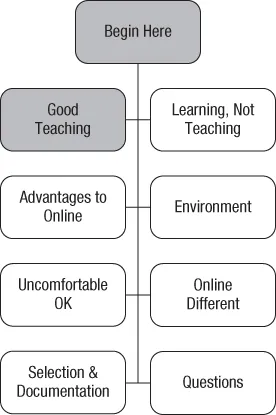
GOOD TEACHING
Why are you involved in education? Who influenced you to invest part of your life's work in teaching and learning? Is there any particular person who stands out to you as someone who helped shape your decision to be involved in education? As faculty members we usually choose our subject matter because of passion for that topic. The natural world and problem solving intrigue me; therefore, I originally trained as a scientist. What is it that made you select your discipline? Perhaps it was a teacher who took a special interest in you, a class that challenged you, or some particular lesson that touched you at a sensitive time in your life. Typically, a person's favorite teacher is not one who was his or her easiest teacher; rather the person provided motivation, inspiration, practical application, or something similar. Your learners will likely find these qualities beneficial as well.
ACTION ITEM 1
Think of your favorite teacher from all your years of schoolâthe one who made a positive lasting impression on you.
Using Form 1, document the qualities that stood out about this person.
FORM 1
MY FAVORITE TEACHER
QUESTIONS
RESPONSES
Subject this person taught
The year in school I had this teacher
The main thing that comes to mind when I think of this teacher
What he or she did that caught my attention
The qualities that stand out about his or her teaching
What I'd like to adopt from this person
Form available at www.josseybass.com/go/conqueringthecontent
In addition to learning effective practices from those who taught us, we can adopt the teaching principles found to be the most effective, which have been documented by several studies.
You may be familiar with the classic study by Chickering and Gamson (1987), which established seven principles for undergraduate teaching:
Encourage faculty-to-learner interaction.
Encourage learner-to-learner interaction.
Promote active learning.
Communicate high expectations.
Facilitate time on task.
Provide rich, rapid feedback.
Respect diverse learning.
These same teaching principles hold true whether you are teaching in a face-to-face or an online environment. If you are not familiar with these principles, I encourage you to find and review this study. Among the many additional articles referencing Chickering and Gamson's original work is Chickering and Ehrmann's âImplementing the Seven Principles: Technology as Leverâ (1996), which provides ideas for using the seven principles in an online course.
Another excellent guide for online courses is Merrill's âFirst Principles of Instructionâ (2002). Most effective learning environments are those that are problem based and involve learners in four distinct phases of learning:
Activation of prior experience
Demonstration of skills
Application of skills
Integration of these skills into real-world activities
These principles can be applied to instructional design; learning is facilitated when
Learners are engaged in solving real-world problems.
Existing knowledge is activated as a foundation for new knowledge.
New knowledge is demonstrated to the learner.
It is applied by the learner.
It is integrated into the learner's world.
No one would expect an athlete or a musician to perform without hours of practice. Yet much instruction seems to assume that when it comes to cognitive skills, such practice is unnecessary. Merrill (2002) notes that âappropriate practice is the single most neglected aspect of effective instructionâ (p. 43).
Your learning experience, research, and your own teaching experience work together to help inform your teaching. It is important to ...