- Covers the Chinese DTTB standard which was announced recently and hasn't been covered in detail
- Introduces the SFN network using the successful implementation of DTMB in Hong Kong as an example
- Introduces the latest announced systems including the ATSC M/H and DVB-NGH
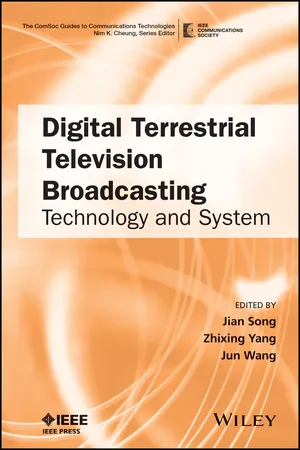
eBook - ePub
Digital Terrestrial Television Broadcasting
Technology and System
- English
- ePUB (mobile friendly)
- Available on iOS & Android
eBook - ePub
Digital Terrestrial Television Broadcasting
Technology and System
About this book
This book covers channel coding and modulation technologies in DTTB systems from the general concepts to the detailed analysis and implementation.
Information
1
Basic Concepts of Digital Terrestrial Television Transmission System
1.1 Introduction and Historic Review
Television is a word of Latin and Greek origin meaning “far sight.” In Greek, tele means “far” while visio is “sight” in Latin. A television (TV) system transmits both audio and video signals to millions of households through electromagnetic waves and is one of the most important means of entertainment as well as information access. With the never-ending technological breakthroughs and the continuously increasing demands of audio and video services, the TV system has evolved over generations with several important developmental periods in less than a century.
1.1.1 Birth and Development of Television Black-and-White TV Era
In the mid-1920s, the Scottish inventor John Logie Baird demonstrated the successful transmission of motion images produced by a scanning disk with the resolution of 30 lines, good enough to discern a human face. In 1928, the first TV signal transmission was carried out in Schenectady, New York, and the world's first TV station was established by the British Broadcasting Corporation in London eight years later. After World War II, the black-and-white TV era began. Detailed technical and implementation specifications of TV service, including photography, editing, production, broadcasting, transmission, reception, and networking, were gradually formulated. With the ever-growing popularity of TV viewers, the color TV with better watching experience was invented to simulate the real world.
1.1.2 Analog Color TV Era
In 1940, Peter Carl Goldmark with CBS (Columbia Broadcasting System) Lab invented a color TV system known as the field-sequential system. This system occupied an analog bandwidth of 12 MHz and was carried by 343 lines (∼100 lines less than that of the black-and-white TV) at different field scan rates, and hence was incompatible with black-and-white TV. The system started field trial broadcast in 1946, and this is the dawn of the color TV age.
In the 1950s, a color TV signal system called NTSC (National Television Standards Committee) was developed in the United States that was compatible with the black-and-white TV. This scheme uses a luminance–chrominance encoding scheme with red, green, and blue (RGB) primary signals encoded into one luminance signal (Y) and two quadrature-amplitude-modulated color (or chrominance) signals (U and V), and all are transmitted at the same time. An NTSC TV channel occupies 6 MHz bandwidth with the video signal transmitted between 0.5 and 5.45 MHz baseband. The video carrier is 1.25 MHz and the video carrier generates two sidebands, similar to most amplitude-modulated signal, one above the carrier and one below. The sidebands are each 4.2 (5.45–1.25) MHz wide. The entire upper sideband will be transmitted while only 1.25 MHz of the lower sideband (known as a vestigial sideband, VSB) is transmitted. The color subcarrier is 3.579545 MHz above the video carrier and quadrature amplitude modulated with the suppressed carrier while the audio signal is frequency modulated. The NTSC system was deployed in most of North America, parts of South America, Myanmar, South Korea, Taiwan, Japan, the Philippines, and some Pacific island nations and territories. This invention is considered as the landmark of the second stage of the development—the analog color TV era.
A group of French researchers started their work in parallel and this led to the invention of the Sequential Color with Memory (SECAM) system in 1956, and the system was successfully demonstrated in 1961. In the SECAM system, two color difference signals are transmitted alternately (line by line) and frequency modulated by the color subcarrier. This system was adopted by France, the Soviet Union, Eastern European countries (except for Romania and Albania), and Middle East countries and was the first color TV standard in Europe. In 1962, Walter Bruch, a German engineer at Telefunken, put forward the Phase Alternate Line (PAL) system based on the NTSC system in the Federal Republic of Germany. This system performs line-by-line phase inversion of the quadrature component of the chrominance signal in the NTSC system and can effectively offset the phase error and increase the tolerance for differential phase error from ±12° to ±40° in the NTSC system. This new system was adopted by more than 120 countries successively, and in 1972 China decided to adopt it as well.
In the first 70 years of the twentieth century, even though the development of TV had gone through two different phases (black and white and color), the fundamental characteristics of TV signal transmission was unchanged, that is, the TV signal was continuous, or analog, and hence why both black-and-white and color TVs were called analog. In analog TV signal transmission, the amplitude, frequency, phase, or a combination of these parameters of the carrier are changed in accordance with the contents to be transmitted. Linear modulation as well as transmission are therefore achieved in one step. Though simple and straightforward, the analog TV system has the following issues in practice [1]:
- In terms of the quality, long-term storage, and dissemination of the video programs, the analog TV program source suffers from color–luminance interference, large-area flicker, and poor image definition, and it is difficult to replicate the content for too many times.
- In terms of signal transmission efficiency, the analog TV network is largely restricted by the bandwidth available. For example, the PAL system can accommodate only one analog video signal and one analog audio signal in 8 MHz bandwidth, and the spectral efficiency is low. In addition, due to cochannel and adjacent-channel interference in neighboring areas, different analog channels have to be used to carry the same programs to different areas to avoid mutual interference. Therefore, the spectral efficiency is further decreased, and it is very difficult to introduce new programs by assigning additional channels in the same region due to the limited available spectrum.
- In terms of the quality of the signal transmission, the analog TV signal may suffer from “ghosts” from terrestrial broadcasting due to its poor anti-multipath interference ability, which severely affects the viewer's experience. In addition, if the analog TV signal needs to be amplified for a longer transmission distance, the noise accumulation will make the signal quality very poor due to the deteriorating signal-to-noise ratio.
- In terms of the circuitry, network equipment, and terminals of the analog TV system, the geometric distortion of images is inevitable due to the nonlinearity of the circuitry while the phase distortion of the amplifiers would cause color deviation, aggravating the Ghost phenomenon. In addition, the analog TV system suffers from poor stability, time-domain aliasing, low degree of integration, difficulty in calibration, automatic control, and monitoring.
1.1.3 Digital TV Era
People's demands for better audio and video quality of the TV signal has always been a tremendous driving force for the broadcasting industry, and this led to the invention of the digital television (DTV). Also, due to significant technical breakthroughs in the digital signal processing field (including signal acquisition, recording, compression, storage, distribution, transmission, and reception), the semiconductor industry, and other related industries in the past half century, the broadcasting industry is now embracing the third important stage in its history, i.e. the DTV era.
The visual information received by human eyes in daily life is always analog, and the mission of both the first and second generation of TV broadcasting systems (black and white or color) is to transmit these analog signals to the numerous TV sets with the highest possible quality. Although the definition or the structure of the different DTV systems may be slightly different, the core definition or the major functional blocks are the same. They must include the sampling, quantization, and encoding of analog TV programs to convert them into digital format before they are further processed, recorded, stored, and distributed. The sequence segmentation, scrambling, forward error correction coding, modulation, and up conversion are done in the baseband to form the DTV radio frequency (RF) signals after up conversion at the transmit side. At the receive side, after achieving the system synchronization and signal equalization based on accurate channel estimation, inverse operations on the received signal to that at the transmit side will be performed before the final program can be finally displayed on the TV screen. Digital broadcasting technologies not only provide better reception and display performances compared to its analog counterpart but also introduce new functions that are not available with the analog broadcasting technologies. Considering all the advantages digital technology can provide over its analog counterpart, it is obvious that a DTV system can offer high-quality audio visual experiences and more comprehensive services for consumers. Given all these featured services the DTV system can support, digitization is widely considered a fundamental change and new landmark in the TV broadcasting industry, after the introduction of the black-and-white TV and the color TV.
The advantages of DTV over the traditional analog TV can be summarized as follows:
- Better Anti-Interference Ability, No Noise Accumulation, and High-Quality Signals. After digitization, the analog signal is changed into a binary (two-level) sequence. Unless the amplitude of the noise exceeds a certain level, noise introduced during processing or transmission can be effectively eliminated. Error-free transmission can also be achieved by means of forward error correction coding. During transmission of the DTV signal, the quality of the image and sound received by the users in the coverage is almost identical to that originally transmitted from the TV station. Thus the quality of programs in DT...
Table of contents
- Cover
- Series Page
- Title Page
- Copyright
- Preface
- Chapter 1: Basic Concepts of Digital Terrestrial Television Transmission System
- Chapter 2: Channel Characteristics of Digital Terrestrial Television Broadcasting Systems
- Chapter 3: Channel Coding for DTTB System
- Chapter 4: Modulation Technologies for DTTB System
- Chapter 5: First-Generation DTTB Standards
- Chapter 6: Second-Generation DTTB Standards
- Chapter 7: Design and Implementation of DTV Receiver
- Chapter 8: Network Planning for DTTB Systems
- Chapter 9: Performance Measurement on DTTB Systems
- Chapter 10: Digital Mobile Multimedia Broadcasting Systems
- Index
- The Comsoc Guides to Communications Technologies
- End User License Agreement
Trusted by 375,005 students
Access to over 1.5 million titles for a fair monthly price.
Study more efficiently using our study tools.
Frequently asked questions
Yes, you can cancel anytime from the Subscription tab in your account settings on the Perlego website. Your subscription will stay active until the end of your current billing period. Learn how to cancel your subscription
No, books cannot be downloaded as external files, such as PDFs, for use outside of Perlego. However, you can download books within the Perlego app for offline reading on mobile or tablet. Learn how to download books offline
Perlego offers two plans: Essential and Complete
- Essential is ideal for learners and professionals who enjoy exploring a wide range of subjects. Access the Essential Library with 800,000+ trusted titles and best-sellers across business, personal growth, and the humanities. Includes unlimited reading time and Standard Read Aloud voice.
- Complete: Perfect for advanced learners and researchers needing full, unrestricted access. Unlock 1.5M+ books across hundreds of subjects, including academic and specialized titles. The Complete Plan also includes advanced features like Premium Read Aloud and Research Assistant.
We are an online textbook subscription service, where you can get access to an entire online library for less than the price of a single book per month. With over 1.5 million books across 990+ topics, we’ve got you covered! Learn about our mission
Look out for the read-aloud symbol on your next book to see if you can listen to it. The read-aloud tool reads text aloud for you, highlighting the text as it is being read. You can pause it, speed it up and slow it down. Learn more about Read Aloud
Yes! You can use the Perlego app on both iOS and Android devices to read anytime, anywhere — even offline. Perfect for commutes or when you’re on the go.
Please note we cannot support devices running on iOS 13 and Android 7 or earlier. Learn more about using the app
Please note we cannot support devices running on iOS 13 and Android 7 or earlier. Learn more about using the app
Yes, you can access Digital Terrestrial Television Broadcasting by Jian Song, Zhixing Yang, Jun Wang, Jian Song,Zhixing Yang,Jun Wang, Nim K. Cheung in PDF and/or ePUB format, as well as other popular books in Technology & Engineering & Signals & Signal Processing. We have over 1.5 million books available in our catalogue for you to explore.