Insightful modelling of dynamic systems for better business strategy
The business environment is constantly changing and organisations need the ability to rehearse alternative futures. By mimicking the interlocking operations of firms and industries, modelling serves as a 'dry run' for testing ideas, anticipating consequences, avoiding strategic pitfalls and improving future performance.
Strategic Modelling and Business Dynamics is an essential guide to credible models; helping you to understand modelling as a creative process for distilling and communicating those factors that drive business success and sustainability. Written by an internationally regarded authority, the book covers all stages of model building, from conceptual to analytical. The book demonstrates a range of in-depth practical examples that vividly illustrate important or puzzling dynamics in firm operations, strategy, public policy, and everyday life.
This updated new edition also offers a rich Learners' website with models, articles and videos, as well as a separate Instructors' website resource, with lecture slides and other course materials (see Related Websites/Extra section below). Together the book and websites deliver a powerful package of blended learning materials that:
Introduce the system dynamics approach of modelling strategic problems in business and society
Include industry examples and public sector applications with interactive simulators and contemporary visual modelling software
Provide the latest state-of-the-art thinking, concepts and techniques for systems modelling
The comprehensive Learners' website features models, microworlds, journal articles and videos. Easy-to-use simulators enable readers to experience dynamic complexity in business and society. Like would-be CEOs, readers can re-design operations and then re-simulate in the quest for well-coordinated strategy and better performance. The simulators include a baffling hotel shower, a start-up low-cost airline, an international radio broadcaster, a diversifying tyre maker, commercial fisheries and the global oil industry.
"Much more than an introduction, John Morecroft's StrategicModellingandBusinessDynamics uses interactive 'mini-simulators and microworlds' to create an engaging and effective learning environment in which readers, whatever their background, can develop their intuition about complex dynamic systems."
"Illustrated by examples from everyday life, business and policy, John Morecroft expertly demonstrates how systems thinking aided by system dynamics can improve our understanding of the world around us."
Stewart Robinson, Associate Dean Research, President of the Operational Research Society, Professor of Management Science, School of Business and Economics, Loughborough University
CHAPTER 1 The Appeal and Power of Strategic Modelling
Introduction
A New Approach to Modelling
The Puzzling Dynamics of International Fisheries
Model of a Natural Fishery
Operating a Simple Harvested Fishery
Preview of the Book and Topics Covered
Appendix – Archive Materials from World Dynamics
Introduction1
I have always been fascinated by models and games and particularly by model conceptualisation, the process by which people represent and simplify situations from the real world to make sense of them. Consider for example, the popular board game of Monopoly. Players find themselves as property developers in an imaginary city. It could be London or New York, except of course (and this is the curious thing) the board doesn't look remotely like a real city or even like a geographical map of either city. The game board is just a large square of card on which are printed neatly labelled and coloured boxes displaying familiar place names like cheap and cheerful Old Kent Road in brown, bustling Trafalgar Square in red and elegant Mayfair in dark blue. There are houses and hotels, but no streets. There are stations, but no railway lines. There is a community chest, but no community of people. There is a jail, but no police department. Players move around the city with a throw of the dice in a curious assortment of vehicles: a boot, a ship, a horse, an iron, a cannon and even a top hat. It is a fantasy world, a much simplified view of real estate in a city, and yet it captures something real – the essence of commercial property ownership and development in a growing competitive market. The more property you own and control, the more you earn. Bigger is better, winner takes all.
The challenge of any kind of modelling lies precisely in deciding, among myriad factors, what to include and what to leave out. The same principle applies whether you are devising a board game like Monopoly or building a simulator for a management team in BMW, Dow Chemical, Goldman Sachs, Harley-Davidson, Mars Inc., Microsoft, Royal Dutch/Shell or Transport for London. The starting point is essentially, ‘what's important here?’ What do you and others have in mind when you think about the strategy and future success of a business, a city or an entire industry? What is the issue under investigation and which factors need most attention to address the issue? These practical questions in turn raise a more basic philosophical question about how we conceptualise the enterprises in which we live and work. How do people, whether they are leaders, advisers or commentators, make sense of firms, industries or societies, explain them to others, and anticipate outcomes well enough to shape and communicate intelligent strategy and policy?
I can recall this fascination with conceptualisation from a time when business dynamics, or more generally system dynamics (and its specialist visual language of stocks, flows and information feedback), was entirely new and unfamiliar to me. It was back in the early 1970s. The Limits to Growth study, a research project exploring how to create an economically and ecologically sustainable society, was attracting attention worldwide. The project was conducted at the Massachusetts Institute of Technology (MIT) and two influential books based on this work, World Dynamics (Forrester, 1971) and Limits to Growth (Meadows et al., 1972), had already been published. Further work on the paradox of global growth and sustainability was in full flow. Thousands of miles away I was a graduate student at London University's Imperial College, completing a masters degree in operational research. I had only just encountered Industrial Dynamics, the seminal book that marked the beginning of system dynamics (Forrester, 1961).
Nevertheless, I experienced a sense of excitement about the possibility of using computer models to visualise and simulate issues that were foremost in the minds of business and political leaders and important for our everyday lives. Certainly I was no novice to computer modelling, but up until then I had used computational power for optimisation and decision support. What I found appealing in this new area of system dynamics was the promise of a subject aimed at broad policy making backed up by the discipline of model building and the power of simulation.
Imagine you are contemplating the dilemma of fast-growing global population in a world of finite resources. Today, there are 7 billion of us on the planet. Back in 1850 there were just over one billion. By 2050 there could be as many as nine billion people. Is it really possible that mankind could outgrow the planet and overexploit its abundant natural resources to usher in a dark age of pollution, poverty and suffering? Why might this happen and when? How do you begin to answer such questions and how do you conceive a ‘global system’ in your mind? I was captivated by a representation in World Dynamics that limited itself to only two pages of symbols whose clearly defined purpose was to explore alternative future time paths for global industrial society. It was a bold sketch on a compact canvas.
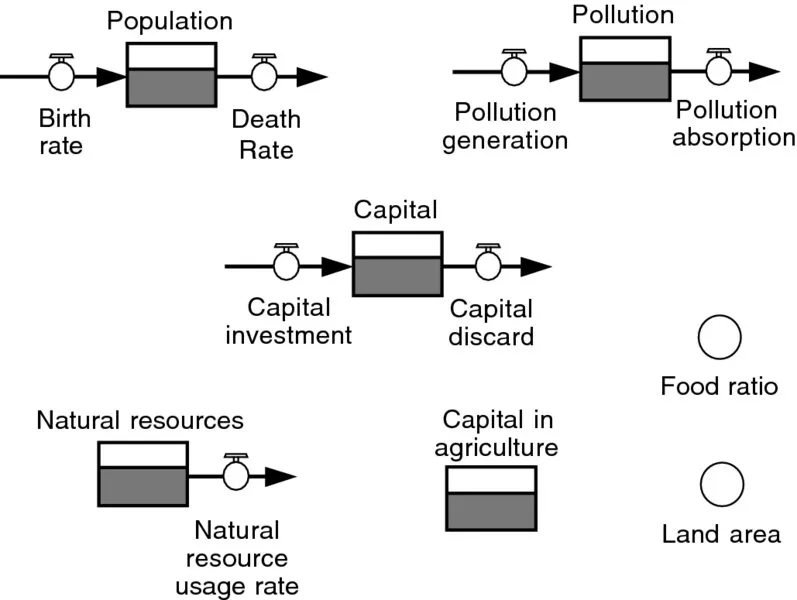
For those who have read World Dynamics, Figure 1.1 will evoke memories of the model. However, for most readers who are new to system dynamics you will glimpse what I saw as a graduate student: strange symbols and familiar phrases which claim to set some sort of boundary on the set of factors that will shape the environmental and economic destiny of mankind. I have deliberately chosen to show a much-simplified diagram that leaves out many intermediate variables and the complex network of connections, because that is how I first perceived the model. There are only four stock accumulations (shown as rectangles with inflows and outflows), representing aspects of our world, that have grown steadily and relentlessly over many centuries: population, capital, pollution and natural resources (which have declined). This fact alone I found remarkable for its brevity yet common-sense appeal. To understand global limits to growth one surely has to think hard about the drivers of population (birth rate and death rate, shown as small circles with tiny taps superimposed on arrows); the engines of human economic activity (capital investment, capital discard and the usage rate of natural resources); and the consequences of human activity on the global environment (the processes of pollution generation and absorption).
Figure 1.1 Stock accumulations for global growth
Source: Adapted from Forrester (1971, pp. 20–21).
These factors must co-evolve over time. But what forces or influences make sure they evolve in a balanced way that can satisfy the aspirations and sustain the living standards of a healthy global population? My picture does not show the full web of coordinating forces. That is something you will learn to model and interpret later in the book. For now you just have to imagine there is such a web operating behind the scenes that determines how, for example, the birth rate depends on population, capital and pollution, or how capital investment depends on population and natural resources. But can a sustainable balance be achieved? Is there a coordinating web that will steer global growth within the constraints of finite natural resources, limited land area, and biological/physical laws (that govern the world's ecology), while at the same time meeting the needs of billions of global stakeholders (parents and families, investors in productive capital, exploiters of natural resources)?
It came as a shock all those years ago to realise there is no nation, no government and no responsible business community that has the power or the information to mastermind a global growth engine.2 A coordinating web is certainly there (reproduced in the Appendix as Figure 1.13), but it is a weak and imperfect invisible hand. In the long run, this invisible hand will achieve a ruthless balance of population, resources and human activity. But the time path to this ultimate balance may involve a catastrophic decline of living standards and population or spiralling pollution.
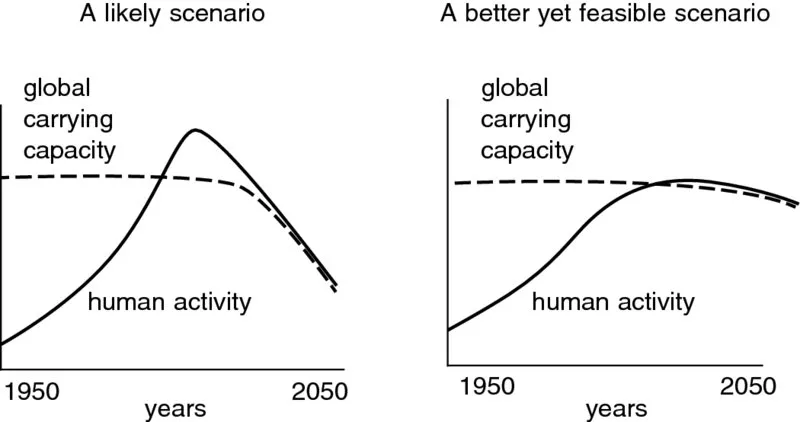
Figure 1.2 Limits to global growth – rough sketches of alternative futures
Figure 1.2 compares two (among many) alternative time paths that summarise the message as I recall it from my early encounter with system dynamics (Randers, 1980). Bear in mind these are rough hand-drawn sketches, not formal simulations. Nevertheless, the century-long timescale on these charts is representative of the time horizon in the original study and left a deep impression about the ambition of the field to understand the long term by simulating the interaction of human decisions-and-actions with enduring natural forces. On the left is a likely scenario. Global carrying capacity (defined as how much human activity the globe can sustain) starts high in the uncrowded world of the 1950s. Human activity starts low. As population and capital grow, human activity rises steadily and exponentially, approaching the finite (but unknown) global capacity around the turn of the millennium. There is no particularly strong signal to announce that this hidden capacity limit has been reached, nor any coalition of stakeholders with the power to restrict human activity once the limit is exceeded. So ‘the band plays on’ for another 20 years. Collectively, we live beyond the generous but limited means of our planet. This overexploitation of resources an...
Table of contents
Cover
Epigraph
Title page
Copyright
Dedication
About the Author
Foreword by Peter Checkland
Preface to the Second Edition
Preface from the First Edition
How to Use This Book
Chapter 1 The Appeal and Power of Strategic Modelling
Chapter 2 Introduction to Feedback Systems Thinking
Chapter 3 Modelling Dynamic Systems
Chapter 4 World of Showers
Chapter 5 Cyclical Dynamics and the Process of Model Building
Chapter 6 The Dynamics of Growth from Diffusion
Chapter 7 Managing Business Growth
Chapter 8 Industry Dynamics – Oil Price and the Global Oil Producers
Chapter 9 Public Sector Applications of Strategic Modelling
Chapter 10 Model Validity, Mental Models and Learning
About the Website Resources
Index
EULA
Trusted by 375,005 students
Access to over 1.5 million titles for a fair monthly price.
Study more efficiently using our study tools.
Frequently asked questions
Yes, you can cancel anytime from the Subscription tab in your account settings on the Perlego website. Your subscription will stay active until the end of your current billing period. Learn how to cancel your subscription
No, books cannot be downloaded as external files, such as PDFs, for use outside of Perlego. However, you can download books within the Perlego app for offline reading on mobile or tablet. Learn how to download books offline
Perlego offers two plans: Essential and Complete
Essential is ideal for learners and professionals who enjoy exploring a wide range of subjects. Access the Essential Library with 800,000+ trusted titles and best-sellers across business, personal growth, and the humanities. Includes unlimited reading time and Standard Read Aloud voice.
Complete: Perfect for advanced learners and researchers needing full, unrestricted access. Unlock 1.5M+ books across hundreds of subjects, including academic and specialized titles. The Complete Plan also includes advanced features like Premium Read Aloud and Research Assistant.
Both plans are available with monthly, semester, or annual billing cycles.
We are an online textbook subscription service, where you can get access to an entire online library for less than the price of a single book per month. With over 1.5 million books across 990+ topics, we’ve got you covered! Learn about our mission
Look out for the read-aloud symbol on your next book to see if you can listen to it. The read-aloud tool reads text aloud for you, highlighting the text as it is being read. You can pause it, speed it up and slow it down. Learn more about Read Aloud
Yes! You can use the Perlego app on both iOS and Android devices to read anytime, anywhere — even offline. Perfect for commutes or when you’re on the go. Please note we cannot support devices running on iOS 13 and Android 7 or earlier. Learn more about using the app
Yes, you can access Strategic Modelling and Business Dynamics by John D. W. Morecroft in PDF and/or ePUB format, as well as other popular books in Business & Management. We have over 1.5 million books available in our catalogue for you to explore.