This book presents a new fracturing technique that should be considered as a potential alternative, or a companion technique, to hydraulic fracturing of tight gas reservoirs and low permeability rock masses. As opposed to hydraulic fracturing which generates a few numbers of large cracks, electro-hydraulic fracturing induces diffuse micro-cracking and fragmentation of rocks. Laboratory tests demonstrate that increases of permeability by two orders of magnitude can be reached, without major cracking in tested specimens. This book discusses the principles of this new technique, reports experiments which have been developed is order to prove the concept and finally describes the numerical model from which the potentialities of this technique in representative reservoir conditions can be assessed.
The experimental program presented in this chapter included several distinct phases:
– mechanical experiments in which specimens were subjected to representative confinement stresses and to pulsed arc electrohydraulic discharges (PAEDs);
– permeability tests performed before and after the mechanical experiments in order to quantify the increase in permeability upon electrohydraulic fracturing;
– X-ray scanning tomography before and after the mechanical experiments in order to visualize the crack network generated by the mechanical loads.
We are going to detail the experiments and discuss the results obtained on a model material (mortar), and on sandstone.
1.1. Mechanical set-up
Our aim is to design experiments that implement conditions that are that are as close as possible to real ones.
It means that specimens ought to be subjected to the triaxial confinement experienced underground at several different depths, and that the pulse applied should be generated in a specimen geometry that is close to a real well bore.
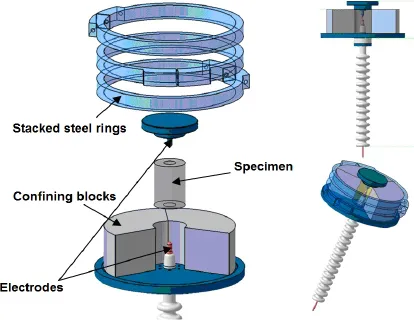
The shock wave is generated in a hollow cylinder (mortar or rock) filled with water. The radial confinement pressure is applied with three stacked steel rings (600 mm in diameter, 60 mm in height and 30 mm thick) tightened with the help of a beam wrench. The steel rings were equipped with strain gauges to check the confining pressure during the tightening phase. Three confining blocks made of ultra high-performance concrete reinforced with metallic fibers are placed between the specimen and the steel rings in order to absorb the shock wave and to homogenize the radial pressure on the external face of the specimen. The high-performance concrete used to confine the specimen has approximately the same dynamic impedance characteristics as the specimen in order to avoid wave reflections at the boundary. This set-up is shown in Figure 1.1.
Figure 1.1.Overall view of the triaxial cell
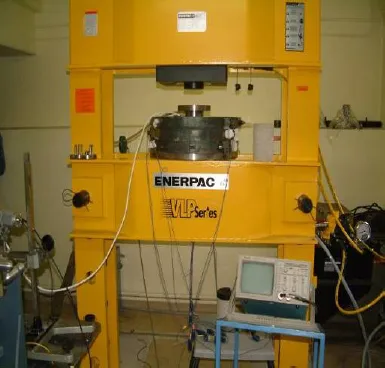
The vertical load is applied with a 2,000 kN hydraulic jack (Figure 1.2), which is placed in a protected environment with respect to electromagnetic radiations and electrical surges.
Figure 1.2.Hydraulic frame hosting the triaxial cell
Due to the radiations generated by the electrical discharges, it was not possible to use the displaced transducers or electronic equipment for load control or resistive gauge measurements. For this reason, the frame is a pneumatic one, the confinement is applied in a passive way and no transducers were able to be placed in order to record loads or deformations.
Specimens are confined according to three levels of radial stresses and vertical loads corresponding to three depths: low confinement (depth = 0 m), medium confinement (depth equal to 1,500 m and Biot factor equal to 1) and high confinement (depth equal to 2,250 m and Biot factor equal to 0.5 or depth equal to 3,000 m and Biot factor equal to 1). Vertical and lateral stresses are detailed in Table 1.1.
Table 1.1.Vertical and lateral stresses of the mortar
Vertical loads (MPa)
Lateral stresses (MPa)
Depth (m)
Low confinement
2
2
0
Medium confinement
19.5
9.1
1,500
High confinement
40
25
2,250
1.2. Pulsed arc electric generator
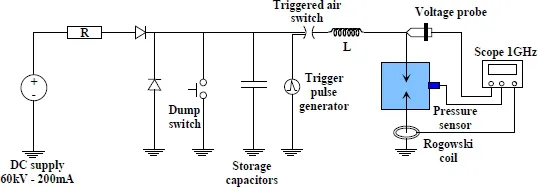
The electrodes are placed inside the hollow part of the specimen which is immersed in water (Figure I.1). The electrodes are made up of two vertical cylindrical tubes, on the lower ends of which are screwed two stainless steel electrodes (5 mm diameter). The gap between the two electrodes is equal to 5 mm. The positive impulse voltage is obtained by charging storage capacitors in the C = 300 nF to 21 µF range, depending on the electrical energy to be released during the electric discharge. A triggered spark-gap allows the switching of energy of up to 20 kJ in water. The maximum charging voltage of the capacitors is 40 kV. The voltage impulse and the current are monitored with a North Star probe (100 kV–90 MHz) and a Pearson current monitor (50 kA–4 MHz), respectively.
Figure 1.3.Experimental set-up – electrical part
Figure 1.3 shows the schematic organization of the electrical set-up. During the tests, the pressure sensor is removed. It is used for the calibration of the energy–pressure relationship only. According to previous investigations [TOU 06], the dynamic pressures generated by subsonic water discharges present in bi-exponential form and are characterized by a rise time of about 500 ns and a pulse width of a few microseconds. The associated frequency spectrum reaches 200 kHz at –20 dB.
The general form of the pressure pulse applied can be written using the following relationship:
[1.1]
where P i...
Table of contents
Cover
Table of Contents
Title
Copyright
Preface
Introduction
1 Experiments in a Representative Environment
2 Computational Modeling of the Process: Principles
3 Validation of the Computational Model
4 Computations on Representative Reservoir Geometries
Concluding Remarks and Future Outlook
Bibliography
Index
End User License Agreement
Trusted by 375,005 students
Access to over 1.5 million titles for a fair monthly price.
Study more efficiently using our study tools.
Frequently asked questions
Yes, you can cancel anytime from the Subscription tab in your account settings on the Perlego website. Your subscription will stay active until the end of your current billing period. Learn how to cancel your subscription
No, books cannot be downloaded as external files, such as PDFs, for use outside of Perlego. However, you can download books within the Perlego app for offline reading on mobile or tablet. Learn how to download books offline
Perlego offers two plans: Essential and Complete
Essential is ideal for learners and professionals who enjoy exploring a wide range of subjects. Access the Essential Library with 800,000+ trusted titles and best-sellers across business, personal growth, and the humanities. Includes unlimited reading time and Standard Read Aloud voice.
Complete: Perfect for advanced learners and researchers needing full, unrestricted access. Unlock 1.5M+ books across hundreds of subjects, including academic and specialized titles. The Complete Plan also includes advanced features like Premium Read Aloud and Research Assistant.
Both plans are available with monthly, semester, or annual billing cycles.
We are an online textbook subscription service, where you can get access to an entire online library for less than the price of a single book per month. With over 1.5 million books across 990+ topics, we’ve got you covered! Learn about our mission
Look out for the read-aloud symbol on your next book to see if you can listen to it. The read-aloud tool reads text aloud for you, highlighting the text as it is being read. You can pause it, speed it up and slow it down. Learn more about Read Aloud
Yes! You can use the Perlego app on both iOS and Android devices to read anytime, anywhere — even offline. Perfect for commutes or when you’re on the go. Please note we cannot support devices running on iOS 13 and Android 7 or earlier. Learn more about using the app
Yes, you can access Electrohydraulic Fracturing of Rocks by Christian La Borderie,Thierry Reess,Wen Chen,Olivier Maurel,Franck Rey-Berbeder,Antoine de Ferron, Gilles Pijaudier-Cabot in PDF and/or ePUB format, as well as other popular books in Technology & Engineering & Mechanical Engineering. We have over 1.5 million books available in our catalogue for you to explore.