eBook - ePub
Software Defined Mobile Networks (SDMN)
Beyond LTE Network Architecture
- English
- ePUB (mobile friendly)
- Available on iOS & Android
eBook - ePub
Software Defined Mobile Networks (SDMN)
Beyond LTE Network Architecture
About this book
This book describes the concept of a Software Defined Mobile Network (SDMN), which will impact the network architecture of current LTE (3GPP) networks. SDN will also open up new opportunities for traffic, resource and mobility management, as well as impose new challenges on network security. Therefore, the book addresses the main affected areas such as traffic, resource and mobility management, virtualized traffics transportation, network management, network security and techno economic concepts. Moreover, a complete introduction to SDN and SDMN concepts. Furthermore, the reader will be introduced to cutting-edge knowledge in areas such as network virtualization, as well as SDN concepts relevant to next generation mobile networks. Finally, by the end of the book the reader will be familiar with the feasibility and opportunities of SDMN concepts, and will be able to evaluate the limits of performance and scalability of these new technologies while applying them to mobile broadb and networks.
Information
Part I
Introduction
1
Overview
Madhusanka Liyanage,1 Mika Ylianttila,2 and Andrei Gurtov3
1 Centre for Wireless Communication, University of Oulu, Oulu, Finland
2 Centre for Internet Excellence, University of Oulu, Oulu, Finland
3 Helsinki Institute for Information Technology HIIT, Aalto University, Espoo, Finland
Future mobile network architectures need to evolve to cope with future demand for high bandwidth, a large and evolving set of services with new specific requirements, high-level security, low energy consumption, and optimal spectrum utilization. Specifically, the increasing number of mobile users and services will result in the increasing capacity requirements for the mobile network. On the other hand, it is expected that mobile data traffic will grow faster than the fixed Internet during the upcoming years. Thus, accommodating this expected traffic growth is an imminent requirement of future mobile networks.
In order to keep up with the traffic growth, mobile networks have not only to go through architecture processes to optimize the current resources but also to add new components/technologies that increase the capacity. However, mobile backhaul networks contain remarkably complex and inflexible devices. Although the interfaces of a cellular network are globally standardized, still most of these devices are vendor specific. Thus, mobile operators do not have flexibility to “mix and match” capabilities from different vendors. In another aspect, the standardization process for mobile networks is a long-lasting process. Although operators find promising concepts, they need to wait years to implement them in their networks. This might bury lots of interesting opportunities due to the lack of support.
On these grounds, software defined networking (SDN) is one of the promising technologies that are expected to solve these limitations in current mobile networks. SDN provides the required improvements in flexibility, scalability, and performance to adapt the mobile network to keep up with the expected growth. Software defined mobile networking (SDMN) is directing the current mobile network toward a flow-centric model that employs inexpensive hardware and a logically centralized controller. SDN enables the separation of the data forwarding plane from the control planes (CP). The SDN-enabled switches, routers, and gateways are controlled through an SDN controller/network operating system (NOS) and are seen as virtual resources. The CP of the mobile networking elements can be deployed onto an operator cloud for computing.
In this paradigm, each operator has the flexibility to develop his own networking concepts, optimize his network, and address specific needs of his subscribers. Furthermore, software-programmable network switches in SDMN use modern agile programming methodologies. These software methodologies can be developed, enhanced, and upgraded at much shorter cycles than the development of today’s state-of-the-art mobile backhaul network devices.
The acquisition of virtualization into Long-Term Evolution (LTE) mobile networks brings the economic advantage in two ways. First, SDMN requires inexpensive hardware such as commodity servers and switches instead of expensive mobile backhaul gateway devices. Second, the introduction of SDN technology to mobile networks allows entering new actors in the mobile network ecosystem such as independent software vendors (ISV), cloud providers, and Internet service providers (ISP) that will change the business model of mobile networks.
Thus, the concept of SDMN would change the network architecture of the current LTE 3rd Generation Partnership Project (3GPP) networks. SDN will also open up new opportunities for traffic, resource, and mobility management as well as impose new challenges on network security. Many academic and industrial researchers are working on the deployment of SDMNs. We believe that ideas stemming from design and experiments with SDMN provide indispensable knowledge for anybody interested in next-generation mobile networks.
The overview chapter starts with Section 1.1, which contains a discussion on the limitation of the present mobile network. The SDMN architecture and its components are presented in Section 1.2. The key benefits of SDMN architectures are described in Section 1.3. Section 1.4 contains the conclusion.
1.1 Present Mobile Networks and Their Limitations
The mobile communication was introduced in the 1980s. The first generation of mobile networks supports only the voice call services and the connectivity speed up to 56 kbps. However, the mobile network technology achieved a tremendous development during the last four decades. Today’s mobile networks support various network services such as amended mobile Web access, Internet Protocol (IP) telephony, gaming services, high-definition mobile television (TV), videoconferencing, 3D television, cloud computing, and high-speed broadband connectivity up to several Gbps [1].
With inbuilt mobility support, these services fuel the attraction toward the mobile broadband networks instead of wired Internet. It is expecting that the mobile data traffic will be exceeding the wired data traffic in the near future. On the other hand, mobile networks have to provide carrier-grade high-quality services for their subscribers even while copping with these traffic demands.
It is challenging to satisfy all these requirements by using present-day mobile network architecture. Present-day mobile networks are facing various limitations, and they can be categorized as below [2, 3]:
- Scalability limitations – The rapid increment of mobile traffic usage is projected due to new bandwidth-hungry mobile services such as online streaming, video calls, and high-definition mobile TV. The existing static overprovisioned mobile networks are inflexible and costly to scale to keep up with the increasing traffic demand.
- Complex network management – Significant expertise and platform resources are required to manage the present mobile network. In most cases, backhaul devices are lacking of common control interfaces. Therefore, straightforward tasks such as configuration or policy enforcement also require a significant amount of effort.
- Manual network configuration – Most of the network management systems are manually intensive, and trained operators are required [4–7] to achieve even moderate security [8]. However, these manual configurations are prone to misconfiguration errors. Also, it is expensive and taking a long time to troubleshoot such errors. According to the Yankee Group report [4], 62% of network downtime in multivendor networks happened due to human errors. Furthermore, 80% of IT budgets are spent on maintenance and operations of the network.
- Complex and expensive network devices – Some of the mobile backhaul devices have to handle extensive amount of work. For instance, Packet Data Network Gateway (PDN GW) is responsible for many important data plane (DP) functions such as traffic monitoring, billing, quality-of-service (QoS) management access control, and parental controls in LTE networks. Thus, the devices are complex and expensive.
- Higher cost – Mobile operators do not have flexibility to “mix and match” capabilities from different vendors’ devices. Therefore, they cannot build their network by using the cheap equipment from different vendors. It directly increases the CAPEX of the network. On the other hand, the manual configuration and inflexibility increase the OPEX of the network.
- Inflexibility – The standardization process for mobile networks is a long-lasting process. It requires many months or years to introduce new services. Furthermore, the implementation of new service also takes weeks or months due to the manually intensive service activation, delivery, and assurance.
Apart from these key issues, future mobile networks will face critical network congestion issues. Regardless of the limited radio bandwidth, the demand for mobile data is increasing rapidly. Therefore, mobile network operators have to use smaller cells to accommodate the traffic growth, which ultimately increases the number of base stations in the network. It is predicted that the global number of cellular sites will reach up to 4 million by the end of 2015. It was only 2.7 million by the end of 2010 [1]. Therefore, mobile backhaul networks will face congestion in a manner similar to data center networks due to the increment of mobile broadband traffic and the number of base stations as a solution.
1.2 Software Defined Mobile Network
The adaptation of SDN and virtualization concepts to the mobile network domain will solve the previously mentioned issues. The SDN concepts not only solve these issues but also improve the flexibility, scalability, and performance of a telecommunication network. SDN is originally designed for fixed networks. However, mobile networks have different requirements than fixed networks such as mobility management, precious traffic transportation, efficient protection of the air interface, higher QoS, the heavy use of tunneling in packet transport, and more. Therefore, SDMN concept is proposed as an extension of SDN paradigm to support mobile network-specific functionality. Furthermore, SDMN has a greater degree of service awareness and optimum use of network resources than original SDN concepts.
The least telecommunication architectures such as the 3GPP Evolved Packet Core (EPC) explained the advantages of the separation of the CP from the DP. EPC supported this separation to some extent. However, SDN enables the complete separation of the CP from the data forwarding plane. Furthermore, standardization organizations such as the Internet Engineering Task Force (IETF) and the European Telecommunications Standards Institute (ETSI) are interested to utilize network function virtualization (NFV) concepts in telecommunication networks. The SDN concepts help to adapt the NFV functions as well. Basically, the NFV concepts facilitate on-demand provision and online scale-up for mobile networks.
The SDMN architecture is now directing the current mobile network toward a flow-centric model that employs inexpensive hardware and a logically centralized controller. SDMN is basically an approach to networking in which the CP is decoupled from telecom-specific hardware and given to a software application called the controller. The SDN-enabled switches, routers, and gateways are controlled through the SDN controller and NOS. The CP of the mobile networking elements can deploy in an operator cloud as virtual components. Furthermore, the modern agile programming methodologies can be used to program and upgrade the performance of software-programmable network switches in SDMNs. These software methodologies can be developed, enhanced, and upgraded at much shorter cycles than the development of today’s state-of-the-art mobile backhaul network devices. In this paradigm, each operator has the flexibility to develop his own networking concepts to address specific needs of his subscribers and optimize his network to achieve better performance. During the past few years, many academic and industrial researchers are working on the deployment of SDMNs. The integration of SDN in mobile networks is proposed in various papers [3, 9–11].
Figure 1.1 illustrates the basic architecture of SDMNs [2, 12].
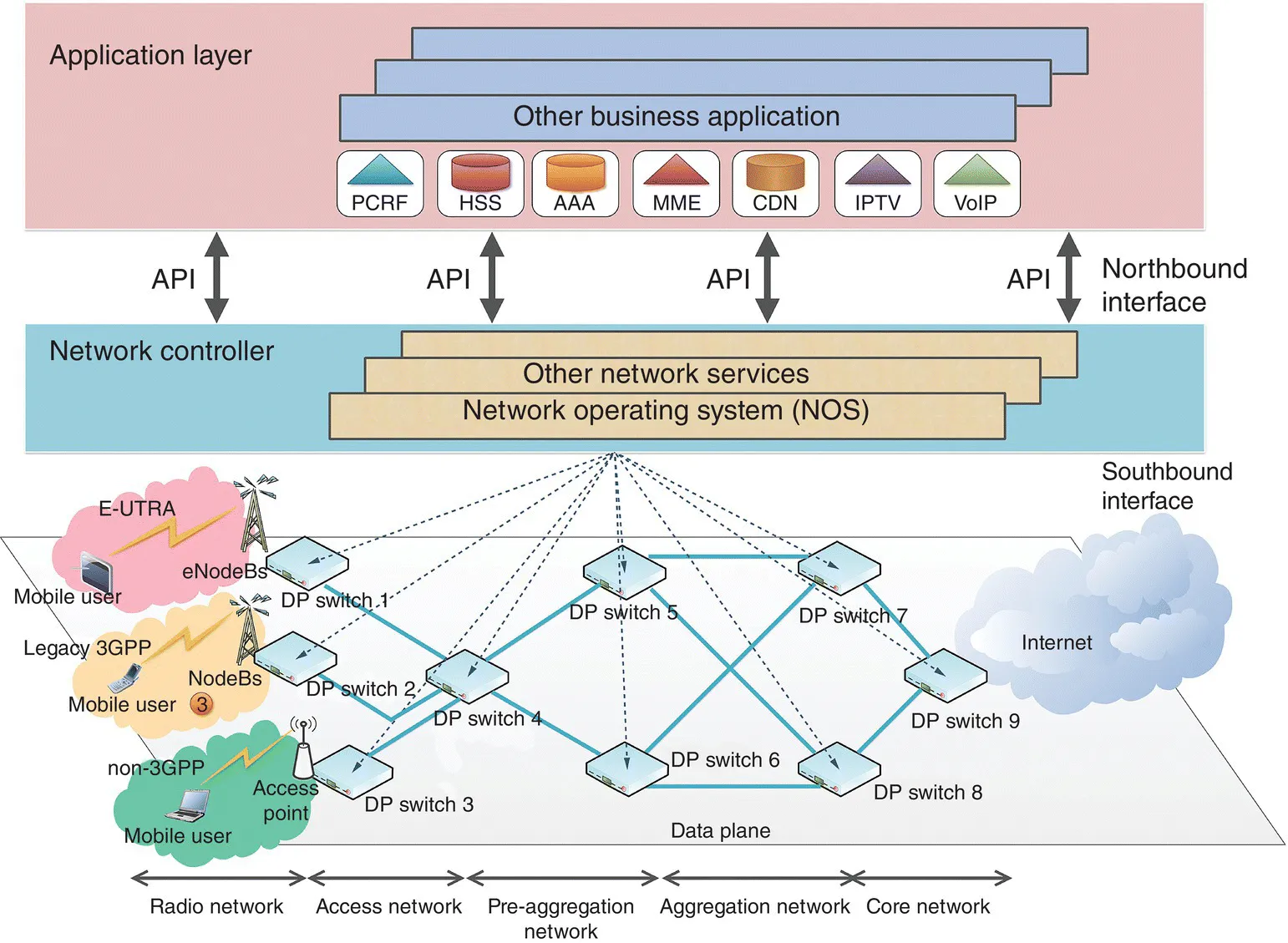
Figure 1.1 SDMN architecture.
Basically, SDMN splits the CP and the DP of the mobile network. It allows centralizing all the controlling functionalities. The DP now consists of low-end switches and links among them.
The SDMN architecture can be divided into three layers [2, 12, 13]:
- DP layer The DP layer is also known as the infrastructure layer. It consists of the network elements such as switch...
Table of contents
- Cover
- Title page
- Table of Contents
- Editors
- Contributors
- Foreword
- Foreword
- Preface
- Acknowledgments
- Abbreviations
- Part I: Introduction
- Part II: SDMN Architectures and Network Implementation
- Part III: Traffic Transport and Network Management
- Part IV: Resource and Mobility Management
- Part V: Security and Economic Aspects
- Index
- End User License Agreement
Trusted by 375,005 students
Access to over 1.5 million titles for a fair monthly price.
Study more efficiently using our study tools.
Frequently asked questions
Yes, you can cancel anytime from the Subscription tab in your account settings on the Perlego website. Your subscription will stay active until the end of your current billing period. Learn how to cancel your subscription
No, books cannot be downloaded as external files, such as PDFs, for use outside of Perlego. However, you can download books within the Perlego app for offline reading on mobile or tablet. Learn how to download books offline
Perlego offers two plans: Essential and Complete
- Essential is ideal for learners and professionals who enjoy exploring a wide range of subjects. Access the Essential Library with 800,000+ trusted titles and best-sellers across business, personal growth, and the humanities. Includes unlimited reading time and Standard Read Aloud voice.
- Complete: Perfect for advanced learners and researchers needing full, unrestricted access. Unlock 1.5M+ books across hundreds of subjects, including academic and specialized titles. The Complete Plan also includes advanced features like Premium Read Aloud and Research Assistant.
We are an online textbook subscription service, where you can get access to an entire online library for less than the price of a single book per month. With over 1.5 million books across 990+ topics, we’ve got you covered! Learn about our mission
Look out for the read-aloud symbol on your next book to see if you can listen to it. The read-aloud tool reads text aloud for you, highlighting the text as it is being read. You can pause it, speed it up and slow it down. Learn more about Read Aloud
Yes! You can use the Perlego app on both iOS and Android devices to read anytime, anywhere — even offline. Perfect for commutes or when you’re on the go.
Please note we cannot support devices running on iOS 13 and Android 7 or earlier. Learn more about using the app
Please note we cannot support devices running on iOS 13 and Android 7 or earlier. Learn more about using the app
Yes, you can access Software Defined Mobile Networks (SDMN) by Madhusanka Liyanage, Andrei Gurtov, Mika Ylianttila, Madhusanka Liyanage,Andrei Gurtov,Mika Ylianttila in PDF and/or ePUB format, as well as other popular books in Technology & Engineering & Mobile & Wireless Communications. We have over 1.5 million books available in our catalogue for you to explore.