This book presents the architecture of two networks that make up the backbone of the telephone service VoLTE and video service ViLTE. The 4G mobile network makes it possible to construct bearers through which IP packets, containing either telephone signals (SIP, SDP) or voice or video media (RTP stream), are transported.
The IMS network performs the processing of the telephone signal to provide VoLTE and ViLTE services, including call routing and the provision of additional services. Different procedures are described: the set-up and termination of a session, interconnection with third-party networks, roaming and intra-system handover.
The inter-system handover PS-CS is a special case that occurs when the mobile loses 4G network coverage over the course of a session. The e-SRVCC mechanism enables continuity of the service during the switch of the telephone communication to the 2G or 3G networks. The SMS service for short messages, which is a special telephone service in itself, is provided by two structures, one relying on the IMS network, and a second on the CSFB functionality.
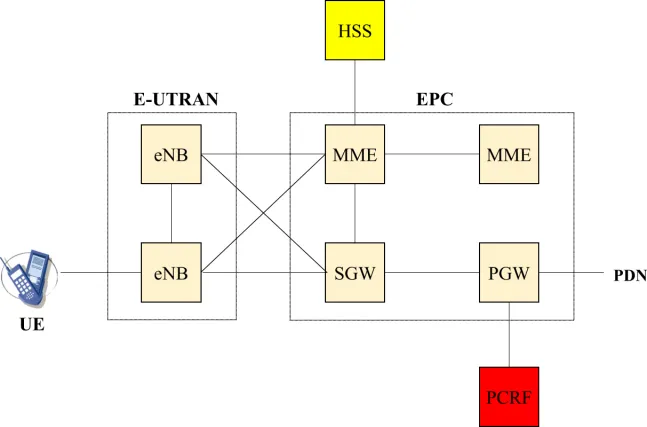
The functional architecture of the evolved packet system (EPS) network is illustrated in Figure 1.1.
Figure 1.1.Functional architecture of EPS network
The EPS mobile network consists of an evolved packet core (EPC) network and an evolved universal terrestrial radio access network (E-UTRAN).
The E-UTRAN access network ensures the connection of the User Equipment (UE).
The EPC core network interconnects the access networks, provides the interface to the packet data network (PDN) and ensures the attachment of mobile phones and the establishment of bearers.
1.1.1.1. eNB entity
The E-UTRAN access network includes a single type of entity, the evolved Node Base station (eNB) that connects to the mobiles.
The eNB entity is responsible for the management of radio resources, for the control of the establishment of the data radio dearer (DRB), in which the mobile traffic is transmitted and for its mobility management during the session (handover).
The eNB entity transfers the traffic data from the mobile (respectively from the Serving Gateway (SGW)) to the SGW entity (to the mobile phones concerned, accordingly).
When the eNB entity receives data from the mobile or the SGW entity, it refers to the QoS class identifier (QCI) in accordance with the data scheduling mechanism.
The eNB entity can perform the marking of the DiffServ code point (DSCP) field of IP header, based on the assigned QCI identifier, for the outgoing data to the SGW entity.
The eNB entity performs compression and encryption of traffic data on the radio interface.
The eNB entity performs encryption and integrity control of signaling data exchanged with the mobile.
It also undertakes the selection of the mobility management entity (MME) to which the mobile is attached.
It treats paging requests sent by the MME entity for their distribution in the cellphone corresponding to the radio coverage area of the eNB entity.
The eNB entity also distributes system information to the cell containing the technical characteristics of the radio interface and allowing the mobile access to connect.
The eNB entity uses the measurements made by the mobile to decide on the initiation of a cell change during a session (handover).
1.1.1.2. MME entity
The MME entity is the network control tower, allowing mobile access and controlling bearer establishment for the transmission of traffic data.
The MME entities belong to a group (pool). Load balancing of MME entities is provided by the eNB entities within a group that must have access to each MME entity of the same group.
The MME entity is responsible for attachment and detachment of the mobile phone to the network concerned.
During attachment, the MME entity retrieves the subscriber’s profile and the subscriber’s authentication data stored in the home subscriber server (HSS) and performs authentication of the mobile.
During attachment, the MME entity registers the tracking area identity (TAI) of the mobile and allocates a globally unique temporary identity (GUTI) to the mobile which replaces the private international mobile subscriber identity (IMSI).
The MME entity manages a list of location areas allocated to the mobile, where the mobile can move in an idle state, without contacting the MME entity to update its TAI location area.
When attaching the mobile, the MME selects SGW and PGW (PDN Gateway) entities for the construction of the default bearer, e.g. for the transport of IP packets containing Session Initiation Protocol (SIP) signaling.
For the construction of the bearer, the selection of the PGW entity is obtained from the access point name (APN), communicated by the mobile or by the HSS entity in the subscriber’s profile.
The source MME entity also selects the target MME entity when the mobile changes both cell and group (pool).
The MME entity provides the information required for lawful interception, such as the mobile status (idle or connected), the TAI location area if the mobile is idle or the E-UTRAN Cell Global Identifier (ECGI) if the mobile is in session.
1.1.1.3. SGW entity
The SGW entities are organized into groups (pools). To ensure load balancing ...
Table of contents
Cover
Table of Contents
Title
Copyright
Preface
List of Abbreviations
1 Network Architecture
2 Signaling Protocols
3 Basic Procedures
4 Radio Interface Procedures
5 Service Profiles
6 Interconnections
7 Handover
8 Roaming
9 Service Centralization and Continuity
10 Short Message Service
Bibliography
Index
End User License Agreement
Trusted by 375,005 students
Access to over 1.5 million titles for a fair monthly price.
Study more efficiently using our study tools.
Frequently asked questions
Yes, you can cancel anytime from the Subscription tab in your account settings on the Perlego website. Your subscription will stay active until the end of your current billing period. Learn how to cancel your subscription
No, books cannot be downloaded as external files, such as PDFs, for use outside of Perlego. However, you can download books within the Perlego app for offline reading on mobile or tablet. Learn how to download books offline
We are an online textbook subscription service, where you can get access to an entire online library for less than the price of a single book per month. With over 1.5 million books across 990+ topics, we’ve got you covered! Learn about our mission
Look out for the read-aloud symbol on your next book to see if you can listen to it. The read-aloud tool reads text aloud for you, highlighting the text as it is being read. You can pause it, speed it up and slow it down. Learn more about Read Aloud
Yes! You can use the Perlego app on both iOS and Android devices to read anytime, anywhere — even offline. Perfect for commutes or when you’re on the go. Please note we cannot support devices running on iOS 13 and Android 7 or earlier. Learn more about using the app
Yes, you can access VoLTE and ViLTE by André Pérez,André Perez in PDF and/or ePUB format, as well as other popular books in Technology & Engineering & Mobile & Wireless Communications. We have over 1.5 million books available in our catalogue for you to explore.