Electromagnetic Modeling and Simulation
eBook - ePub

Electromagnetic Modeling and Simulation

  1. English
  2. ePUB (mobile friendly)
  3. Available on iOS & Android
eBook - ePub

Electromagnetic Modeling and Simulation

About this book

This unique book presents simple, easy-to-use, but effective short codes as well as virtual tools that can be used by electrical, electronic, communication, and computer engineers in a broad range of electrical engineering problems

Electromagnetic modeling is essential to the design and modeling of antenna, radar, satellite, medical imaging, and other applications. In this book, author Levent Sevgi explains techniques for solving real-time complex physical problems using MATLAB-based short scripts and comprehensive virtual tools.

Unique in coverage and tutorial approach, Electromagnetic Modeling and Simulation covers fundamental analytical and numerical models that are widely used in teaching, research, and engineering designs—including mode and ray summation approaches with the canonical 2D nonpenetrable parallel plate waveguide as well as FDTD, MoM, and SSPE scripts. The book also establishes an intelligent balance among the essentials of EM MODSIM: The Problem (the physics), The Theory and Models (mathematical background and analytical solutions), and The Simulations (code developing plus validation, verification, and calibration).

Classroom tested in graduate-level and short courses, Electromagnetic Modeling and Simulation:

  • Clarifies concepts through numerous worked problems and quizzes provided throughout the book
  • Features valuable MATLAB-based, user-friendly, effective engineering and research virtual design tools
  • Includes sample scenarios and video clips recorded during characteristic simulations that visually impact learning—available on wiley.com
  • Provides readers with their first steps in EM MODSIM as well as tools for medium and high-level code developers and users

Electromagnetic Modeling and Simulation thoroughly covers the physics, mathematical background, analytical solutions, and code development of electromagnetic modeling, making it an ideal resource for electrical engineers and researchers.
Frequently asked questions

Yes, you can cancel anytime from the Subscription tab in your account settings on the Perlego website. Your subscription will stay active until the end of your current billing period. Learn how to cancel your subscription.
At the moment all of our mobile-responsive ePub books are available to download via the app. Most of our PDFs are also available to download and we're working on making the final remaining ones downloadable now. Learn more here.
Perlego offers two plans: Essential and Complete
  • Essential is ideal for learners and professionals who enjoy exploring a wide range of subjects. Access the Essential Library with 800,000+ trusted titles and best-sellers across business, personal growth, and the humanities. Includes unlimited reading time and Standard Read Aloud voice.
  • Complete: Perfect for advanced learners and researchers needing full, unrestricted access. Unlock 1.4M+ books across hundreds of subjects, including academic and specialized titles. The Complete Plan also includes advanced features like Premium Read Aloud and Research Assistant.
Both plans are available with monthly, semester, or annual billing cycles.
We are an online textbook subscription service, where you can get access to an entire online library for less than the price of a single book per month. With over 1 million books across 1000+ topics, we’ve got you covered! Learn more here.
Look out for the read-aloud symbol on your next book to see if you can listen to it. The read-aloud tool reads text aloud for you, highlighting the text as it is being read. You can pause it, speed it up and slow it down. Learn more here.
Yes! You can use the Perlego app on both iOS or Android devices to read anytime, anywhere — even offline. Perfect for commutes or when you’re on the go.
Please note we cannot support devices running on iOS 13 and Android 7 or earlier. Learn more about using the app.
Yes, you can access Electromagnetic Modeling and Simulation by Levent Sevgi in PDF and/or ePUB format, as well as other popular books in Physical Sciences & Electromagnetism. We have over one million books available in our catalogue for you to explore.

Information

CHAPTER 1
Introduction to MODSIM

Today's technical challenges posed by system complexities require a range of multidisciplinary, physics-based, problem-matched analytical and computational skills [1]. In electrical engineering (EE), real-life systems (from nanoscale to kilometer-wide) are among the most complex ones and almost totally involved in electromagnetics (EMs). EM theory is well established with Maxwell's equations but teaching/lecturing is always a challenge. Experimentation and hands-on measurement are the fundamentals of EM engineering education; however, strong theoretical background and numerical simulations are also essential. An intelligent approach is to use physics-based modeling, hands-on training, numerical-based modeling, and computer simulations all together.
Computer simulations, either in-house prepared or commercially available, have been effectively used in EMs. Key issues are model validation, code verification, and calibration (VV&C) and physical interpretation of the numbers obtained. The four critical words are mathematics, physics, experience, and practice [1]. A good EM modeling and simulation (EM-MODSIM) course should cover them all. Note that despite a correctly presented physical model, numerical simulation of the model contains errors caused by the numerical method itself, simplification of the physical structure, assumptions made there, machine computation limitations, and so forth. It is a challenge to establish a confidence in the results of numerical simulations.
Numerical models can be viewed differently from the developer's and the user's perspectives [2]. Developers, in addition to their concern about accuracy, cost/competition, and user friendly graphical user interface (GUI) design, deal primarily with the conceptual suitability and implementational steps of the code (verification), while the users are more involved in computation and application. Both are concerned with validation, although users are often tempted to apply code in a manner that it is not designed for, thus making validation an especially a sensitive topic. From the developer's perspective, the process of developing a numerical model involves conceptualization, formulation, numerical implementation, computation, and validation. On the other hand, the user's perspective involves the problem, that is, choosing a problem-matched approach and the application steps. A developer needs to know how the code works, but the user needs to know what it can do.
The fair metrics in characterization and comparison of numerical simulators are accuracy, reliability, efficiency, and, finally, applicability. Someone who deals with numerical simulation is in a quite similar position to that of an experimenter. They both need to understand requirements for their particular problem in terms of basic EM phenomena, but both also need to depend on complex tools that they did not design in order to accomplish their particular goals.

1.1 Models and Modeling

When not measuring or soldering, engineers continuously deal with models when analyzing, designing, and implementing [1–3]. The two phases in modeling are utilization and creation. The utilization is common practice and does not necessitate further comment other than “make the right choice and use the model carefully.” The creation phase requires delicate measurements, extreme perception, and/or excellent imagination.
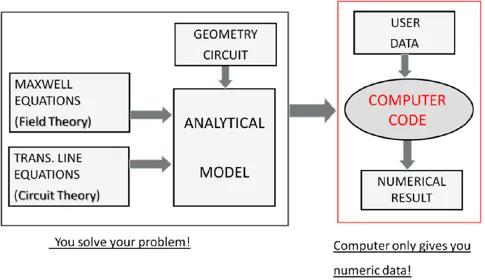
Maxwell's well-known equations establish the physics of EE, well define the interaction of electromagnetic waves with matter, and form the basis for a real understanding of EE problems and their solutions. Moreover, circuit theory equations are also derived from Maxwell's equations. There are two different solution approaches: analytical formulations and direct numerical simulation methods. Analytical and numerical model-based approaches are schematized in Fig. 1.1 and Fig. 1.2, respectively. The key difference between these two is the placement of problem geometry (i.e., boundary conditions [BCs]). Analytical-based approaches are problem (geometry) dependent. Once geometry changes, the problem has to be resolved. On the other hand, numerical-based approaches are problem (geometry) independent.
c1-fig-0001
Figure 1.1. Analytical-based modeling.
c1-fig-0002
Figure 1.2. Numerical-based modeling.
The model is derived from Maxwell's equations under a given problem geometry (i.e., for a given boundary conditions and medium parameters) for the analytical model-based approach. These models express solutions for independent variables, such as electric and magnetic field components or input–output voltages and currents, in terms of analytic functions (such as sine/cosine functions, Bessel/Hankel series, etc.). A computer program is required only to calculate an output value for a given input supplied by the user.
On the other hand, the principal algorithm models the intrinsic behavior of fields/circuits without reference to specific boundary and material configurations. Some well-known and widely used numerical approaches are also listed in the figure. The generic numerical model is applied from the very beginning and is augmented by boundary simulators and/or other peripheral units, such as near-field far-field transformations. Different problems (with respect to geometry and medium parameters) can be accommodated using such models.
Whether analytical or numerical, models need to be coded for calculations on a computer. While the model used in analytical solutions is constructed according to the geometry of the problem (i.e., boundary conditions and medium parameters), the numerical model is general and the geometry of the problem (together with the input parameters) is supplied after the model is built. That is, the boundary and/or initial conditions are supplied externally to the numerical model together with the medium parameters, operating frequency, signal bandwidth, and so forth. Once they are specified, simulations are run and sets of observable-based output parameters are computed for a given set of input parameters.
So the challenging question for an engineer becomes “which model to use, when?” No easy answer exist other than “experience.” One may wonder, “why not use the most sophisticated one?” The simple reply is that, to use a more complex model than needed may consume huge amount of computation time and, more importantly, obscure the insight to the problem.

1.2 Validation, Verification, and Calibration

Engineers, when analyzing, designing, calculating, simulating, ...

Table of contents

  1. Cover
  2. IEEE Press
  3. Title page
  4. Copyright page
  5. Dedication
  6. Preface
  7. About the Author
  8. Acknowledgments
  9. CHAPTER 1: Introduction to MODSIM
  10. CHAPTER 2: Engineers Speak with Numbers
  11. CHAPTER 3: Numerical Analysis in Electromagnetics
  12. CHAPTER 4: Fourier Transform and Fourier Series
  13. CHAPTER 5: Stochastic Modeling in Electromagnetics
  14. CHAPTER 6: Electromagnetic Theory: Basic Review
  15. CHAPTER 7: Sturm–Liouville Equation: The Bridge between Eigenvalue and Green's Function Problems
  16. CHAPTER 8: The 2D Nonpenetrable Parallel Plate Waveguide
  17. CHAPTER 9: Wedge Waveguide with Nonpenetrable Boundaries
  18. CHAPTER 10: High Frequency Asymptotics: The 2D Wedge Diffraction Problem
  19. CHAPTER 11: Antennas: Isotropic Radiators and Beam Forming/Beam Steering
  20. CHAPTER 12: Simple Propagation Models and Ray Solutions
  21. CHAPTER 13: Method of Moments
  22. CHAPTER 14: Finite-Difference Time-Domain Method
  23. CHAPTER 15: Parabolic Equation Method
  24. CHAPTER 16: Parallel Plate Waveguide Problem
  25. APPENDIX A: Introduction to MATLAB
  26. APPENDIX B: Suggested References
  27. APPENDIX C: Suggested Tutorials and Feature Articles
  28. Index
  29. IEEE PRESS SERIES ON ELECTROMAGNETIC WAVE THEORY
  30. End User License Agreement