Fungi have an integral role to play in the development of the biotechnology and biomedical sectors. The fields of chemical engineering, Agri-food,Biochemical, pharmaceuticals, diagnostics and medical device development all
employ fungal products, with fungal biomolecules currently used in a wide range of applications, ranging from drug development to food technology and agricultural biotechnology. Understanding the biology of different fungi in diverse ecosystems, as well as their biotropic interactions with other microorganisms, animals and plants, is essential to underpin effective and innovative technological developments.
Fungal Biomolecules is a keystone reference, integrating branches of fungal product research into a comprehensive volume of interdisciplinary research. As such, it:
reflects state-of-the-art research and current emerging issues in fungal biology and biotechnology
reviews the methods and experimental work used to investigate different aspects of fungal biomolecules
provides examples of the diverse applications of fungal biomolecules in the areas of food, health and the environment
is edited by an experienced team, with contributions from international specialists
This book is an invaluable resource for industry-based researchers, academic institutions and professionals
working in the area of fungal biology and associated biomolecules for their applications in food technology, microbial and biochemical process, biotechnology, natural products, drug development and agriculture.
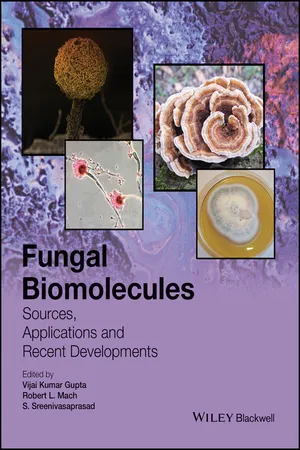
eBook - ePub
Fungal Biomolecules
Sources, Applications and Recent Developments
- English
- ePUB (mobile friendly)
- Available on iOS & Android
eBook - ePub
Fungal Biomolecules
Sources, Applications and Recent Developments
About this book
Information
Section 1
Fungi as cell factories
Chapter 1
Fungal biofilms: An overview
Virginia Medeiros de Siqueira
Microbial Resources Division (DRM), Research Center for Chemistry, Biology and Agriculture (CPQBA), Campinas University (UNICAMP), Campinas, SP, Brazil
1.1 Biofilm: Definition and basic concepts
In fact, there has been an explosion of studies examining microbial biofilms in the last 20 years, which have been accompanied by the development and improvement of the techniques that revolutionized our understanding of biofilms; but despite the several advantages brought about by the new techniques, a very simple question still remains: what is a biofilm?
The term biofilm is self-explanatory, but even for biofilm researchers, its definition remains controversial for many reasons. For example, film semantically implies a continuous and relatively thin layer, but many biological structures regarded as biofilms are neither continuous nor thin (Lewandowski and Beyenal 2007). Moreover, research on biofilms has developed into interdisciplinary work, and scientists involved are from different research fields that leads to individual judgements regarding the professional area. Consequently, it can be said that there are almost as many definitions as there are scientists working in the biofilm field. Facing the problematic definition, Wimpenny (2000) listed the types and descriptions of microbial systems that are related to biofilms but, as a result of these diverse definitions, still left divergences in the application of the terminology.
Despite the difficulties in defining biofilm, and the diversity of pathways utilized to make a biofilm documented, the past decades have revealed common phenotypes conserved among biofilms. Thus, observing similarities among very different biofilms will likely teach us much. In this chapter, it used a simple and widely accepted definition which says that biofilms are microbial communities formed by microorganisms attached to a surface and enclosed in a matrix of extracellular polymeric substances (EPS) (Donlan and Costerson 2002; Stoodley et al. 2002; Harrison et al. 2005; Huq et al. 2008). As microbial communities, biofilms are assemblages of diverse species occupying the same, functional discrete environment and have a complex level of organization with a distinctive structure, own activities and laws, which depend on the relationships between their constituents (Wimpenny 2000).
In general, for the development of a biofilm, the cell leaves its planktonic condition and attach to a surface and/or other cells within an exopolymeric matrix. In a biofilm, the structures of individual cells are not significantly altered, but the individuals become organized into a complex structure and display novel characteristics and phenotypes (Harding et al. 2009). The physical proximity of other cells promotes synergistic interactions and aid to microbial cells in numerous aspects of their life cycles. These benefits may include increased tolerance to chemical, biological and physical stresses; efficient capture of nutrients; enhanced cell to cell communication; and colonization of host tissues (Lewis 2001; Mahmoud and O’Toole 2001). A typical bacterial biofilm development model can be described in five main stages: (1) adsorption, association or initial attachment of a single cell to a surface, (2) adhesion, (3) microcolony formation, (4) maturation and (5) dispersal.
The third stage of biofilm development in which cells form microcolonies is characterized by the production of EPS. EPS can represent 50–90% of the total organic matter of biofilms and are responsible for binding cells and other particulate materials together (cohesion) and to the surface (adhesion), that is, providing the structural support for the biofilm maturation (Allison 2003). Polysaccharides are characteristic components of EPS, but its chemistry is complex and in general also comprises proteins, nucleic acids, lipids, phospholipids and humic substances. Although polysaccharides have been well studied, the literature suggests a large variety, but uncharacterized, of components produced by different species under different growth conditions (Sutherland 2001). Beyond mechanical stability, EPS protect biofilm against adverse conditions and biocides and also permit the development of microconsortia, concentration gradients, retention of extracellular enzymes, convective mass transport through channels, easy horizontal gene transfer, a matrix for exchange of signalling molecules and light transmission into the deeper layers of the biofilm structure (Flemming 2002). Biofilm formation at the interface between a solid substratum and a liquid is a common phenomenon in natural, medical and industrial environments. In water distribution systems, it is estimated that 95% of microbial biomass is in biofilms (Momba et al. 2000); thus, biofilms are considered a main reservoir of pathogens and a great threat to safe drinking water.
1.2 Fungi and fungal biofilms
1.2.1 Fungi
Fungi are a ubiquitous and diverse group of organisms belonging to the kingdom Fungi which was first considered as the fifth kingdom by Whittaker (1959). According to the most recent classification, this kingdom comprises 1 subkingdom, 7 phyla, 10 subphyla, 35 classes, 12 subclasses and 129 orders (Hibbett et al. 2007). It has been estimated that 1.5 million species exist worldwide and about only 120,000 species have been described to date (Kirk et al. 2001).
Despite difficulties defining the limits of the group, mycologists have defined fungi as ‘eukaryotic, spore-producing, achlorophyllous organisms with absorptive nutrition that generally reproduce both sexually and asexually and whose usually filamentous branched somatic structures, known as hyphae, typically are surrounded by cell walls’ (Alexopoulos et al. 1996). Based on their lifestyle, fungi are characterized by heterotrophic nutrition and cosmopolitan distribution (Kendrick 1992). As a matter of didactic and a practical approach to classification, fungi have been divided into groups based on their morphology, that is, filamentous fungi (or moulds), yeasts and mushrooms.
As a diverse and dynamic group, fungi are involved in many activities that affect human both in a good and bad way. In general, the single most important role that fungi play is not specifically identified yet, but fungi are the most important agent of decay on Earth (Alexopoulos et al. 1996) and play a predominant role in recycling organic matter in the environment. Fungi are often observed on decaying foodstuff on which some fungi produce toxins (mycotoxins); many of them are plant and human pathogens. In addition, fungi are used to produce commercial products such as antibiotics (e.g. penicillin), organic acids (e.g. citric acid), industrial alcohol (e.g. biofuel) and enzymes (e.g. amylases). Moreover, fungi are also used in food industry for the production of a diverse range of important foodstuffs such as bread, beer, cheese, meats and soy sauce (Paterson and Lima 2005).
1.2.2 Filamentous fungal biofilms
Bacterial and yeast biofilms have been greatly studied in the last 20 years (Chandra et al. 2001; Kumamoto and Vinc...
Table of contents
- Cover
- Title page
- Copyright page
- Contributors
- Foreword
- Preface
- Section 1: Fungi as cell factories
- Section 2: Production of recombinant peptides
- Section 3: Fungal secondary metabolites and synthesis
- Section 4: Regulation of fungal secondary metabolism
- Section 5: Developments and advancements
- Index
- End User License Agreement
Trusted by 375,005 students
Access to over 1.5 million titles for a fair monthly price.
Study more efficiently using our study tools.
Frequently asked questions
Yes, you can cancel anytime from the Subscription tab in your account settings on the Perlego website. Your subscription will stay active until the end of your current billing period. Learn how to cancel your subscription
No, books cannot be downloaded as external files, such as PDFs, for use outside of Perlego. However, you can download books within the Perlego app for offline reading on mobile or tablet. Learn how to download books offline
Perlego offers two plans: Essential and Complete
- Essential is ideal for learners and professionals who enjoy exploring a wide range of subjects. Access the Essential Library with 800,000+ trusted titles and best-sellers across business, personal growth, and the humanities. Includes unlimited reading time and Standard Read Aloud voice.
- Complete: Perfect for advanced learners and researchers needing full, unrestricted access. Unlock 1.5M+ books across hundreds of subjects, including academic and specialized titles. The Complete Plan also includes advanced features like Premium Read Aloud and Research Assistant.
We are an online textbook subscription service, where you can get access to an entire online library for less than the price of a single book per month. With over 1.5 million books across 990+ topics, we’ve got you covered! Learn about our mission
Look out for the read-aloud symbol on your next book to see if you can listen to it. The read-aloud tool reads text aloud for you, highlighting the text as it is being read. You can pause it, speed it up and slow it down. Learn more about Read Aloud
Yes! You can use the Perlego app on both iOS and Android devices to read anytime, anywhere — even offline. Perfect for commutes or when you’re on the go.
Please note we cannot support devices running on iOS 13 and Android 7 or earlier. Learn more about using the app
Please note we cannot support devices running on iOS 13 and Android 7 or earlier. Learn more about using the app
Yes, you can access Fungal Biomolecules by Vijai Kumar Gupta, Robert L. Mach, S. Sreenivasaprasad, Vijai Kumar Gupta,Robert L. Mach,S. Sreenivasaprasad in PDF and/or ePUB format, as well as other popular books in Biological Sciences & Cell Biology. We have over 1.5 million books available in our catalogue for you to explore.