Winner of the CHOICE Outstanding Academic Title 2017 Award
This comprehensive collection of top-level contributions provides a thorough review of the vibrant field of chemistry education. Highly-experienced chemistry professors and education experts cover the latest developments in chemistry learning and teaching, as well as the pivotal role of chemistry for shaping a more sustainable future.
Adopting a practice-oriented approach, the current challenges and opportunities posed by chemistry education are critically discussed, highlighting the pitfalls that can occur in teaching chemistry and how to circumvent them. The main topics discussed include best practices, project-based education, blended learning and the role of technology, including e-learning, and science visualization.
Hands-on recommendations on how to optimally implement innovative strategies of teaching chemistry at university and high-school levels make this book an essential resource for anybody interested in either teaching or learning chemistry more effectively, from experience chemistry professors to secondary school teachers, from educators with no formal training in didactics to frustrated chemistry students.
eBook - ePub
Chemistry Education
Best Practices, Opportunities and Trends
- English
- ePUB (mobile friendly)
- Available on iOS & Android
eBook - ePub
Chemistry Education
Best Practices, Opportunities and Trends
About this book
Information
Part I
Chemistry Education: A Global Endeavour
Chapter 1
Chemistry Education and Human Activity
Peter Mahaffy
1.1 Overview
The context for the book Chemistry Education: Best Practices, Opportunities, and Trends is set by this opening chapter, which asserts that the difference between historical “chemical education” and contemporary “chemistry education” is human activity. Tetrahedral chemistry education is reviewed as a visual and conceptual metaphor that was created to emphasize the need to situate chemical concepts, symbolic representations, and chemical substances and reactions in important human contexts. Three dimensions of human activity that require strong emphasis for educational practice to meet the learning needs of students are developed: (i) the human activity of learning and teaching chemistry; (ii) the human activity of carrying out chemistry; and (iii) the human activity that has imprinted itself in such a substantial way on the chemistry of our planet that it has defined a new geological epoch. Introducing chemistry content through rich contexts is proposed as one evidence-based approach for weaving all three of these dimensions of human activity into the practice of teaching and learning chemistry at secondary and post-secondary levels.
1.2 Chemistry Education and Human Activity
The term “chemical” education, which I encounter every day, has a long and storied history. I belong to the “chemical” education divisions of both the Chemical Institute of Canada and the American Chemical Society (ACS). On my bookshelf is the Journal of “Chemical” Education, and I access resources from the “Chemical” Education Digital Library. I regularly attend “chemical” education conferences and visit “chemical” education centers. In my professional circles, research and practice is supported by “chemical” education foundations, and exemplary practitioners of the art, science, and craft of teaching chemistry receive awards for contributions to “chemical” education.
Yet, by design, the title of both this chapter and this book uses the word “chemistry” instead of “chemical” education. Should the two terms be used interchangeably, as is so often done?
The difference between chemical education and chemistry education is human activity.
How should the modern profession of “chemistry” education differ from historic “chemical” education? The term “chemical” education accurately conveys that at the heart of this domain of education are substances: their structures and properties, and the reactions that change them into other substances. But, beyond chemicals, human activity is central to (i) teaching and learning chemistry, (ii) the practice of chemistry in laboratories and industry, and (iii) the use and reactions of chemical substances by ordinary people. This opening chapter in Chemistry Education: Best Practices, Opportunities, and Trends asserts that chemistry educators should embed an understanding of all three of these different types of human activity into their practices of teaching and learning about the structures, properties, and reactions of chemical substances. And consistently using the term “chemistry education” as a more authentic descriptor than “chemical education” is a good starting point in conveying to students and the public the centrality of human activity in our professional domain.
1.3 A Visual Metaphor: Tetrahedral Chemistry Education
As chemistry educators, are we stuck in some of the historic practices of “chemical” education that we may have experienced as students? Have we narrowed our field of vision to presenting the intricate details of chemical substances and their reactions? Do our course and program learning objectives sufficiently incorporate students' need to understand why they should care about the “chemical” content they receive? Understanding how to effectively present “chemistry” authentically to students, including the multifaceted human connections of the discipline, has motivated an important thread of my research and practice for over a decade. Knowing that metaphors can influence as well as reflect practice, I have encouraged stronger emphasis on human activity in chemistry education through a new visual and conceptual metaphor – tetrahedral chemistry education [1].
How does a tetrahedral shape relate to the move from “chemical” to “chemistry” education? Chemistry educators have shown that students need to encounter chemistry at different thinking levels to obtain a rich understanding of chemical substances and reactions. To address human learning patterns, Johnstone, Gabel, and others [2] have proposed three widely accepted thinking levels needed to learn chemistry: the symbolic or representational (symbols, equations, calculations), the macroscopic (tangible, visible, laboratory), and the molecular or submicroscopic. These are often represented as a triangle of thinking levels required for mastery of chemistry. As shown in Figure 1.1, the visual metaphor of tetrahedral chemistry education extends the triangle of levels of engaging chemistry into a third dimension, in which the fourth vertex represents the human contexts for chemistry. This new visual dimension emphasizes the need to situate chemical concepts, symbolic representations, and chemical substances and processes in the authentic contexts of the human beings who create substances, the culture that uses them, and the students who try to understand them. The tetrahedral chemistry education metaphor has been adapted and extended in various initiatives to articulate and support approaches to curriculum that foreground the human contexts for chemistry [3].
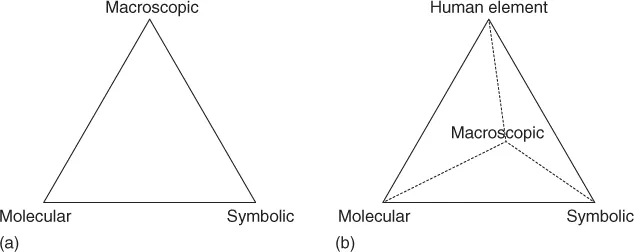
Figure 1.1 Tetrahedral chemistry education (b), as an extension of the triangle of thinking levels (a), making the focus on human activity in learning and teaching chemistry more visible and intentional.
1.4 Three Emphases on Human Activity in Chemistry Education
What sorts of human activities are implied by changing the description of “chemical” to chemistry education, and emphasized by invoking the metaphor of tetrahedral chemistry education? What implications might more formal and systematic emphases on the human element have on learning through and about chemistry? How does emphasizing the human activity of chemistry flow from and inform research findings? Is our developing understanding of how the scale of human activity impacts the chemistry of our planet's life support systems adequately reflected in curriculum and pedagogy?
In this opening chapter, we take a 10-km high view of chemistry education to articulate three dimensions of human activity that should receive strong emphases in our professional efforts to ensure that our practice meets the learning needs of chemistry stud...
Table of contents
- Cover
- Related Titles
- Title Page
- Copyright
- Foreword
- Preface
- List of Contributors
- Part I: Chemistry Education: A Global Endeavour
- Part II: Best Practices and Innovative Strategies
- Part III: The Role of New Technologies
- Index
- End User License Agreement
Trusted by 375,005 students
Access to over 1.5 million titles for a fair monthly price.
Study more efficiently using our study tools.
Frequently asked questions
Yes, you can cancel anytime from the Subscription tab in your account settings on the Perlego website. Your subscription will stay active until the end of your current billing period. Learn how to cancel your subscription
No, books cannot be downloaded as external files, such as PDFs, for use outside of Perlego. However, you can download books within the Perlego app for offline reading on mobile or tablet. Learn how to download books offline
Perlego offers two plans: Essential and Complete
- Essential is ideal for learners and professionals who enjoy exploring a wide range of subjects. Access the Essential Library with 800,000+ trusted titles and best-sellers across business, personal growth, and the humanities. Includes unlimited reading time and Standard Read Aloud voice.
- Complete: Perfect for advanced learners and researchers needing full, unrestricted access. Unlock 1.5M+ books across hundreds of subjects, including academic and specialized titles. The Complete Plan also includes advanced features like Premium Read Aloud and Research Assistant.
We are an online textbook subscription service, where you can get access to an entire online library for less than the price of a single book per month. With over 1.5 million books across 990+ topics, we’ve got you covered! Learn about our mission
Look out for the read-aloud symbol on your next book to see if you can listen to it. The read-aloud tool reads text aloud for you, highlighting the text as it is being read. You can pause it, speed it up and slow it down. Learn more about Read Aloud
Yes! You can use the Perlego app on both iOS and Android devices to read anytime, anywhere — even offline. Perfect for commutes or when you’re on the go.
Please note we cannot support devices running on iOS 13 and Android 7 or earlier. Learn more about using the app
Please note we cannot support devices running on iOS 13 and Android 7 or earlier. Learn more about using the app
Yes, you can access Chemistry Education by Javier García-Martínez, Elena Serrano-Torregrosa, Javier García-Martínez,Elena Serrano-Torregrosa in PDF and/or ePUB format, as well as other popular books in Technology & Engineering & Materials Science. We have over 1.5 million books available in our catalogue for you to explore.