- Demonstrates the importance of research with children and research from a child perspective, in order to fully understand the meaning and impact of health and illness in children's lives
- Encourages critical reflection on contemporary health policy and its relationships to culturally specific ways of knowing and understanding children's health
- Brings together new and leading scholars in the field of children's health and illness
- Moves the highly important issue of children's health into the mainstream sociology of health and illness
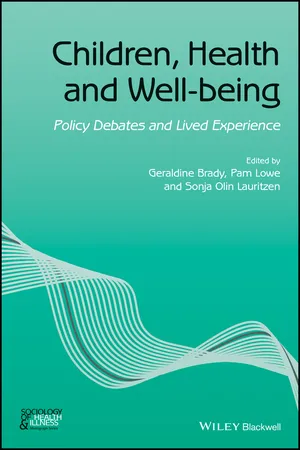
eBook - ePub
Children, Health and Well-being
Policy Debates and Lived Experience
- English
- ePUB (mobile friendly)
- Available on iOS & Android
eBook - ePub
Children, Health and Well-being
Policy Debates and Lived Experience
About this book
This book brings together new and leading scholars, who demonstrate the importance of research with children and from a child perspective, allowing for a fuller understanding of the meaning and impact of health and illness in children's lives.
Information
1
Connecting a sociology of childhood perspective with the study of child health, illness and wellbeing: introduction
Geraldine Brady, Pam Lowe and Sonja Olin Lauritzen
The health and wellbeing of children and young people has been studied from a range of different perspectives in social science and the health sciences as a whole. Much of the research to date has been for or on children and has focused on promoting health, detecting illness and its causes or investigating the social determinants of health. While these make vital contributions to making the world better for children and young people, we would argue there is also a need for research with children, research from a child perspective, to fully understand the meaning and impact of health and illness in children's lives. Furthermore, there is a need to explore the social and cultural contexts of child health that frame the lived experiences of children and their parents. More specifically, there is a need to interrogate the explicit as well as the implicit perceptions of childhood and the child in health policy, perceptions that are reproduced in various health and social practices. The purpose of this issue is to contribute to a further understanding of these issues by bridging developments in the sociology of childhood and the sociology of health and illness.
In the last decades we have seen a growing interest across disciplines in research on children's own experiences and understandings of health and illness. It can be argued that this increasing interest has been stimulated by developments in the sociology of childhood. Through the 1990s a body of work emerged which criticised dominant notions of child development where children were largely depicted as immature and passive objects of socialisation (Burman 1994, Halldén 1991, James and Prout 1997, Qvortrup 1994).
Scholars of the sociology of childhood problematised these notions of the child by theorising the ways in which childhood is socially constructed and understandings of the child vary across different sociocultural contexts. Importantly, the focus was shifted from seeing children as immature becomings on their way to adulthood to a focus on children as beings and as competent actors with a social agency of their own, not only influenced by but also influencing their social worlds (James et al. 1998, James and Prout 1997, Qvortrup 1994). Moreover, by understanding children as a specific social group, attention could be directed at children's rights and the structures that enabled and restricted control over their lives (Alanen and Mayall 2001).
Since these early years, the theoretical positions and central concepts in the sociology of childhood (and its place in sociology) have been, and are, debated (see, for example, Alanen 2014, James 2010, Moran-Ellis 2010). At the same time, empirical studies of children and childhoods have been burgeoning in sociology and in other disciplines. Although a full account of these developments and disciplinary differences falls outside the scope of this issue, here we want to draw attention to some of the central concepts and theoretical points of departure in this tradition that we find of particular interest for studies of child health and wellbeing.
Firstly, seeing children as a social (minority) group draws our attention to the ways this group is placed and perceived in the structures of societies. Children as a social group need to be understood in relation to other social groups. Importantly, work on children as positioned in intergenerational relations has added to understanding of the dynamics in relations between children, parents and adult society (Mayall 1996, 1998). This involves power relations and the ways children (as a group) are listened to and taken account of in different social settings, such as in healthcare settings and at school, but also prevailing discourses and images of the child in social and health policy and health promotion interventions addressing children and young people.
Secondly, understanding children as social agents and as co-constructors of their social worlds is fundamental to studying their experiences and ways of dealing with health and well-being in everyday life. Child agency is a core issue in the sociology of childhood, but it has also been debated in this tradition in recent years. Agency is not to be seen as just something positive, or a personal competence, but as a more complex and multidimensional concept (Valentine 2011). Children's agency is bounded by and in intergenerational relations as well as in wider socioeconomic contexts and bodily, social and material resources. This raises questions about whose actions should impact on whom (Tisdall and Punch 2012). Power and participation are situated and changeable, which calls for attention to how children's agency is perceived, facilitated and restrained in specific settings.
Thirdly, in recent years, there has been a turn towards seeing children as beings (not just becomings). However, it is also argued that all humans are becomings; subjects who develop and change as they experience the world and in relation to different social contexts (Lee 2001, 2005, Prout 2005, Uprichard 2008). Further, there is an issue with diversity and variation in children's lives. There is no typical child. Children are of different ages, gender, ethnicity, socioeconomic circumstances and capacity. They live in different national and cultural contexts and attend different educational institutions. Thus, they are subject to different structures and discourses on children and childhoods (Prout 2005). Increasingly, conceptualisations of the child that homogenise and decontextualise children and their lives are being viewed as problematic (see, for example, Singal and Muthukrishna, 2014).
We argue that there is a need to reflect more broadly on learning from the sociology of childhood in research on child health. This tradition is now well established and there is much evidence to indicate that children are competent social actors, yet we are in agreement with Tisdall and Punch when they state that:
Focusing on children and young people's perspectives, agency and participation is no longer sufficient; greater emphasis is needed on the intricacies, complexities, tensions, ambiguities and ambivalences of children and young people's lives across both Majority and Minority World contexts. (2012: 22)
These issues also raise questions about research methodology. The risk of homogenising and decontextualising children also applies to the context of research on children's lives. If it is important to do research with children, how do we locate children at the centre of knowledge production? How can we access children's perspectives and lived experience? One avenue suggested is to use a range of methods to take account of diversity between children (see, for example, Christensen and James 2000) or to involve children as actors in research as a way to overcome the power imbalance between the child and the researcher (Alderson 2000, Mason and Hood 2011) which, however, might create new methodological problems (Harden et al. 2000). On the other hand, whether research with children is necessarily different from research with adults is also being questioned. ‘If children are competent social actors, why are special “child-friendly methods” needed to communicate with them?’ (Punch 2002: 321). These, and other methodological issues are part and parcel of research with children and need to be addressed to obtain a child's perspective on health and wellbeing.
So, what are the child health issues and concerns in contemporary society? Children are diagnosed with an increasing range of conditions and are subject to more and more elaborate child health and welfare interventions, reflecting a medical perspective on the changing panorama of illness and health risks in the 21st century. We see today a growing concern with mental health (for example, the autistic spectrum), as well as emerging contested illnesses (attention deficit hyperactivity disorder [ADHD]), life-style related conditions (obesity and allergies) or ‘new’ infectious diseases (HIV/AIDS). However, we would argue that in trying to bridge the sociology of childhood with that of health and illness, it is important to look beyond what is discussed as child health issues and take account of issues currently debated in the sociology of health and illness more generally. Health behaviour approaches have almost universally been adopted by those involved in healthcare research, with little critical attention paid to the conceptualization of health behaviour (Cohn, 2014). The assumption that there are easily identifiable and observable forms of health behaviour can be difficult to challenge, not least because the way in which health behaviours are seen as the outcome of individual choices has become established as the norm. This model also draws on ideas about agency, particularly in relation to choice and personal responsibility, often devoid of the social, economic and political context in which such agency is being enacted. In addition, a focus on health risks and surveillance medicine, as well as on lay understandings and patient perspectives, are relevant in the study of child health. However, research on these health issues, similarly to the old issues of chronic or life threatening illness, have largely been limited to the taken-for-granted adult person (Williams 2000). Expanding research to other phases of the life-course to include childhood is important not only to understand the meaning of child health and children's experiences but also to add important knowledge at a more general level to the understandings of health and illness.
Themes of this issue
As outlined above, in this issue we focus on the ways that socially and culturally constructed understandings and conceptualisations of childhood impact on issues of health and well-being and on the ways in which children exercise agency and competence in dealing with health and illness. A further consideration is how agency is bounded in intergenerational relations; while the focus of this issue is on children, the role of parents as mediators and facilitators in the healthcare division of labour (Stacey 1988, Mayall 1996) cannot be underestimated. Further, health, we argue, can be understood only by locating children as embodied beings (Bendelow 2009) in different social and cultural contexts. To advance our understandings of child health, it is necessary to situate child health issues in wider social, economic, cultural and national contexts as well as in the variety of public and social policies that will impact on dominant ways of understanding childhood and on children's lives and opportunities.
Children's daily lives play out across the social contexts which structure their lives. The settings of school and home largely organise children's lives, while their movement between such settings straddles the public and private domains. Messages about health are communicated to children both explicitly and implicitly so that they begin to learn social norms around health and, sometimes, change their behaviour in response to such messages. Mayall has argued that ‘child health is not a neutral, factual concept; notions of child health are constructed out of essentially political considerations’ (Mayall 1996:22). It may be assumed that children are relatively passive and conforming when faced with illness or diagnoses, yet children do exercise choices. Children have an active role in the management of health risks, their conditions and interactions with healthcare services. Moreover, they develop a repertoire of strategies to cope and sometimes to resist adult defined agendas (Bluebond-Langner 1978, 1996). Adults can be unaware of the ways in which children are interpreting information on health and making it meaningful to their lives. Previous health research has shown that even chronologically young children are competent reporters of their illness experiences (Alderson 1993) and that children can understand complex information if it is presented in appropriate ways (Alderson and Goodey 1996).
Since Mayall's 1998 article in this journal calling for a sociology of child health, research published in this area has increased but is sometimes disparately located. In this issue, the aim is to contribute to the development of a sociology of child health by bringing together current research that draws on t...
Table of contents
- Cover
- Series
- Title page
- Copyright
- Notes on contributors
- 1 Connecting a sociology of childhood perspective with the study of child health, illness and wellbeing: introduction
- 2 Where is the child? A discursive exploration of the positioning of children in research on mental–health-promoting interventions
- 3 Biologising parenting: neuroscience discourse, English social and public health policy and understandings of the child
- 4 Obesity in question: understandings of body shape, self and normalcy among children in Malta
- 5 ‘You have to do 60 minutes of physical activity per day … I saw it on TV’: Children's constructions of play in the context of Canadian public health discourse of playing for health
- 6 Parents' experiences of diagnostic processes of young children in Norwegian day-care institutions
- 7 The meaning of a label for teenagers negotiating identity: experiences with autism spectrum disorder
- 8 What am I ‘living’ with? Growing up with HIV in Uganda and Zimbabwe
- 9 Food, risk and place: agency and negotiations of young people with food allergy
- 10 Negotiating pain: the joint construction of a child's bodily sensation
- 11 Understanding inter-generational relations: the case of health maintenance by children
- Index
- EULA
Trusted by 375,005 students
Access to over 1.5 million titles for a fair monthly price.
Study more efficiently using our study tools.
Frequently asked questions
Yes, you can cancel anytime from the Subscription tab in your account settings on the Perlego website. Your subscription will stay active until the end of your current billing period. Learn how to cancel your subscription
No, books cannot be downloaded as external files, such as PDFs, for use outside of Perlego. However, you can download books within the Perlego app for offline reading on mobile or tablet. Learn how to download books offline
We are an online textbook subscription service, where you can get access to an entire online library for less than the price of a single book per month. With over 1.5 million books across 990+ topics, we’ve got you covered! Learn about our mission
Look out for the read-aloud symbol on your next book to see if you can listen to it. The read-aloud tool reads text aloud for you, highlighting the text as it is being read. You can pause it, speed it up and slow it down. Learn more about Read Aloud
Yes! You can use the Perlego app on both iOS and Android devices to read anytime, anywhere — even offline. Perfect for commutes or when you’re on the go.
Please note we cannot support devices running on iOS 13 and Android 7 or earlier. Learn more about using the app
Please note we cannot support devices running on iOS 13 and Android 7 or earlier. Learn more about using the app
Yes, you can access Children, Health and Well-being by Geraldine Brady,Pam Lowe,Sonja Olin Lauritzen in PDF and/or ePUB format, as well as other popular books in Social Sciences & Sociology. We have over 1.5 million books available in our catalogue for you to explore.