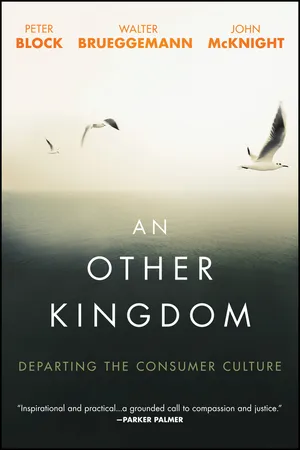
An Other Kingdom
eBook - ePub

An Other Kingdom

Departing the Consumer Culture

  1. English
  2. ePUB (mobile friendly)
  3. Available on iOS & Android
eBook - ePub

An Other Kingdom

Departing the Consumer Culture

About this book

Our seduction into beliefs in competition, scarcity, and acquisition are producing too many casualties. We need to depart a kingdom that creates isolation, polarized debate, an exhausted planet, and violence that comes with the will to empire. The abbreviation of this empire is called a consumer culture.

We think the free market ideology that surrounds us is true and inevitable and represents progress. We are called to better adapt, be more agile, more lean, more schooled, more, more, more. Give it up. There is no such thing as customer satisfaction.

We need a new narrative, a shift in our thinking and speaking. An Other Kingdom takes us out of a culture of addictive consumption into a place where life is ours to create together. This satisfying way depends upon a neighborly covenant—an agreement that we together, will better raise our children, be healthy, be connected, be safe, and provide a livelihood. The neighborly covenant has a different language than market-hype. It speaks instead in a sacred tongue.

Authors Peter Block, Walter Brueggemann, and John McKnight invite you on a journey of departure from our consumer market culture, with its constellations of empire and control. Discover an alternative set of beliefs that have the capacity to evoke a culture where poverty, violence, and shrinking well-being are not inevitable—a culture in which the social order produces enough for all. They ask you to consider this other kingdom. To participate in this modern exodus towards a modern community. To awaken its beginnings are all around us. An Other Kingdom outlines this journey to construct a future outside the systems world of solutions.

Frequently asked questions

Yes, you can cancel anytime from the Subscription tab in your account settings on the Perlego website. Your subscription will stay active until the end of your current billing period. Learn how to cancel your subscription.
At the moment all of our mobile-responsive ePub books are available to download via the app. Most of our PDFs are also available to download and we're working on making the final remaining ones downloadable now. Learn more here.
Perlego offers two plans: Essential and Complete
  • Essential is ideal for learners and professionals who enjoy exploring a wide range of subjects. Access the Essential Library with 800,000+ trusted titles and best-sellers across business, personal growth, and the humanities. Includes unlimited reading time and Standard Read Aloud voice.
  • Complete: Perfect for advanced learners and researchers needing full, unrestricted access. Unlock 1.4M+ books across hundreds of subjects, including academic and specialized titles. The Complete Plan also includes advanced features like Premium Read Aloud and Research Assistant.
Both plans are available with monthly, semester, or annual billing cycles.
We are an online textbook subscription service, where you can get access to an entire online library for less than the price of a single book per month. With over 1 million books across 1000+ topics, we’ve got you covered! Learn more here.
Look out for the read-aloud symbol on your next book to see if you can listen to it. The read-aloud tool reads text aloud for you, highlighting the text as it is being read. You can pause it, speed it up and slow it down. Learn more here.
Yes! You can use the Perlego app on both iOS or Android devices to read anytime, anywhere — even offline. Perfect for commutes or when you’re on the go.
Please note we cannot support devices running on iOS 13 and Android 7 or earlier. Learn more about using the app.
Yes, you can access An Other Kingdom by Peter Block,Walter Brueggemann,John McKnight in PDF and/or ePUB format, as well as other popular books in Business & Business General. We have over one million books available in our catalogue for you to explore.

Information

Publisher
Wiley
Year
2015
Print ISBN
9781119194729
eBook ISBN
9781119194743
Edition
1

1
THE FREE MARKET CONSUMER IDEOLOGY

I will pull down my barns and build bigger barns.
—Luke 12:18
The free market consumer ideology rests on four pillars: Scarcity, Certainty, Perfection, and Privatization. We take as true and inevitable that the contracts of commerce, resting on these pillars, which produce the commercial order, are the defining producer of our cultural order.
The culture produced by the free market consumer ideology relies on the idea of needs—real or manufactured—that can only be satisfied by production, distribution, and purchase. Monopoly is the unstated intention. It stands on autonomy as an organizing principle of culture; it is indifferent to gifts. When the apostle Paul asks, ā€œWhat do you have that you have not been given?ā€ the neighborly culture would say that everything I have has been given. The free market consumer ideology declares that everything I have I’ve earned.
This contract culture sends us down a track laid down by systems. In the systems world, whatever is un-organized and un-managed does not exist. Institutions are its structure of preference, and the ā€œfreeā€ market a core conviction. Its idea of free is the absence of limits and restraints. There should be no restraints when it comes to production, distribution, or creating a compelling reason to purchase.
This reliance on needs, autonomy, and ā€œfreeā€ supports the market’s core beliefs in scarcity, certainty, perfection, and privatization.

SCARCITY

If I speak in the tongues of mortals and of angels but do not have love, I am a noisy gong or clanging cymbal. And if I have prophetic powers, and understand all mysteries and all knowledge, and if I have all faith, so as to remove mountains, but do not have love, I am nothing.
—I Cor. 13:1–2
Foundational to a culture ordered by contract is the question of whether there is enough to go around. Market and contract value only what is scarce.
If we construct an economy where quantities are controlled, based on the belief there is never enough for all, then we must compete to determine the winners. We begin this with grades in the first grade. There is the presumption that competition is essential and so there must be a normal distribution of grades. All students cannot receive high marks. If I get an A, someone in the class must perform poorly. It is an early lesson in how the marketplace ideology works. In a community organized around abundance, competition will occur, but it is not built into the system as a core design element. In a neighborly culture, the abundance of resources becomes the design element.
Scarcity is the deep belief that no matter how much we have, it is not enough. Therefore, more scale and growth is always required. Grow or die. The system of scarcity feeds on itself. We deny the abundance of the wilderness. This is the argument for free market consumption. This is what produces or manufactures scarcity. There is enough food to feed the world, but if the food were simply fully distributed, the market for food, as we know it, would collapse.
Both scarcity and abundance breed more of themselves. The practice of abundance is itself generative of more abundance. Agri-business is the practice of scarcity; it’s like a cancer cell, which grows and grows until it destroys its host. Scarcity has the effect of destroying the host, the planet, and its ecology. Good farming is the practice of abundance. The soil becomes richer. It causes the land to generate more food for the neighborhood.
It isn’t just that there is enough, but the practice of a belief in abundance makes more available. Theologically, what that means is if you practice abundance, God gives more.
Love has the same effect. It produces more of itself.
There is a conservative psychologist in Abilene, Texas, who talks about how leprosy is treated in the Bible: You don’t want to touch someone with leprosy because you will get the disease. What he says is that Jesus touched lepers, but the process worked the other way: His health was transferred to the leper rather than leprosy being transferred to Him.

CERTAINTY AND PERFECTION

The free market consumer ideology promises a world of predictability and safety. It is repulsed by surprise and believes that all things are eventually knowable.
It believes in the limitless possibility of development and growth. You must strive for perfection, ā€œfailure is not an option.ā€ This applies to individuals, enterprises, and countries. Individuals are always a work in progress, enterprises grow or die, poor countries need to be developed by rich countries. Death is simply a medical failing, correctable over time. Human suffering is solvable by better and more services. Planetary risks will be solved by technology. Promoting and ensuring progress is the priority.

PRIVATIZATION

No Ammonite or Moabite shall be admitted to the assembly of the Lord.
—Deut. 23:3
The free market system is addicted to privatization. If it is a not-for-profit, if it’s government, if it’s schools, we have to make it more like a business. And so we have been privatizing for about 250 years, which means we have diverted resources from the common good and put them into the private sector.
The privatization that began with British enclosure was a violation of community. It was the removal of the rights of the commoners to use the land. The overthrow of the common good. And the covenant we have with each other.

THE INSTITUTIONAL ASSUMPTIONS

These four ideas—scarcity, certainty, perfection, and privatization—lead to ways of thinking we call the institutional assumptions. That means that I see my being, my future, the future I want to travel as one where the road is laid by the great institutions of society. If they are working, then I’m moving right down the highway. If they aren’t working, then they need to be fixed with a bigger road-laying machine.

BETTER MANAGEMENT/TECHNOLOGY IS THE FIX

The fix for broken institutions is usually thought of in terms of questions of management or technology: How can we better manage this big machine, or what new technological invention can we bring to it that will make it finally lay the right road for me? This way of thinking rests on the premise that if we really compete and perform effectively, the cream will rise to the top. We will have the best technology and the best management at the top, and then down the highway we go. The market ideology has a near-religious trust in management and efficiency and a good interstate highway system.
The institutions that now provide the road are not just the institutions of commerce; they include those we call not-for-profits: the health and welfare institutions and the institutions of government. We hold the mechanistic idea in most all of our solutions that we have to fix the institutions. Individuals and the community are relegated to wait for the institutional fix. We simply play our part as members of the institution.
That machine cannot be fixed. It has done all it can do. And wherever we are going to go, it’s a path that is constructive, not additive. We are going to have to re-conceive the nature of departure.

INTERPERSONAL IS A PROBLEM

A key tenet of institutions is that anything that is personal is a problem to be solved. Also, all things interpersonal are likewise problems to be solved. This is the beauty of automation. This thinking is basically about depersonalizing relationships. Institutions hold that we are not dependent on the unique characteristics of a small group of people. They care most about continuity, replication, and management. Everyone is dispensable.
When institutions talk about ā€œgoing to scaleā€ it means moving away from personal relationships. The very heart of institutionalization is to deny the value of unique human beings interacting together in productive ways and to replace this with a machine or digital account. It’s the move from the tribe to the dynamo. And, in a sense, that is the track that western civilization has taken: the move from community to mechanistic institutionalization. We have bought the story that this is progress. Now we are looking for a path away from the notion that market success is progress.

COMPETITION TRUMPS TRUST

A culture of contest and contract regards everyone else as a competitor or a rival or a threat. So you never trust. It is a world that values dominance. A culture of covenant and neighborliness depends on trust. All the research and political theory about associational life says its base is trust. Money does not hold it together. The currency of contracts is money. The currency of covenant is trust.
The neighborly covenant replaces contracts with vows, which are simply unspecified promises. We have to decide whether we will trust a person’s vow. If someone breaks a vow, there is no legal recourse as there is in a contract. When the Amish sold land, they wrote out the title deed, and the seller kept the document. The buyer, who normally takes possession of the deed, would hand it to the seller and say, ā€œWell, why don’t you keep that, so it’ll remind you.ā€
Trust is the glue of a communal narrative. It is a given, the absolute without which all the rest doesn’t work. If employees have trust in an employer, then they know that they are not a displaceable part, but a member of the organization, the commu...

Table of contents

  1. Cover
  2. Praise
  3. Title page
  4. Copyright
  5. Dedication
  6. SIGNS OF THE TIMES
  7. INTRODUCTION: CONTEXT IS DECISIVE
  8. 1 THE FREE MARKET CONSUMER IDEOLOGY
  9. 2 NEIGHBORLY BELIEFS
  10. 3 ENOUGH IS ENOUGH
  11. 4 TENTACLES OF EMPIRE
  12. 5 THE COMMON GOOD IS THE NEW FRONTIER
  13. 6 THE DISCIPLINES OF NEIGHBORLINESS
  14. POSTSCRIPT: BEYOND MONEY AND CONSUMPTION
  15. COMMENTARIES
  16. REFERENCES AND FURTHER READING
  17. ACKNOWLEDGMENTS
  18. ABOUT THE AUTHORS
  19. INDEX
  20. EULA