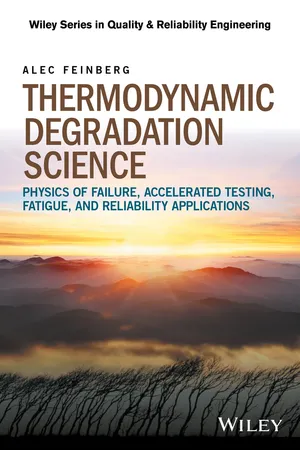
Thermodynamic degradation science is a new and exciting discipline. This book merges the science of physics of failure with thermodynamics and shows how degradation modeling is improved and enhanced when using thermodynamic principles.
The author also goes beyond the traditional physics of failure methods and highlights the importance of having new tools such as "Mesoscopic" noise degradation measurements for prognostics of complex systems, and a conjugate work approach to solving physics of failure problems with accelerated testing applications.
Key features:
• Demonstrates how the thermodynamics energy approach uncovers key degradation models and their application to accelerated testing.
• Demonstrates how thermodynamic degradation models accounts for cumulative stress environments, effect statistical reliability distributions, and are key for reliability test planning.
• Provides coverage of the four types of Physics of Failure processes describing aging: Thermal Activation Processes, Forced Aging, Diffusion, and complex combinations of these.
• Coverage of numerous key topics including: aging laws; Cumulative Accelerated Stress Test (CAST) Plans; cumulative entropy fatigue damage; reliability statistics and environmental degradation and pollution.
Thermodynamic Degradation Science: Physics of Failure, Accelerated Testing, Fatigue and Reliability Applications is essential reading for reliability, cumulative fatigue, and physics of failure engineers as well as students on courses which include thermodynamic engineering and/or physics of failure coverage.
eBook - ePub
Thermodynamic Degradation Science
Physics of Failure, Accelerated Testing, Fatigue, and Reliability Applications
- English
- ePUB (mobile friendly)
- Available on iOS & Android
eBook - ePub
Thermodynamic Degradation Science
Physics of Failure, Accelerated Testing, Fatigue, and Reliability Applications
About this book
Information
1
Equilibrium Thermodynamic Degradation Science
1.1 Introduction to a New Science
Thermodynamic degradation science is a new and exciting discipline. Reviewing the literature, one might note that thermodynamics is underutilized for this area. You may wonder why we need another approach. The answer is: in many cases you do not. However, the depth and pace of understanding physics of failure phenomenon, and the simplified methods it offers for such problems, is greatly improved because thermodynamics offers an energy approach. Further, systems are sometimes complex and made up of many components. How do we describe the aging of a complex system? Here is another possibility where thermodynamics, an energy approach, can be invaluable. We will also see that assessing thermodynamic degradation can be very helpful in quantifying the life of different devices, their aging laws, understanding of their failure mechanisms and help in reliability accelerated test planning [1–4]. One can envision that degradation is associated with some sort of device damage that has occurred. In terms of thermodynamics, degradation is about order versus disorder in the system of interest. Therefore, often we will use the term thermodynamic damage which is associated with disorder and degradation. One clear advantage to this method is that:
thermodynamics is an energy approach, often making it easier to track damage due to disorder and the physics of failure of aging processes.
More importantly, thermodynamics is a natural candidate to use for understanding system aging.
Here the term “system” can be a device, a complex assembly, a component, or an area of interest set apart for study.
Although most people who study thermodynamics are familiar with its second law, not many think of it as a good explanation of why a system degrades over time. We can manipulate a phrasing of the second law of thermodynamics to clarify our point [1, 4].
Second law in terms of system thermodynamic damage: the spontaneous irreversible damage processes that take place in a system interacting with its environment will do so in order to go towards thermodynamic equilibrium with its environment.
There are many phrasings of the second law. This phrasing describes aging, and we use it in this chapter as the second law in terms of thermodynamics damage occurring in systems as they age. We provide some examples in Chapter 2 (see Sections 2.10 and 2.11) of this statement in regards to aging to help clarify this.
When we state that degradation is irreversible, we mean either non-repairable damage or that we cannot reverse the degradation without at the same time employing some new energetic process to do so. We see there is a strong parallel consequence of the second law of thermodynamics associated with spontaneous degradation processes.
The science presents us with a gift, for its second law actually explains the aging processes [1, 4].
We are therefore compelled to look towards this science to help us in our study of system degradation. Currently the field of physics of failure includes a lot of thermodynamic-type explanations. Currently however, the application of thermodynamics to the field of device degradation is not fully mature. Its first and second laws can be difficult to apply to complex aging problems. However, we anticipate that a thermodynamic approach to aging will be invaluable and provide new and useful...
Table of contents
- Cover
- Title Page
- Table of Contents
- List of Figures
- List of Tables
- About the Author
- Preface
- 1 Equilibrium Thermodynamic Degradation Science
- 2 Applications of Equilibrium Thermodynamic Degradation to Complex and Simple Systems: Entropy Damage, Vibration, Temperature, Noise Analysis, and Thermodynamic Potentials
- 3 NE Thermodynamic Degradation Science Assessment Using the Work Concept
- 4 Applications of NE Thermodynamic Degradation Science to Mechanical Systems
- 5 Corrosion Applications in NE Thermodynamic Degradation
- 6 Thermal Activation Free Energy Approach
- 7 TAT Model Applications: Wear, Creep, and Transistor Aging
- 8 Diffusion
- 9 How Aging Laws Influence Parametric and Catastrophic Reliability Distributions
- 10 The Theory of Organization
- Special Topics A
- Special Topics B
- Special Topics C
- Overview of New Terms, Equations, and Concepts
- Index
- End User License Agreement
Trusted by 375,005 students
Access to over 1.5 million titles for a fair monthly price.
Study more efficiently using our study tools.
Frequently asked questions
Yes, you can cancel anytime from the Subscription tab in your account settings on the Perlego website. Your subscription will stay active until the end of your current billing period. Learn how to cancel your subscription
No, books cannot be downloaded as external files, such as PDFs, for use outside of Perlego. However, you can download books within the Perlego app for offline reading on mobile or tablet. Learn how to download books offline
Perlego offers two plans: Essential and Complete
- Essential is ideal for learners and professionals who enjoy exploring a wide range of subjects. Access the Essential Library with 800,000+ trusted titles and best-sellers across business, personal growth, and the humanities. Includes unlimited reading time and Standard Read Aloud voice.
- Complete: Perfect for advanced learners and researchers needing full, unrestricted access. Unlock 1.5M+ books across hundreds of subjects, including academic and specialized titles. The Complete Plan also includes advanced features like Premium Read Aloud and Research Assistant.
We are an online textbook subscription service, where you can get access to an entire online library for less than the price of a single book per month. With over 1.5 million books across 990+ topics, we’ve got you covered! Learn about our mission
Look out for the read-aloud symbol on your next book to see if you can listen to it. The read-aloud tool reads text aloud for you, highlighting the text as it is being read. You can pause it, speed it up and slow it down. Learn more about Read Aloud
Yes! You can use the Perlego app on both iOS and Android devices to read anytime, anywhere — even offline. Perfect for commutes or when you’re on the go.
Please note we cannot support devices running on iOS 13 and Android 7 or earlier. Learn more about using the app
Please note we cannot support devices running on iOS 13 and Android 7 or earlier. Learn more about using the app
Yes, you can access Thermodynamic Degradation Science by Alec Feinberg in PDF and/or ePUB format, as well as other popular books in Technology & Engineering & Quality Control in Engineering. We have over 1.5 million books available in our catalogue for you to explore.