- Uses empirical and social theoretical resources developed in the course of a 40-month research project entitled 'Biosecurity borderlands'
- Focuses on the food and farming sector, where the generation and subsequent transmission of disease has the ability to reach pandemic proportions
- Demonstrates the importance of a geographical and spatial analysis, drawing together social, material and biological approaches, as well as national and international examples
- The book makes three main conceptual contributions, reconceptualising disease as situated matters, the spatial or topological analysis of situations and a reformulation of biopolitics
- Uniquely brings together conceptual development with empirically and politically informed work on infectious and zoonotic disease, to produce a timely and important contribution to both social science and to policy debate
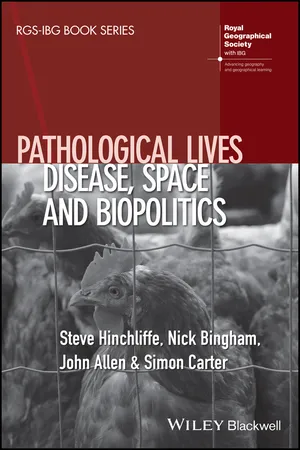
eBook - ePub
Pathological Lives
Disease, Space and Biopolitics
- English
- ePUB (mobile friendly)
- Available on iOS & Android
eBook - ePub
Pathological Lives
Disease, Space and Biopolitics
About this book
Pandemics, epidemics and food borne diseases are a major global challenge. Focusing on the food and farming sector, and mobilising social theory as well as empirical enquiry, Pathological Lives investigates current approaches to biosecurity and ask how pathological lives can be successfully 'regulated' without making life more dangerous as a result.
Information
Part I
Framing Pathological Lives
Chapter One
Pathological Lives – Disease, Space and Biopolitics
The diversity and geographical distribution of influenza viruses currently circulating in wild and domestic birds are unprecedented since the advent of modern tools for virus detection and characterisation. The world needs to be concerned (WHO, 2015).The number one risk on the [UK] Government’s national risk assessment for civil emergencies, ahead of both coastal flooding and a major terrorist incident, is the risk of pandemic influenza (House of Commons Committee of Public Accounts, 2013: 6).We are left in the hands of the generations which, having heard of microbes much as St Thomas Aquinas heard of angels, suddenly concluded that the whole art of healing should be summed up in the formula: Find the microbe and kill it. And even that they did not know how to do (George Bernard Shaw, 1909: Preface to the Doctor’s Dilemma).
Introduction: The Emergency of Emergent Infectious Diseases
In Western states, at least, emerging infectious diseases have become emergencies in waiting. The threat of a widespread and acute malady affecting people, or indeed the plants and animals on which they rely (to say nothing of the technical infrastructures or other living and non‐living networks which sustain life), is a long‐standing one. But it is the imagined and to some extent experienced interdependencies and vulnerabilities that people share with each other and with other living bodies that seem to have raised the stakes in the last few decades. So much so that we are, for some at least, ‘teetering on the edge’ of a major disease event or catastrophe (Webster and Walker, 2003).
Simplifying somewhat, this apparent emergency‐to‐come has two core elements. First, it is socio‐ecological and based on the sciences of ‘emerging and re‐emerging diseases’. Here the focus tends to be on mutable microorganisms and the potential for those organisms to wreak havoc in a highly ‘infectable’ and densely interconnected modern world (Braun, 2007). Previously, and in the main, microorganisms had been understood as more or less fixed entities that would inevitably run their evolutionary course, becoming less significant over time (Methot and Fantini, 2014). The emergence of new infectious diseases, like AIDS (Acquired Immune Deficiency Syndrome) and SARS (Severe Acute Respiratory Syndrome), and the re‐emergence of newly virulent scourges (like influenza and tuberculosis) in the later part of the twentieth century suggested that life, and microbial life in particular, was less fixed and so less predictable than we might have countenanced.
These new agents of concern could mutate and recombine, jump species, take advantage of new environmental conditions, and could move through the dense and rapid transit routes that circled the planet. Instead of being on the wane, microbes were back on the agenda. Along with climate change and global terrorism, they formed a raft of ‘agents’ that were regarded as mutable, indeterminate and generative of catastrophic events. For some at least, global connectivity and molecular mutability had combined to usher in a new age of plagues, epidemics and pandemics (Garret, 1994). Arguably, emerging diseases suggested that the world was now more ‘infectable’ than ever.
Second, this emergency‐to‐come is governmental. Here, emergency relates to a form of anticipatory or future‐oriented government that seeks to highlight (even give greater emphasis to) potential breakdowns in social order. In this style of governance of and through emergencies – which has arguably become dominant in recent decades (Amoore, 2013) – the role of public and private institutions is to organise for events that are of sufficient magnitude that they demand foresight and preparation (Anderson, 2010; Collier and Lakoff, 2008b).
Pandemics, infectious animal diseases and food contamination events, for example, can all exact such far‐reaching challenges to social and economic life that they constitute security issues, necessitating some kind of civil emergency planning in order to prepare for or mitigate their worst effects. Infectious disease, in this sense, has become part and parcel of a logic and practice of security. Indeed, the term biosecurity is often used in relation to the threat of emerging infectious diseases, and refers to the raft of measures and policies that governments, commercial and other organisations seek to put in place in order to reduce the risk of a disease event and/or prepare for the consequences of such an event in terms of emergency response. Whether the resulting biosecurity practices are effective or make matters more prone to go wrong is a major question that we will return to throughout this book.
These socio‐ecological and governmental aspects of emerging infectious diseases may well be mutually re‐affirming. First, and most obviously, changes to the ‘infectability’ of the planet may be accompanied by shifts in approaches to infectious disease control, leading to the rise of biosecurity as a discourse and material practice. Second, the rise of a form of anticipatory governance clearly requires its own set of justifications. Mutable microbes form a convenient ontology or cause under which new kinds of human authority and control can be justified and normalised (King, 2002). For some commentators, a mode of life (a modus vivendi (Sloterdijk, 2013)) emerges in which control is predicated on accentuating certain threats. This may be more than ideological. Perhaps what is most interesting here is the possibility that, third, these forms of human control can in turn produce new microbial environments that may inadvertently be even more challenging. Spiralling efforts to counter microbial threats, or a hypertrophic approach to security, can seed further changes to rapidly evolving microbiomes (Landecker, 2015). So much so that a belief in human authority and control may well be part of the problem.
Pathological Lives engages with the disease emergency, its rise up scientific and political agenda, its formatting through biosecurity and, crucially, the extent to which the resulting foci of attention may well be making matters worse rather than better. We focus on the particular ways in which emergency diseases are constituted – how they are understood, marshalled, measured, generated and even ignored. Our method is at once geographical and based within science and technology studies. In taking these approaches, with their legacy of fieldwork and ‘theorising empirically’ (Mol, 2002), we are interested in the practical ‘doings’ of disease rather than the grand stories that are told about them. Only by investigating practices (what is done as well as what is said) can we assess the extent to which these doings may play a part in bringing about the emergency they seek to mitigate – or, indeed, may offer new openings for doing things otherwise.
This book is empirically grounded, and in being so it can make some claim to a better understanding of how communicable diseases are being managed and mismanaged and will aim to make some concrete suggestions about what it takes to do health and disease in ways that are better suited to the current predicament. It is based on fieldwork that we undertook across a range of sites and involving all manner of species (from farms to restaurants, from wildlife reserves to virological laboratories, and from factories to living rooms). Our methods are varied, though mostly ethnographic in character and sensibility, and our aim has been to allow the practices that we have observed, written down and questioned, to surprise us, to put our concepts at risk and to force us to think carefully and critically about the disease emergency.
Pathological Lives is also conceptual. In working across numerous sites and species, and in linking together those sites and species, our argument pulls together key geographical or spatial insights on the relations between people, animals, microbes, infrastructures and ways of governing disease. Rather than focusing on one part of the disease system, we are interested in what happens when you take the changing relations between hosts, microbes and their environments, as well as the emerging regimes of control or governance, as the key concern for investigation. Infectious disease in this instance, and for us, is not only a result of microorganisms infecting a host, but the multi‐faceted outcome of the changing relations that make microbes more or less likely to be effective in generating disease.
The key question becomes, in this sense, how various matters (including not only microbes) combine with other conditions to produce disease. We make a distinction, then, between those approaches that focus on disease as a matter of discrete causative agents and those that view disease as a more relational phenomenon. In the first instance, approaches to infectious disease management or control that focus on microbes as pathogens tend to emphasise their absence and exclusion. They involve constructing and maintaining real as well as metaphorical walls (see Figure 1.1).

Figure 1.1 How safe is your town? – US Public Health Poster, undated. The divisions between a contingent wild world and a domestic culture are clearly marked as spatially exclusive. The existence of a single non‐human on the right side of the wall, on two legs and with tail docked, is emblematic of this nature/culture binary that is in play.
(Virginia Health Bulletin, 1908: 216).
This so‐called ‘ontological’ approach to disease, with microbiological organisms as agents of causation, is often in tension with the second, relational or more ‘physiological’ and ‘ecological’ understandings of disease (Anderson and MacKay, 2014). In the latter, microbes may be just one component of a complex of matters that conspire to produce disease. Here, understanding disease is less likely to focus on a single agent and pathway to the host, but on a suite of issues, on biographical details (a patient or host’s propensity to develop symptoms) and on the patient’s social and ecological setting (relating to a population, its density, levels of immunity and so on). It may even stretch to consider the role of disease management and governance in the shaping of the disease.
In these ecological approaches, the focus may be less concerned with keeping matters out and more attentive to the multiple relations that make disease. How these relations are configured, spatially, becomes the key matter of concern. It is the constellation of matters that twist and turn bodies of all shapes and sizes into diseased relations that grab our attention. All life in that sense is more or less pathological. It is the quality of the relations that make those lives more or less liveable.
In order to make these spatial arguments we employ some key terms. First, in Chapter 2, we introduce disease diagrams, which we take to be ways of understanding and acting upon disease and health threats. For example, if disease is understood as a germ‐borne menace, then exclusion is the spatial practice of choice. Conversely, if a more ecological or biographical approach is taken, then disease may be diagrammed as a matter of social inclusion and public health campaigns (perhaps by improving health services, availability of vaccines...
Table of contents
- Cover
- Title Page
- Table of Contents
- List of Figures
- Series Editors’ Preface
- Acknowledgements
- Foreword
- Part I: Framing Pathological Lives
- Part II: Disease Situations
- Index
- End User License Agreement
Trusted by 375,005 students
Access to over 1.5 million titles for a fair monthly price.
Study more efficiently using our study tools.
Frequently asked questions
Yes, you can cancel anytime from the Subscription tab in your account settings on the Perlego website. Your subscription will stay active until the end of your current billing period. Learn how to cancel your subscription
No, books cannot be downloaded as external files, such as PDFs, for use outside of Perlego. However, you can download books within the Perlego app for offline reading on mobile or tablet. Learn how to download books offline
Perlego offers two plans: Essential and Complete
- Essential is ideal for learners and professionals who enjoy exploring a wide range of subjects. Access the Essential Library with 800,000+ trusted titles and best-sellers across business, personal growth, and the humanities. Includes unlimited reading time and Standard Read Aloud voice.
- Complete: Perfect for advanced learners and researchers needing full, unrestricted access. Unlock 1.5M+ books across hundreds of subjects, including academic and specialized titles. The Complete Plan also includes advanced features like Premium Read Aloud and Research Assistant.
We are an online textbook subscription service, where you can get access to an entire online library for less than the price of a single book per month. With over 1.5 million books across 990+ topics, we’ve got you covered! Learn about our mission
Look out for the read-aloud symbol on your next book to see if you can listen to it. The read-aloud tool reads text aloud for you, highlighting the text as it is being read. You can pause it, speed it up and slow it down. Learn more about Read Aloud
Yes! You can use the Perlego app on both iOS and Android devices to read anytime, anywhere — even offline. Perfect for commutes or when you’re on the go.
Please note we cannot support devices running on iOS 13 and Android 7 or earlier. Learn more about using the app
Please note we cannot support devices running on iOS 13 and Android 7 or earlier. Learn more about using the app
Yes, you can access Pathological Lives by Steve Hinchliffe,Nick Bingham,John Allen,Simon Carter in PDF and/or ePUB format, as well as other popular books in Physical Sciences & Geography. We have over 1.5 million books available in our catalogue for you to explore.