Drive marketing ROI with an investor's mindset and a proven toolkit
Top marketers today don't shy away from financial accountability. In fact, they actively seek to account for the return on their companies' investments in marketing – because they want their budget to make a difference for their brands and for their business: more relevant messages, more effective campaigns, more satisfied customers, more profitable promotions, higher returns to shareholders. If this is how you think about marketing, this book is for you. It is a book for CMOs who adopt an investor's mindset, and it deals with the most pressing marketing performance questions.
This isn't a work of theory. This is a hands-on guide to better marketing for top managers, neatly packaged into ten concise chapters that are just right for a short-haul flight.
Learn how to:
Increase sales with smarter fund allocation
Reduce marketing costs without sacrificing effectiveness
Strengthen the role of marketing with quantified ROI
Build capabilities for sustainable performance improvements
Marketing Performance delivers expert insight, a wealth of proven success factors, and real-life case studies that will help you drive marketing performance and grow your business.
1— Budget sizing: Combine multiple lenses to right-size your marketing budget
Why does budget sizing matter?
How much should you spend on marketing? It's the biggest question of all, and yet many companies settle on an easy answer. Most years, they spend whatever they spent the previous year. If they make adjustments at all, these are often a function of overall company performance: if the company is prospering, the budget goes up – sometimes beyond what is necessary or effective. And in times of stagnation or decline, marketing budget cuts are as certain as death and taxes, even if reduced marketing support is the last thing a troubled company needs. This is because a lot of companies still define their marketing budget as a percentage of past sales. In effect, budget sizing is decoupled from business requirements. Budgeting inertia is further aggravated by the fact that many companies buy media many months – if not years – in advance.1 If you are serious about turning the marketing function into a profit centre that contributes to the company's bottom line, put an end to these wasteful practices and introduce zero-based budgeting. First conceived in 1970 by Peter Pyhrr2 – a controller at Texas Instruments at the time – zero-based budgeting is about “reviewing every dollar in the annual budget”, 3 taking nothing for granted, and only signing off on budget positions that promise sufficient returns. Applied to marketing, this is nothing short of a paradigm shift – from a cost item to an investment opportunity.
The role of marketing is not a constant, nor is your mandate as the CMO. Markets change, and so does your company's competitive position. Even your brand profile and your business model are bound to evolve over time. Such changes need to be reflected in the size of the marketing budget. Consider, for example, the case of an insurance company that depends on frontline excellence. If sales force performance is lagging, you may have to intensify your marketing communication to drive short-term consumer pull while your peers in sales do their homework to fix the underlying issues. Now fast-forward five years into the future. Aggressive new market entrants have declared a price war, and your competitors are launching secondary brands to secure their share of the lower end of the market. In this new situation, you will want to invest in brand building to strengthen your brand, justify your price premium, and protect the profitability of your company.4 Now fast-forward 20 years into the future. Your brand is the top dog, and you are the market leader. You are finally able to decrease the marketing budget and allocate funds to other functions without putting your business at risk.
Whatever happens, we encourage you to put an end to “budgeting as usual”. The size of your budget should reflect your ambitions for future growth, rather than the past performance of the company. Start treating budgeting as a profitability driver and build your budget as an investment case rather than as a cost item.
How to drive marketing performance with fact-based budget sizing
A few years ago, an electronics retailer embarked on a radical experiment. For an entire month, the company cut its ad spend by 60 percent. It was a top-management decision, just to see what would happen. Revenues plummeted. Store managers felt betrayed by the corporate centre, and their motivation dropped to an all-time low. But while the experiment substantiates the direct sales impact of advertising, it doesn't say much about the appropriate budget level. Indeed, 40 percent of last year's budget may be too little, but how much is enough?
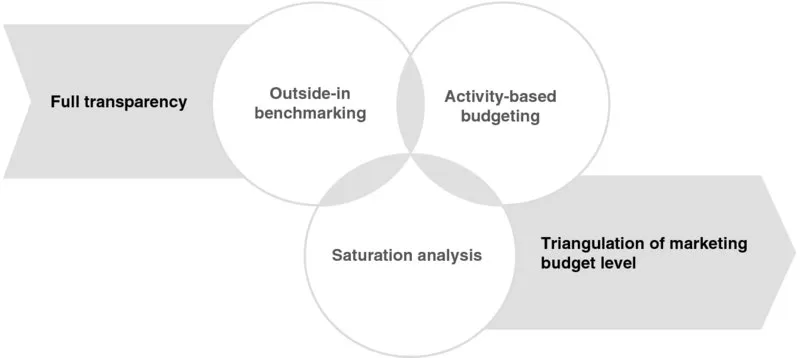
Cause-and-effect relationships between the marketing budget level and market success are notoriously difficult to establish. There are simply too many other influencing factors: the creative quality of your campaigns, your mix of marketing instruments (see Chapters 5 and 6), prices, promotions, distribution, weather, seasonality, consumer confidence, competitors, financial markets. In light of this complexity, no tool or algorithm can give you the right budget level at the push of a button.5 Historic relations between cause and effect should not be the only driver of sizing decisions anyway. Your company's objectives for the future and your own perception of market dynamics are equally important. Instead, we propose a multi-lens approach to budgeting that is both systematic and pragmatic. It starts with transparency creation and moves on to combine three perspectives on overall budget size (Exhibit 1.1).6
Exhibit 1.1 Five elements of budget sizing.
Source: McKinsey
Create full budget transparency; you will be surprised by what is hidden in the cracks and crevices of your organization
Transparency creation – it's easy to say and hard to do. This is because the marketing budget is scattered across so many different business units, functions, and departments at most companies. While most CMOs are in charge of all advertising, responsibility for activities such as co-op campaigns, sales support, public relations, owned media, and sponsorships often resides elsewhere in the organization. Yet all these activities affect your target audience in some way or another, and they should all contribute to your overall marketing objectives. A substantial share of the budget can also be hidden in the P&L of local subsidiaries, franchise partners, or affiliate companies.
So, before you even think about sizing, compile a comprehensive list of all the buckets in your current budget. Obviously, the number and granularity of budget positions will vary from company to company. Conceptually, taking stock should include all investments that are made to advance customers – current as well as prospective – towards your company on their purchase decision journey from awareness and consideration to purchase and loyalty. You don't need us to tell you that marketing is so much more than advertising. But in some industries – such as retail or B2B – traditional advertising typically only accounts for a relatively small share of the total budget. Make sure your transparency effort also captures point-of-sale activities, direct marketing, sales support, events, sponsorships, and indirect costs, such as agency fees and production expense. Compare our discussion of the “total cost of ownership” of a given touch point in Chapter 5.
The structures of most organizations – and the respective decision rules – are often the products of history and politics rather than business requirements. Typically, the marketing budget mirrors this internal view. As a result, the building blocks of the budget are often departments and business units, rather than products, channels, or target groups. But the budget should be a function of the market you are serving, the objectives you are pursuing, and the instruments you are using to reach these objectives. To promote an investor's mindset, we recommend you create transparency in two respects:
Which objective is a given investment meant to support – brand building, customer acquisition, or sales support for a specific product or service?
Which instrument, or combination of instruments, are we using to reach that objective in our target group?
This will lay the foundations for optimizing the allocation of funds to business units (see Chapter 2) and instruments (see Chapters 5 and 6). Ideally, investments should be split according to where and how they reach your audience: on TV, in a print ad, online, as a leaflet that is delivered to their homes, in a store, in the form of an addressed direct mailing, or as part of a loyalty programme. This will help you take on a consumer perspective, rather than worrying about budget ownership. Keep in mind that costs incurred at the same touch point may be split between multiple departments. For example, your company's website may be co-funded by the IT department, corporate PR, and your own function. Some marketing activities may not be treated as marketing expenditure at all. For example, co-funded sales stimulation campaigns are often managed as stand-alone profit centres. While this is good news from a return on investment perspective, it can turn transparency creation into a nightmare. Depending on the size and the complexity of your organization, transparency creation can take several weeks, but it is worth the effort. It will not only help you quantify the total “I” (investment) in “ROI” (return on investment), but often also triggers a productive debate among executives about appropriate allocation keys and accountability assignments.
Systematic transparency creation is imperative not only at the corporate level; it should be a matter of course for all your direct reports and their teams – be i...
Table of contents
Cover
Title Page
Copyright
Introduction: Smart Money
1 — Budget sizing: Combine multiple lenses to right-size your marketing budget
2 — Allocation: Put your money where your strategy is
3 — Insights: Discover what really matters to consumers to sharpen your proposition
4 — Storytelling: Take a publisher's mindset and tell stories that cut through the clutter
5 — One currency: Compare apples to apples as you make trade-offs between instruments
7 — Smart activation: Trim the fat off key instruments to drive incremental benefit
8 — Partners: Build performance partnerships with marketing service providers
9 — IT solutions: Use marketing ROI decision support solutions to transform your company
10 — Agility: Infuse your organization with a return on investment mindset
Credits
Index
EULA
Trusted by 375,005 students
Access to over 1.5 million titles for a fair monthly price.
Study more efficiently using our study tools.
Frequently asked questions
Yes, you can cancel anytime from the Subscription tab in your account settings on the Perlego website. Your subscription will stay active until the end of your current billing period. Learn how to cancel your subscription
No, books cannot be downloaded as external files, such as PDFs, for use outside of Perlego. However, you can download books within the Perlego app for offline reading on mobile or tablet. Learn how to download books offline
Perlego offers two plans: Essential and Complete
Essential is ideal for learners and professionals who enjoy exploring a wide range of subjects. Access the Essential Library with 800,000+ trusted titles and best-sellers across business, personal growth, and the humanities. Includes unlimited reading time and Standard Read Aloud voice.
Complete: Perfect for advanced learners and researchers needing full, unrestricted access. Unlock 1.5M+ books across hundreds of subjects, including academic and specialized titles. The Complete Plan also includes advanced features like Premium Read Aloud and Research Assistant.
Both plans are available with monthly, semester, or annual billing cycles.
We are an online textbook subscription service, where you can get access to an entire online library for less than the price of a single book per month. With over 1.5 million books across 990+ topics, we’ve got you covered! Learn about our mission
Look out for the read-aloud symbol on your next book to see if you can listen to it. The read-aloud tool reads text aloud for you, highlighting the text as it is being read. You can pause it, speed it up and slow it down. Learn more about Read Aloud
Yes! You can use the Perlego app on both iOS and Android devices to read anytime, anywhere — even offline. Perfect for commutes or when you’re on the go. Please note we cannot support devices running on iOS 13 and Android 7 or earlier. Learn more about using the app
Yes, you can access Marketing Performance by Thomas Bauer,Tjark Freundt,Jonathan Gordon,Jesko Perrey,Dennis Spillecke in PDF and/or ePUB format, as well as other popular books in Business & Leadership. We have over 1.5 million books available in our catalogue for you to explore.