Magnetosphere-Ionosphere Coupling in the Solar System
  1. English
  2. ePUB (mobile friendly)
  3. Available on iOS & Android
eBook - ePub

About this book

Over a half century of exploration of the Earth's space environment, it has become evident that the interaction between the ionosphere and the magnetosphere plays a dominant role in the evolution and dynamics of magnetospheric plasmas and fields. Interestingly, it was recently discovered that this same interaction is of fundamental importance at other planets and moons throughout the solar system. Based on papers presented at an interdisciplinary AGU Chapman Conference at Yosemite National Park in February 2014, this volume provides an intellectual and visual journey through our exploration and discovery of the paradigm-changing role that the ionosphere plays in determining the filling and dynamics of Earth and planetary environments. The 2014 Chapman conference marks the 40th anniversary of the initial magnetosphere-ionosphere coupling conference at Yosemite in 1974, and thus gives a four decade perspective of the progress of space science research in understanding these fundamental coupling processes. Digital video links to an online archive containing both the 1974 and 2014 meetings are presented throughout this volume for use as an historical resource by the international heliophysics and planetary science communities.

Topics covered in this volume include:

  • Ionosphere as a source of magnetospheric plasma
  • Effects of the low energy ionospheric plasma on the stability and creation of the more energetic plasmas
  • The unified global modeling of the ionosphere and magnetosphere at the Earth and other planets
  • New knowledge of these coupled interactions for heliophysicists and planetary scientists, with a cross-disciplinary approach involving advanced measurement and modeling techniques

Magnetosphere-Ionosphere Coupling in the Solar System is a valuable resource for researchers in the fields of space and planetary science, atmospheric science, space physics, astronomy, and geophysics. Read an interview with the editors to find out more:
https://eos.org/editors-vox/filling-earths-space-environment-from-the-sun-or-the-earth

Frequently asked questions

Yes, you can cancel anytime from the Subscription tab in your account settings on the Perlego website. Your subscription will stay active until the end of your current billing period. Learn how to cancel your subscription.
At the moment all of our mobile-responsive ePub books are available to download via the app. Most of our PDFs are also available to download and we're working on making the final remaining ones downloadable now. Learn more here.
Perlego offers two plans: Essential and Complete
  • Essential is ideal for learners and professionals who enjoy exploring a wide range of subjects. Access the Essential Library with 800,000+ trusted titles and best-sellers across business, personal growth, and the humanities. Includes unlimited reading time and Standard Read Aloud voice.
  • Complete: Perfect for advanced learners and researchers needing full, unrestricted access. Unlock 1.4M+ books across hundreds of subjects, including academic and specialized titles. The Complete Plan also includes advanced features like Premium Read Aloud and Research Assistant.
Both plans are available with monthly, semester, or annual billing cycles.
We are an online textbook subscription service, where you can get access to an entire online library for less than the price of a single book per month. With over 1 million books across 1000+ topics, we’ve got you covered! Learn more here.
Look out for the read-aloud symbol on your next book to see if you can listen to it. The read-aloud tool reads text aloud for you, highlighting the text as it is being read. You can pause it, speed it up and slow it down. Learn more here.
Yes! You can use the Perlego app on both iOS or Android devices to read anytime, anywhere — even offline. Perfect for commutes or when you’re on the go.
Please note we cannot support devices running on iOS 13 and Android 7 or earlier. Learn more about using the app.
Yes, you can access Magnetosphere-Ionosphere Coupling in the Solar System by Charles R. Chappell, Robert W. Schunk, Peter M. Banks, Richard M. Thorne, James L. Burch, Charles R. Chappell,Robert W. Schunk,Peter M. Banks,Richard M. Thorne,James L. Burch in PDF and/or ePUB format, as well as other popular books in Naturwissenschaften & Geologie & Geowissenschaften. We have over one million books available in our catalogue for you to explore.

Part I
Introduction

1
Magnetosphere‐Ionosphere Coupling, Past to Future

James L. Burch
Southwest Research Institute, San Antonio, TX, USA
Video of Yosemite Talk, URL: http://dx.doi.org/10.15142/T3J01P

ABSTRACT

Prior to the 1970s, magnetospheric physics and upper atmospheric/ionospheric physics were separate scientific disciplines with separate space missions and separate theory and modeling programs. This situation led to a certain labeling (of scientific programs, scientific society sections, conferences, and even scientists), and this labeling was limiting scientific advances. Although some of this labeling still persists, it has largely become recognized that the upper atmosphere, ionosphere, magnetosphere, and the nearby solar wind comprise a single coupled system of geospace that must be studied together. This review traces some of the early concepts of magnetosphere‐ionosphere (M‐I) coupling through the past four decades and makes suggestions for future progress.

1.1. INTRODUCTION

The 1974 Yosemite Conference on Magnetosphere‐Ionosphere Coupling was a unique event during which leading scientists in both magnetospheric and ionospheric physics met together in a remote location to examine in a unique way not only the overlap but also the interrelationships of their previously quite separate disciplines. Since M‐I coupling as a research field has progressed greatly over the past 40 years, it is perhaps informative to trace some of the instances in which coupled magnetospheric and ionospheric phenomena were just beginning to be appreciated in a meaningful way and describe how these ideas have evolved to the present and into the future.
Early models of the interaction between the solar wind and the Earth's magnetosphere included the ionosphere but mainly as a footprint of conductivity for magnetospheric convection [e.g., Axford and Hines, 1961; Wolf, 1970]. During this same time somewhat controversial theories for the production of a polar wind, which populates the magnetosphere with ionospheric plasma, were developed and ultimately became widely accepted [e.g., Banks and Holzer, 1968]. In this same era, Vasyliunas [1970] developed a mathematical theory of M‐I coupling that formed the basis for many theoretical advances in the field [e.g., Wolf, 1975].
Starting in the early 1970s, satellite measurements began to show that cold ionospheric particles (mainly H+ and He+) are important constituents of the inner and middle magnetosphere [Chappell et al., 1970] and that energetic heavy ions (mainly O+) precipitate into the low‐altitude auroral zone during geomagnetic storms [Sharp et al., 1972]. While H+ ions, which dominate magnetospheric plasmas at all energies, can have their origins both in the solar wind and the ionosphere, the widespread prevalence of O+ ions, which are almost exclusively from the ionosphere, suggested that the ionospheric plasma source is important and capable of supplying most if not all of magnetospheric plasma [Chappell et al., 1987].
New data sets and discoveries in that epoch were mainly responsible for the advent of M‐I coupling science. One new data set that came on line was generated by the Chatanika Radar facility, which pioneered the use of the incoherent scatter technique to derive large‐scale plasma convection patterns [Brekke et al., 1974]. These convection patterns can be mapped into the magnetosphere to help gauge and visualize global magnetospheric dynamics. Another landmark discovery was auroral kilometric radiation (AKR), which was originally referred to as terrestrial kilometric radiation (TKR) [Gurnett, 1974; Alexander and Kaiser, 1976]. Since AKR beams outward from the auroral regions, it was only first observed many years after the discovery of radio emissions from Saturn and Jupiter [Kaiser and Stone, 1975]. In the case of Jupiter, the frequencies are much higher so that the so‐called decametric radiation can be observed from the Earth's surface.
By far the strongest channel for coupling between the magnetosphere and ionosphere is the auroral oval and its extension into space. In the early 1970s, auroral particles first began to be observed from orbing spacecraft [e.g., Frank and Ackerson, 1971; Winningham et al., 1973]. Sounding rocket measurements of auroral electrons had shown earlier that their energy spectra were monoenergetic and hence consistent with acceleration by an electric field component aligned along the magnetic field [McIlwain, 1960]. Subsequent measurements, however, showed that lower‐energy electrons also precipitated into the aurora along with the monoenergetic beams [Frank and Ackerson, 1971]. Some controversy therefore arose about the source of the low‐energy electrons, and this controversy was resolved by Evans [1974], who showed that they were backscattered and secondary electrons trapped between the parallel potential drop and the ionosphere. The possibility of AlfvĂ©n‐wave acceleration of auroral electrons was investigated by Hasegawa [1976]. Later on, measurements from the FAST spacecraft showed that AlfvĂ©n‐wave acceleration is an important phenomenon especially near the polar‐cap boundary [e.g., Chaston et al., 2003].
Another auroral phenomenon associated with M‐I coupling is the stable auroral red (SAR) arc, which appears at mid‐latitudes during magnetic storms. These arcs are produced either by Coulomb collisions between ring current particles and plasmaspheric electrons, electro...
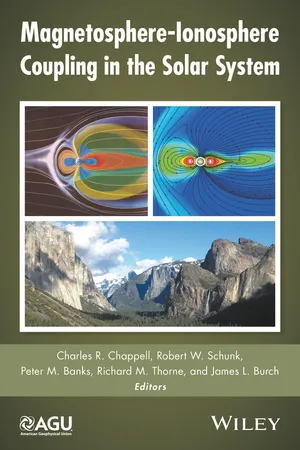
Table of contents

  1. COVER
  2. TITLE PAGE
  3. TABLE OF CONTENTS
  4. CONTRIBUTORS
  5. PROLOGUE
  6. ACKNOWLEDGMENTS
  7. Part I: Introduction
  8. Part II: The Earth’s Ionosphere as a Source
  9. Part III: The Effect of Low‐energy Plasma on the Stability of Energetic Plasmas
  10. Part IV: Unified Global Modeling of Ionosphere and Magnetosphere at Earth
  11. Part V: The Coupling of the Ionosphere and Magnetosphere at Other Planets and Moons in the Solar System
  12. Part VI: The Unified Modeling of the Ionosphere and Magnetosphere at Other Planets and Moons in the Solar System
  13. Part VII: Future Directions for Magnetosphere‐Ionosphere Coupling Research
  14. A LISTING OF THE DOI URL VIDEO LINKAGES IN THE ORDER THAT THEY APPEAR IN THE MONOGRAPH
  15. INDEX
  16. END USER LICENSE AGREEMENT