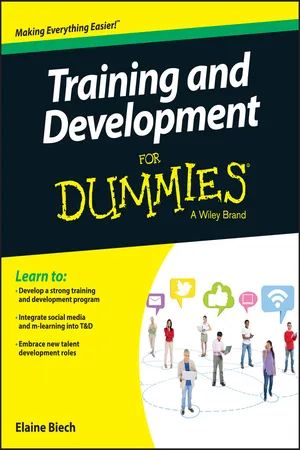
Training & Development For Dummies
eBook - ePub

Training & Development For Dummies

  1. English
  2. ePUB (mobile friendly)
  3. Available on iOS & Android
eBook - ePub

Training & Development For Dummies

About this book

Develop and deliver a robust employee training and development program

Training and Development For Dummies gives you the tools you need to develop a strong and effective training and development program. Covering the latest in talent development, this informative guide addresses classroom, virtual, and blended learning to open up your options and help you design the program that's right for your company. You'll explore the different modes of formal learning, including social learning, m-learning, and MOOCs, and delve into the benefits and implementation of self-directed and informal learning. The discussion covers mentoring and coaching, rotational and stretch assignments, and how to align talent development with the company's needs. You'll learn how to assess employee skills, design and deliver training, and evaluate each step of the process to achieve the goals of both the employee and the organization.

Most employees have some weaknesses in their skill sets. A robust training program allows you to strengthen those skills, and a development program brings all employees up to the highest possible level of productivity and success. This book helps you create consistency in your company by developing and delivering the exact training and development program your people need.

  • Develop a strong training and development program
  • Foster a supportive and innovative work environment
  • Learn about social learning, m-learning, and MOOCs
  • Assess and evaluate your staff more effectively

A great training and development program boosts performance, productivity, job satisfaction, and quality of services, while reducing costs and supervision. Investing in your employees gives an excellent ROI, as talent development is a primary driver behind both motivation and loyalty. Training and Development For Dummies shows you how to reap these benefits, with step by step guidance and essential expert insight.
Frequently asked questions

Yes, you can cancel anytime from the Subscription tab in your account settings on the Perlego website. Your subscription will stay active until the end of your current billing period. Learn how to cancel your subscription.
No, books cannot be downloaded as external files, such as PDFs, for use outside of Perlego. However, you can download books within the Perlego app for offline reading on mobile or tablet. Learn more here.
Perlego offers two plans: Essential and Complete
  • Essential is ideal for learners and professionals who enjoy exploring a wide range of subjects. Access the Essential Library with 800,000+ trusted titles and best-sellers across business, personal growth, and the humanities. Includes unlimited reading time and Standard Read Aloud voice.
  • Complete: Perfect for advanced learners and researchers needing full, unrestricted access. Unlock 1.4M+ books across hundreds of subjects, including academic and specialized titles. The Complete Plan also includes advanced features like Premium Read Aloud and Research Assistant.
Both plans are available with monthly, semester, or annual billing cycles.
We are an online textbook subscription service, where you can get access to an entire online library for less than the price of a single book per month. With over 1 million books across 1000+ topics, we’ve got you covered! Learn more here.
Look out for the read-aloud symbol on your next book to see if you can listen to it. The read-aloud tool reads text aloud for you, highlighting the text as it is being read. You can pause it, speed it up and slow it down. Learn more here.
Yes! You can use the Perlego app on both iOS or Android devices to read anytime, anywhere — even offline. Perfect for commutes or when you’re on the go.
Please note we cannot support devices running on iOS 13 and Android 7 or earlier. Learn more about using the app.
Yes, you can access Training & Development For Dummies by Elaine Biech in PDF and/or ePUB format, as well as other popular books in Business & Human Resource Management. We have over one million books available in our catalogue for you to explore.

Information

Publisher
For Dummies
Year
2015
Print ISBN
9781119076339
eBook ISBN
9781119076155
Part 1

So You're Going to Be a Trainer

image
webextra
Visit www.dummies.com for great Dummies content online.
In this part …
check.png
Introducing you to the world of training and development
check.png
Exploring why adults learn
check.png
Getting to know the training cycle
Chapter 1

What’s Training and Development?

In This Chapter
arrow
Introducing the training and development profession
arrow
Assessing your skills and abilities as a training and development professional
arrow
Determining the importance of developing others
arrow
Exploring the many hats of a 21st century trainer
So you want to be a trainer — a talent development professional. Or perhaps you already are in the field, and you’ve picked up this book to enhance your skills. In either case, this chapter helps you understand the profession and what’s expected of those who develop others.
Having a role in training and development (T&D) is one of the most exciting jobs anyone can have. Although a trainer’s role has changed substantially over the past decade and is currently going through another metamorphosis, many of the positive aspects always remain with the job. First, as a trainer you impact the work of many people — not only the learners with whom you work but also supervisors, senior management, clients, vendors, and perhaps even your company’s board of directors. As a trainer, you have access to many people and can develop a broader picture of your organization’s needs. Trainers are usually good communicators with good information. People listen to you.
In addition, training is exciting because it is a job that is an integral step in an organization’s efforts toward change and improvement. You may be a part of defining the organization of today, envisioning the organization of the future, and helping to incorporate the changes necessary to create the new organization. As a trainer, you have the opportunity to influence the direction your organization takes and how it gets there.
tip
Take a proactive stance in shaping your career. To be the most effective trainer, find out all you can about the organization in which you work. What are the primary issues and priorities it faces? Partner with those who lead your organization and find out how you can help them. Where are the pressure points that affect the bottom line? Identify how your work can positively impact the bottom line, given that you’re in a unique position to impact others. At the same time, remember to also take the opportunity to impact your career.
In this chapter, you answer three big questions.
  • What is training and development and who uses it?
  • What do trainers do?
  • Do you have what it takes to be a trainer?

What Is Training and Development?

We’ve all been in training since the day we were born. You have been learning and changing into the knowledgeable, skilled adult you currently are. Everyone has received training, and we have also all developed others. If you ever demonstrated the phone system to a new employee, advised your boss regarding changes in your department, or explained a shortcut for completing a task to a colleague, you were conducting training.
Training is about change. It is about transformation. It is all about learning. Training is a process designed to assist an individual to learn new skills, knowledge, or attitudes. As a result, individuals make a change or transformation that improves or enhances their performance. These improvements ensure that people and organizations are able to do things better, faster, easier, and with higher quality.

What forms does T&D take?

Learning is acquired in many forms. You may have experienced some of these. You may have a one-on-one session with your supervisor to learn the benefits of a new product your company produces. You may attend a class to upgrade your negotiating skills. You may take an asynchronous online course to learn how to use a new computer program. You may take a golf lesson to learn how to improve your use of long irons. You may be coached by someone in your company to learn to be more politically savvy. You may register for a Massive Open Online Course (MOOC) to learn leadership skills. The key word in each of these examples is “learn.” The reason training is provided is so that someone (or many people) learns something in order to make a change.
Is there really a difference between the words training and development? It seems all professionals in the business have their own definitions, and we aren’t going to resolve a mutual definition in this book. Both concepts are paths to learning and performance. In general people view training as those learning options that include someone who facilitates the learning in a formal setting: classroom, workshop, seminar, virtual instructor-led, or synchronous online. Development, on the other hand, is viewed as more self-directed and informal: coaching, mentoring, reading, self-study, social learning, on-the-job learning, and asynchronous online learning. And there is no denying that learning also occurs during water cooler discussions, in cubical conversations, and at conferences. Trainers are involved in all of these training and development alternatives.
pearlofwisdom
Read that last sentence again and remember it. It doesn’t matter what your official title is or how you deliver learning and performance. Trainers may be involved in all activities where people are learning knowledge and developing skills. Yes, you may design or deliver training in a traditional or virtual classroom. But you may also coach supervisors about the best way to develop their employees or advise leaders of corporate changes required to support desired performance — or even recommend budgets for social media to augment training. In this book I use the title trainer to describe all these roles.
Trainers are necessary in every industry, from aardvark ranches to zipper manufacturers. Trainers have jobs in private industry, education, not-for-profit organizations, and government.
Trainers work with people in all positions and at all levels in an organization: executives, managers, supervisors, secretaries, production workers, scientists, artists, doctors, lawyers, security guards, salespeople, teachers, firefighters, authors, custodial workers, waitstaff, and you. Even this book is a form of training — self-directed training as you learn yo...

Table of contents

  1. Cover
  2. Title Page
  3. Table of Contents
  4. Foreword
  5. Introduction
  6. Part I: So You're Going to Be a Trainer
  7. Part II: Designing the Best Darn Training in the World
  8. Part III: Showtime: Delivering a Dynamic Training Session
  9. Part IV: It's Not Over Yet: The Follow-Up
  10. Part V: The Professional Trainer
  11. Part VI: The Part of Tens
  12. About the Author
  13. Cheat Sheet
  14. Advertisement Page
  15. Connect with Dummies
  16. End User License Agreement