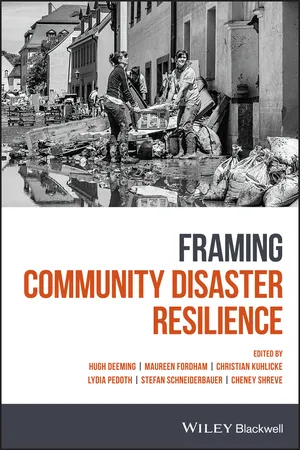
Framing Community Disaster Resilience
  1. English
  2. ePUB (mobile friendly)
  3. Available on iOS & Android
eBook - ePub

About this book

An essential guide to the foundations, research and practices of community disaster resilience 

Framing Community Disaster Resilience offers a guide to the theories, research and approaches for addressing the complexity of community resilience towards hazardous events or disasters. The text draws on the activities and achievements of the project emBRACE: Building Resilience Amongst Communities in Europe. The authors identify the key dimensions of resilience across a range of disciplines and domains and present an analysis of community characteristics, networks, behaviour and practices in specific test cases.

The text contains an in-depth exploration of five test cases whose communities are facing impacts triggered by different hazards, namely: river floods in Germany, earthquakes in Turkey, landslides in South Tyrol, Italy, heat-waves in London and combined fluvial and pluvial floods in Northumberland and Cumbria. The authors examine the data and indicators of past events in order to assess current situations and to tackle the dynamics of community resilience. In addition, they put the focus on empirical analysis to explore the resilience concept and to test the usage of indicators for describing community resilience. This important text:

  • Merges the forces of research knowledge, networking and practices in order to understand community disaster resilience
  • Contains the results of the acclaimed project Building Resilience Amongst Communities in Europe - emBRACE
  • Explores the key dimensions of community resilience
  • Includes five illustrative case studies from European communities that face various hazards

Written for undergraduate students, postgraduates and researchers of social science, and policymakers, Framing Community Disaster Resilience reports on the findings of an important study to reveal the most effective approaches to enhancing community resilience.

The emBRACE research received funding from the European Community's Seventh Framework Programme FP7/2007-2013 under grant agreement n° 283201. The European Community is not liable for any use that may be made of the information contained in this publication.

Trusted by 375,005 students

Access to over 1.5 million titles for a fair monthly price.

Study more efficiently using our study tools.

Information

Year
2018
Print ISBN
9781119165965
eBook ISBN
9781119166016

1
Introduction

Hugh Deeming
HD Research, Bentham, UK
‘Natural’ disasters are not natural. This has been stated by many researchers and practitioners from as early as the eighteenth century onwards (O’Keefe et al. 1976; Blaikie et al. 1994; Kelman 2010; Paravicini and Wiesmann 2016). The key aspects influencing the extent of disastrous losses or damages depend to a large degree on power and access to resources as well as on human behaviour – individual and collective. They are strongly connected to societal norms and values and were characterised as ‘social calculus’ by Smith (2005). This social calculus comprises underlying causes for vulnerabilities, the capacities to prevent and to prepare ahead of hazardous events, the susceptibilities during crisis or the capability to recover in a timely way in their aftermath (Blaikie et al. 1994). During the last decade, the recognition of these facts has found its way into disaster literature. However, activities and measures aiming to reduce disaster impacts often still have natural and environmental processes as their primary focus. To complement this, efforts aiming to build social resilience are now considered relevant to reduce disaster risk and are consequently at the core of Priority 3 of the disaster risk reduction (DRR) focused Sendai Framework 2015–2030 (UNISDR 2015).
The term resilience has a long tradition in engineering and construction but also in art, law, literature and psychology (Alexander 2013). Although it had been introduced as an applied concept in systems ecology by Holling in 1973, it was not until the early years of the twenty‐first century that the concept of resilience became a buzzword in both academic and more policy‐oriented contexts. As part of these attitudinal shifts, we saw the term vulnerability (perhaps the catchword of the later years of the twentieth century), with its sometimes negative connotations, replaced by the word ‘resilience’, seen by many as a more solution‐oriented approach. This almost ubiquitous capture is not without its critics, many of whom see its ascendant position as a depoliticisation project (Cannon and Müller‐Mahn 2010). The term resilience is now on everyone's lips, whether in ecology or economy, in science or policy, in disaster risk reduction or climate change adaptation.
In disaster and climate adaptation research, the resilience concept has given a strong impetus to bridging theory and practice, and emphasising the importance of social and societal aspects in explanation and reduction of negative consequences. However, due to its continuously increasing contexts and purposes, the term has lost sharpness or precision. The number of circumstances in which resilience is used is almost proportional to the number of ways in which it is interpreted (Brand and Jax 2007). Consequently, the concept of resilience has been criticised for being fuzzy and even counterproductive by allowing dominant power structures to allocate liabilities and the burden to deal with vulnerabilities to less powerful communities (see for example Tanner et al. 2017).
This book is about community resilience and tackles the question of how community resilience can be described, explained, assessed and strengthened within the context of natural hazard events and processes. The book can help to (re‐)focus the lens of resilience applications on the essentials required for an in‐depth understanding of underlying causes of harm and pressures aggravating successful resilience building. It places particular emphasis on the significance of community‐related aspects of resilience such as the sense of belonging and commitment, social networks, the sharing of perspectives and mutual actions in geographical locations. However, this, almost universally positive, reading of the ‘community’ concept must also be balanced by the need to avoid homogenising communities, recognising that their inherent social diversity leads inevitably to inequalities of experience and access to resources.
We very much hope that this book contributes to both a better understanding of the theoretical background of community resilience and to the awareness of the need to empower and strengthen communities in their effort to deal with natural events. Except for the chapters dealing with the theoretical concept, the contributions of this book have been achieved together with communities and are strongly based on their participation and input.

1.1 Book Content

The content of this book draws strongly on the activities and achievements of the project emBRACE – Building Resilience Amongst Communities in Europe. emBRACE was a European Commission‐funded Research Project that ran from 2011 to 2015. Its consortium members are placed in six different European countries and cover various academic disciplines from medical science and psychology via social and economic geography to risk research and emergency management. The emBRACE project aimed to build resilience to disasters amongst communities in Europe. Its work was based on the awareness that for the achievement of this objective, it is vital to merge forces in research knowledge, networking and practices. emBRACE tasks therefore covered both academic aspects, such as: framework development and the identification of key dimensions of resilience across a range of disciplines and domains; the operationalisation of theoretical concepts by means of indicators; and the analysis of community characteristics, networks, behaviour and practices in specific test cases.
The most relevant findings of this work – particularly those concerning the generation of new scientific knowledge as well as experience and guidance for assessing and building community resilience in practice – are reported in this book. The applied methodology of the various contributions range from targeted data analysis of the impacts of past hazardous events and resilience indicators to agent‐based modelling and social network analysis. The context for resilience analysis was provided by means of five test cases whose communities are facing impacts triggered by different hazards, namely: river floods in Central Europe (Germany), earthquake in Turkey, landslides in South Tyrol (Italy), heatwaves in London (UK) and combined fluvial and pluvial floods in Northern England (UK).
The book is divided into three main parts. The first part covers the conceptual and theoretical background required to fully understand the complexity of community resilience to hazardous events or disasters. The second part tackles the issue of data and indicators to report on past events, assess current situations and tackle the dynamics of community resilience. The third part focuses on empirical analysis to back the resilience concept and to test the usage of indicators for describing community resilience. Within this part, the contributions reflect the experience of the pilot case work. These three main scientific parts are followed by concluding remarks which reflect upon the emBRACE project journey and the rationale for our approach.

References

  1. Alexander, D. (2013). Resilience and disaster risk reduction: an etymological journey. Natural Hazards and Earth System Science 13 (11): 2707–2716.
  2. Blaikie, P., Cannon, T., Davis, I., and Wisner, B. (1994). At Risk: Natural Hazards, People's Vulnerability, and Disaster. London: Routledge.
  3. Brand, F.S. and Jax, K. (2007). Focusing the meaning(s) of resilience: resilience as a descriptive concept and a boundary object. Ecology and Society 12: 23.
  4. Cannon, T. and Müller‐Mahn, D. (2010). Vulnerability, resilience and development discourses in context of climate change. Natural Hazards 55 (3): 621–635.
  5. Kelman, I. 2010. Natural Disasters Do Not Exist (Natural Hazards Do Not Exist Either). Retrieved from: www.ilankelman.org/miscellany/NaturalDisasters.rtf.
  6. O’Keefe, P., Westgate, K., and Wisner, B. (1976). Taking the naturalness out of natural disasters. Nature 260: 566–567.
  7. Paravicini, G. and Wiesmann, C. (2016). Only Human Beings can Recognize Catastrophes, Provided they Survive them; Nature Recognizes no Catastrophes. Lucerne: Kantonaler Lehrmittelverlag.
  8. Smith, N. 2005. “There's no such thing as a natural disaster”. Understanding Katrina: perspectives from the social sciences. Retrieved from: http://understandingkatrina.ssrc.org/Smith
  9. Tanner, T., Bahadur, A., and Moench, M. (2017). Challenges f...

Table of contents

  1. Cover
  2. Table of Contents
  3. 1 Introduction
  4. Section I: Conceptual and Theoretical Underpinnings to Community Disaster Resilience
  5. Section II: Methods to ‘Measure’ Resilience – Data and Indicators
  6. Section III: Empirically Grounding the Resilience Concept
  7. Conclusions
  8. Index
  9. End User License Agreement

Frequently asked questions

Yes, you can cancel anytime from the Subscription tab in your account settings on the Perlego website. Your subscription will stay active until the end of your current billing period. Learn how to cancel your subscription
No, books cannot be downloaded as external files, such as PDFs, for use outside of Perlego. However, you can download books within the Perlego app for offline reading on mobile or tablet. Learn how to download books offline
Perlego offers two plans: Essential and Complete
  • Essential is ideal for learners and professionals who enjoy exploring a wide range of subjects. Access the Essential Library with 800,000+ trusted titles and best-sellers across business, personal growth, and the humanities. Includes unlimited reading time and Standard Read Aloud voice.
  • Complete: Perfect for advanced learners and researchers needing full, unrestricted access. Unlock 1.5M+ books across hundreds of subjects, including academic and specialized titles. The Complete Plan also includes advanced features like Premium Read Aloud and Research Assistant.
Both plans are available with monthly, semester, or annual billing cycles.
We are an online textbook subscription service, where you can get access to an entire online library for less than the price of a single book per month. With over 1.5 million books across 990+ topics, we’ve got you covered! Learn about our mission
Look out for the read-aloud symbol on your next book to see if you can listen to it. The read-aloud tool reads text aloud for you, highlighting the text as it is being read. You can pause it, speed it up and slow it down. Learn more about Read Aloud
Yes! You can use the Perlego app on both iOS and Android devices to read anytime, anywhere — even offline. Perfect for commutes or when you’re on the go.
Please note we cannot support devices running on iOS 13 and Android 7 or earlier. Learn more about using the app
Yes, you can access Framing Community Disaster Resilience by Hugh Deeming, Maureen Fordham, Christian Kuhlicke, Lydia Pedoth, Stefan Schneiderbauer, Cheney Shreve, Hugh Deeming,Maureen Fordham,Christian Kuhlicke,Lydia Pedoth,Stefan Schneiderbauer,Cheney Shreve in PDF and/or ePUB format, as well as other popular books in Physical Sciences & Geology & Earth Sciences. We have over 1.5 million books available in our catalogue for you to explore.