- Provides the first integrative international perspective on crisis communication
- Articulates a broader understanding of crisis communication, which includes work from scholars in journalism, public relations, audience research, psychology, political science, sociology, economics, anthropology, and international communication
- Explores the topic from cross-national and cross-cultural crisis communication approaches
- Includes research and scholars from countries around the world and representing all regions
- Discusses a broad range of crisis types, such as war, terrorism, natural disasters, pandemia, and organizational crises
eBook - ePub
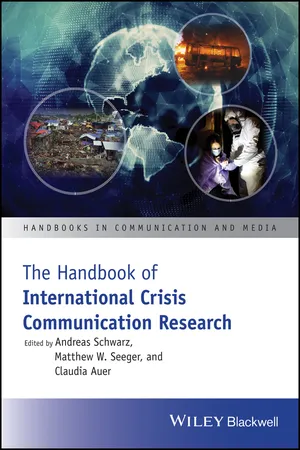
The Handbook of International Crisis Communication Research
- English
- ePUB (mobile friendly)
- Available on iOS & Android
eBook - ePub
The Handbook of International Crisis Communication Research
About this book
The Handbook of International Crisis Communication Research articulates a broader understanding of crisis communication, discussing the theoretical, methodological, and practical implications of domestic and transnational crises, featuring the work of global scholars from a range of sub-disciplines and related fields.
Information
1
Significance and Structure of International Risk and Crisis Communication Research: Toward an Integrative Approach
Andreas Schwarz, Matthew W. Seeger, and Claudia Auer
The Significance of International and Cross-Cultural Crisis Communication
In recent decades, communication scholars have increasingly recognized that the study of communication processes can no longer be restricted to national contexts (Brüggemann & Wessler, 2014). This has been linked to the ongoing process of globalization that affects social, political, and economic activities across the planet. Castells (2010) argues: “Not everything or everyone is globalized, but the global networks that structure the planet affect everything and everyone. This is because all the core economic, communicative, and cultural activities are globalized” (p. 38). He further relates the increasingly networked and globalized society to a number of emerging issues that are global in their manifestation and treatment, including environmental threats (e.g., global warming), the globalization of human rights and social justice, as well as global security as it is linked to international arms trade, war, and terrorism. Between 2003 and 2012 an annual average of 106,654 people were killed and 216 million were affected by natural disasters worldwide, most from floods and storms (Guha-Sapir, Hoyois, & Below, 2014). In 2013, the US National Consortium for the Study of Terrorism and Responses to Terrorism (2014) reported a total of 9,707 terrorist attacks worldwide, resulting in more than 17,800 deaths, more than 32,500 injuries, and more than 2,990 people kidnapped. Although the number of armed conflicts and wars as well as the number of battle fatalities has been decreasing since World War II, the Department of Peace and Conflict Research at Uppsala University (Uppsala Conflict Data Program, 2014) reported a growing share of intrastate conflicts with intervention from other states or secondary parties outside the country. Other types of crises with increasingly international causes and impact are public health crises and pandemia (e.g., Ebola, H1N1, SARS), economic and financial crises, and several crises involving large transnational organizations such as British Petroleum, Toyota, and the European Union (e.g., the European debt crisis).
Risks and crises are becoming more and more international in at least two respects. First, crises are physically transcending national and cultural boundaries in terms of their causes and consequences. The causes of global warming, for example, are related to the global increase of carbon dioxide emissions caused by the combustion of fossil fuels, transportation, and industrial production as well as transnational deforestation. Global warming has been associated with more and more deadly natural disasters with international impact. Second, crises are symbolically transcending national and cultural boundaries in terms of international public discourses on potential crises (risks), ongoing crises, and post-crises (commemoration, learning). The increasingly important role of international media organizations and news agencies, and the rise of networked, web-based, and mobile communication infrastructures and their growing use by ordinary people, professional communicators, and organizations have made many crises global.
Besides domestic actors in specific national environments and media organizations, the agents that play an important role in international risk and crisis communication are also multinational or transnational in terms of their organizational structures and operations. In the business sector, for instance, there are a reported total of 82,000 transnational corporations (TNCs) with 810,000 foreign affiliates worldwide, which account for one third of total world exports of goods and services and employ about 77 million people (United Nations Conference on Trade and Development, 2009). Others have described the rise of a global civil society where especially international nongovernmental organizations establish a “global or international frame of reference in their action and goals” (Castells, 2010, p. 40). These NGOs are increasing in number and in influence on national and international political agendas, and they constantly professionalize their efforts in strategic communication including crisis communication across borders, media channels, and target groups (Schwarz & Fritsch, 2014). NGOs are actively raising awareness of international risks and even create public pressure and crises for domestic governments or private companies. But they are also increasingly affected by crises themselves due to cases of embezzlement, corruption, or misperception in foreign countries where they often operate according to western standards (salaries, values, etc.) (Tkalac & Pavicic, 2009). In addition to civil society actors, several transnational political entities such as the European Union or the United Nations are practicing international risk and crisis communication in the context of public diplomacy, development aid, or disaster relief activities.
Within such organizations, professionals who are in charge of managing communication processes between the organization and its stakeholders are reporting a growing importance in both international communication and crisis communication. According to a survey of more than 2,000 European communication professionals in 43 countries (Zerfass et al., 2013), 45% of the practitioners communicate internationally across different countries on a regular basis, whereas only fewer than one fifth (18%) stated that they do not engage at all in international communication in their daily work. This validates the assumption that “[i]t is increasingly impossible [for communication practitioners] to escape communicating across national, cultural, and linguistic borders” (Hallahan et al., 2007, p. 27). The survey also revealed that almost 70% of European communication managers in private companies, government organizations, nonprofit organizations, and consulting firms had to deal with one or even several crisis situations (including natural disasters) in the year preceding the survey (Zerfass et al., 2013).
Despite the importance of international dimensions of communication, scholars have only recently begun to explore international or cross-cultural dimensions of crisis communication. The authors of the few existing publications on this topic largely agree that the internationalization of companies, NGOs, political organizations, and the media are linked to a growing number and a growing relevance of crises with cross-border impact, which significantly increase the complexity and needed skills of strategic crisis communication practice (Coombs, 2008; Frandsen & Johansen, 2010; Lee, 2005). However, the academic state of the art in this respect has been assessed rather pessimistically: “That international crisis communication is underdeveloped, if not undeveloped, reflects either insensitivity or ethnocentrism in the current crisis communication field” (Lee, 2005, p. 286). This raises serious questions concerning the external validity of the established theoretical frameworks, concepts, and practice recommendations in the crisis communication literature, which in most cases implicitly claim to be universally valid across national or cultural boundaries. However, the conceptual foundations of crisis and crisis communication imply a highly culture-sensitive character in crises and related communication processes. Crises as social constructs emerge in social negotiation processes where (the violation of) societal values, beliefs, expectancies, and norms serve as a fundamental reference for crisis stakeholders to decide whether a certain event, behavior, or process is labeled as crisis. This is more or less explicitly stated in many definitions of the crisis concept (Coombs, 2012; Falkheimer, 2013; Hearit & Courtright, 2004; Pearson & Clair, 1998; Schwarz, 2010; Seeger, Sellnow, & Ulmer, 2003). On the other hand, such values and beliefs are assumed to be one of the core elements of the complex construct of culture (Hofstede, 1980; House et al., 2002; Schwartz, 2006). Schwartz (2006) defines cultural values as “shared conceptions of what is good and desirable in the culture” (p. 139). In addition, he argues that cultural values “shape and justify individual and group beliefs, actions, and goals. Institutional arrangements and policies, norms, and everyday practices express underlying cultural value emphases in societies” (p. 139). This suggests that the way organizations plan, organize, perceive, and practice crisis communication as well as the way stakeholders engage in “co-creating the meaning of crises” (Coombs, 2012, p. 19) is highly contingent on the cultural context and cultural value emphases that shape perception, communication, and behavior of these social entities.
Categories of International, Cross-Cultural, and Comparative Crisis Communication Research
The state of research in international crisis communication including comparative and contextual research is still limited in quantity and scope which was also attributed to the relatively recent emergence of the field as topic of academic inquiry (see chapter 40, Coombs). A...
Table of contents
- Cover
- Title Page
- Table of Contents
- Notes on Contributors
- 1 Significance and Structure of International Risk and Crisis Communication Research
- Part I: Disciplinary Foundations for International Crisis Communication Research
- Part II: Actors and Institutional Communicators in International Crises
- Part III: The Role of the Media in the Construction of International Crises
- Part IV: Domestic and International Audiences in the Context of Crisis Communication
- Part V: The State of Crisis Communication Research Around the Globe
- Part VI: Challenges and Topics of Future Research on Crisis Communication
- Index
- End User License Agreement
Trusted by 375,005 students
Access to over 1.5 million titles for a fair monthly price.
Study more efficiently using our study tools.
Frequently asked questions
Yes, you can cancel anytime from the Subscription tab in your account settings on the Perlego website. Your subscription will stay active until the end of your current billing period. Learn how to cancel your subscription
No, books cannot be downloaded as external files, such as PDFs, for use outside of Perlego. However, you can download books within the Perlego app for offline reading on mobile or tablet. Learn how to download books offline
Perlego offers two plans: Essential and Complete
- Essential is ideal for learners and professionals who enjoy exploring a wide range of subjects. Access the Essential Library with 800,000+ trusted titles and best-sellers across business, personal growth, and the humanities. Includes unlimited reading time and Standard Read Aloud voice.
- Complete: Perfect for advanced learners and researchers needing full, unrestricted access. Unlock 1.5M+ books across hundreds of subjects, including academic and specialized titles. The Complete Plan also includes advanced features like Premium Read Aloud and Research Assistant.
We are an online textbook subscription service, where you can get access to an entire online library for less than the price of a single book per month. With over 1.5 million books across 990+ topics, we’ve got you covered! Learn about our mission
Look out for the read-aloud symbol on your next book to see if you can listen to it. The read-aloud tool reads text aloud for you, highlighting the text as it is being read. You can pause it, speed it up and slow it down. Learn more about Read Aloud
Yes! You can use the Perlego app on both iOS and Android devices to read anytime, anywhere — even offline. Perfect for commutes or when you’re on the go.
Please note we cannot support devices running on iOS 13 and Android 7 or earlier. Learn more about using the app
Please note we cannot support devices running on iOS 13 and Android 7 or earlier. Learn more about using the app
Yes, you can access The Handbook of International Crisis Communication Research by Andreas Schwarz, Matthew W. Seeger, Claudia Auer, Andreas Schwarz,Matthew W. Seeger,Claudia Auer in PDF and/or ePUB format, as well as other popular books in Social Sciences & Media Studies. We have over 1.5 million books available in our catalogue for you to explore.