Exploring and highlighting the new horizons in the studies of reaction mechanisms that open joint application of experimental studies and theoretical calculations is the goal of this book.
The latest insights and developments in the mechanistic studies of organometallic reactions and catalytic processes are presented and reviewed. The book adopts a unique approach, exemplifying how to use experiments, spectroscopy measurements, and computational methods to reveal reaction pathways and molecular structures of catalysts, rather than concentrating solely on one discipline. The result is a deeper understanding of the underlying reaction mechanism and correlation between molecular structure and reactivity. The contributions represent a wealth of first-hand information from renowned experts working in these disciplines, covering such topics as activation of small molecules, C-C and C-Heteroatom bonds formation, cross-coupling reactions, carbon dioxide converison, homogeneous and heterogeneous transition metal catalysis and metal-graphene systems. With the knowledge gained, the reader will be able to improve existing reaction protocols and rationally design more efficient catalysts or selective reactions.
An indispensable source of information for synthetic, analytical, and theoretical chemists in academia and industry.
Chapter 1 Mechanisms of Metal-Mediated C–N Coupling Processes: A Synergistic Relationship between Gas-Phase Experiments and Computational Chemistry
Robert Kretschmer, Maria Schlangen, and Helmut Schwarz
1.1 Introduction
As a consequence of the key positions that the elements carbon and nitrogen occupy in nature, C–N bond formation constitutes an important issue in the synthesis of various products ranging from chemical feedstocks to pharmaceuticals. Not surprisingly, over the last few decades, intensive research has been devoted to this timely topic [1], and the use of ammonia as a relatively inexpensive reagent for C–N coupling reactions has been found to be highly desirable [2]. However, despite the impressive progress reported on the development of new synthetic methodologies, there exists a lack of information on the precise, atomistic-level derived mechanisms in particular for the metal-mediated formation of nitrogen-containing organic molecules generated directly from ammonia. One way to gain such insight is to perform gas-phase experiments on “isolated” reactants. These studies provide an ideal arena for probing experimentally the energetics and kinetics of a chemical reaction in an unperturbed environment at a strictly molecular level without being obscured by difficult-to-control or poorly defined solvation, aggregation, counterion, and other effects. Thus, an opportunity is provided to reveal the intrinsic feature(s) of a catalyst, to explore directly the concept of single-site catalysts, or to probe in detail how mechanisms are affected by factors such as cluster size, different ligands, dimensionality, stoichiometry, oxidation state, degree of coordinative saturation, and charge state. In short, from these experiments, one may learn what determines the outcome of a chemical transformation [3]. In addition, thermochemical and kinetic data derived from these experiments provide a means to benchmark the quality of theoretical studies.
While the study of “naked” gas-phase species will, in principal, never account for the precise kinetic and mechanistic details that prevail at a surface, in an enzyme, or in solution, when complemented by appropriate, computationally derived information, these gas-phase experiments prove meaningful on the ground that they permit a systematic approach to address the above-mentioned questions; moreover, they provide a conceptual framework. The DEGUSSA process, which is the rather unique, platinum-mediated, large-scale coupling of CH4 and NH3 to generate HCN [4], serves as a good example. Mass spectrometry-based experiments [5] suggested both the key role of CH2NH as a crucial gas-phase transient and also pointed to the advantage of using a bimetallic system rather than a pure platinum-based catalyst for the C–N coupling step to diminish undesired, catalyst-poisoning “soot” formation [6, 7]. The existence of CH2NH was later confirmed by in situ photoionization studies [8] and catalysts that are currently employed contain silver-platinum alloys rather than pure platinum.
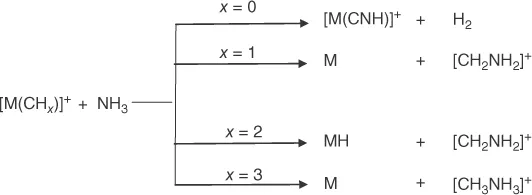
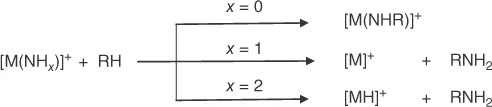
In this chapter, we focus on two types of gas-phase C–N coupling processes, Eqs. (1.2) and (1.2), using metal complexes bearing simple carbon- and nitrogen-based ligands and probing their thermal reactions with ammonia and hydrocarbons, respectively. While we will refrain from describing the various experimental techniques and computational methods or the way the reactive species [M(CHx)]+ and [M(NHx)]+ are generated [9], the emphasis will rather be on the elucidation of the often intriguing mechanisms of these metal-mediated coupling reactions.
1.1
1.2
1.2 From Metal-Carbon to Carbon–Nitrogen Bonds
1.2.1 Thermal Reactions of Metal Carbide and Metal Methylidene Complexes with Ammonia
The major ionic product in the reactions of [Ptn(C)]+ (n = 1, 2) with NH3 correspo...
Table of contents
Cover
Related Titles
Title Page
Copyright
List of Contributors
Preface
Chapter 1: Mechanisms of Metal-Mediated C–N Coupling Processes: A Synergistic Relationship between Gas-Phase Experiments and Computational Chemistry
Chapter 2: Fundamental Aspects of the Metal-Catalyzed C–H Bond Functionalization by Diazocarbenes: Guiding Principles for Design of Catalyst with Non-redox-Active Metal (Such as Ca) and Non-Innocent Ligand
Chapter 3: Using Metal Vinylidene Complexes to Probe the Partnership Between Theory and Experiment
Chapter 4: Ligand, Additive, and Solvent Effects in Palladium Catalysis – Mechanistic Studies En Route to Catalyst Design
Chapter 5: Computational Studies on Sigmatropic Rearrangements via π-Activation by Palladium and Gold Catalysts
Chapter 6: Theoretical Insights into Transition Metal-Catalyzed Reactions of Carbon Dioxide
Chapter 7: Catalytically Enhanced NMR of Heterogeneously Catalyzed Hydrogenations
Chapter 8: Combined Use of Both Experimental and Theoretical Methods in the Exploration of Reaction Mechanisms in Catalysis by Transition Metals
Chapter 9: Is There Something New Under the Sun?Myths and Facts in the Analysis of Catalytic Cycles
Chapter 10: Computational Tools for Structure, Spectroscopy and Thermochemistry
Chapter 11: Computational Modeling of Graphene Systems Containing Transition Metal Atoms and Clusters
Index
End User License Agreement
Trusted by 375,005 students
Access to over 1.5 million titles for a fair monthly price.
Study more efficiently using our study tools.
Frequently asked questions
Yes, you can cancel anytime from the Subscription tab in your account settings on the Perlego website. Your subscription will stay active until the end of your current billing period. Learn how to cancel your subscription
No, books cannot be downloaded as external files, such as PDFs, for use outside of Perlego. However, you can download books within the Perlego app for offline reading on mobile or tablet. Learn how to download books offline
Perlego offers two plans: Essential and Complete
Essential is ideal for learners and professionals who enjoy exploring a wide range of subjects. Access the Essential Library with 800,000+ trusted titles and best-sellers across business, personal growth, and the humanities. Includes unlimited reading time and Standard Read Aloud voice.
Complete: Perfect for advanced learners and researchers needing full, unrestricted access. Unlock 1.5M+ books across hundreds of subjects, including academic and specialized titles. The Complete Plan also includes advanced features like Premium Read Aloud and Research Assistant.
Both plans are available with monthly, semester, or annual billing cycles.
We are an online textbook subscription service, where you can get access to an entire online library for less than the price of a single book per month. With over 1.5 million books across 990+ topics, we’ve got you covered! Learn about our mission
Look out for the read-aloud symbol on your next book to see if you can listen to it. The read-aloud tool reads text aloud for you, highlighting the text as it is being read. You can pause it, speed it up and slow it down. Learn more about Read Aloud
Yes! You can use the Perlego app on both iOS and Android devices to read anytime, anywhere — even offline. Perfect for commutes or when you’re on the go. Please note we cannot support devices running on iOS 13 and Android 7 or earlier. Learn more about using the app
Yes, you can access Understanding Organometallic Reaction Mechanisms and Catalysis by Valentin P. Ananikov in PDF and/or ePUB format, as well as other popular books in Physical Sciences & Organic Chemistry. We have over 1.5 million books available in our catalogue for you to explore.