- Composed of over 30 essays written by an international array of scholars and meticulously edited by one of the best known authorities on the study of deviance
- Features chapters on cutting-edge topics, such as terrorism and environmental degradation as forms of deviance
- Each chapter includes a critical review of what is known about the topic, the current status of the topic, and insights about the future of the topic
- Covers recent theoretical innovations in the field, including the distinction between positivist and constructionist perspectives on deviance, and the incorporation of physical appearance as a form of deviance
- English
- ePUB (mobile friendly)
- Available on iOS & Android
eBook - ePub
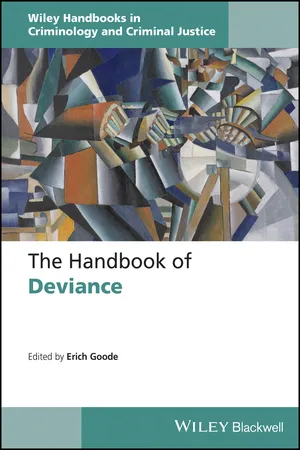
The Handbook of Deviance
About this book
The Handbook of Deviance is a definitive reference for professionals, researchers, and students that provides a comprehensive and engaging introduction to the sociology of deviance.
Information
Part I
Deviance
The Conceptual Foundations
1
The Sociology of Deviance
An Introduction
Erich Goode
Virtually all societies everywhere and throughout recorded time have established and promulgated rules or norms – including codified laws – that demarcate the good from the bad: the true from the false, desirable from undesirable, acceptable from unacceptable, legal from illegal, licit from illicit, legitimate from illegitimate, and behavior, beliefs, and characteristics that are valued from those that are disvalued. Likewise, all societies have spelled out sanctions, punishments – appropriate reactions that audiences and agents of social control should invoke or apply against violators of those rules. And all societies invoke such sanctions against miscreants variably according to the nature of the violation – its degree of seriousness and whether it is the breach of formal or informal norms, whether it becomes widely known, what the circumstances of the violation are, and who the violators are – for instance, their age, social rank, and their degree of intimacy with relevant audiences. At the same time, remarkably, the sanctioning of putative wrongdoers is both erratic and patterned: deviants often, though not always, bring forth censure, condemnation, and punishment, and the reasons why they do – or don’t – is sociologically problematic and often revealing. And all complex, contemporary societies are arranged in such a way that collectivities within them vary considerably as to what is considered wrongful, making the investigation of deviance very complicated indeed.
Who are these audiences that do, or would – or could – condemn or censure normative violations? They include lawmakers and enforcers and functionaries of the criminal justice system, officials, politicians, the general public, parents and other relatives, friends, lovers, and other intimates, professionals (such as teachers, physicians, and psychiatrists), religious figures, members of the media – just about any collectivity whose members interact, whether directly or indirectly, with anyone who might violate the law or a social norm. In other words, deviance comes into being as a result of moral enterprise. That is, first, a rule is defined as deviant, and second, a particular audience reacts to a given violation as a case of deviance (Becker, 1963, pp. 147–163). Some rules are ancient and nearly universal, but from a constructionist or interactionist perspective, to be deviant a violation must be reacted to – whether directly or indirectly – by a given audience. Note that not all audiences, and not all members of any given audience, necessarily agree on what is deviant or wrong; what is considered wrongful is debated, contested, reevaluated, and argued about. At the same time, some norms are so strongly held that the likelihood is extremely high that one or more members of these collectivities will react to such a violation in a negative, censorious, rebukeful way; other norms are very nearly matters of indifference, or are held by such a small number of members of a given society, or collectivities within a given society, that negative reactions to their violation are extremely unlikely, or are likely to be weak. Clearly, deviance is a matter of degree.
Sociologists define “deviant” behavior or “deviance” as acts, beliefs, and characteristics that violate major social norms and attract, or are likely to attract, condemnation, stigma, social isolation, censure, and/or punishment by relevant audiences (Clinard, 1957, p. vii; Clinard & Meier, 2011; Goode, 2015, Chapter 1). “Deviance” is behavior, beliefs, and characteristics, and are disvalued or stigmatized, and a “deviant” is a disvalued person, someone who is, and who members of a particular society or social circle are told should be, isolated, rejected, avoided, stigmatized, and censured, or otherwise treated in a negative fashion (Sagarin, 1975). Again, what is considered deviant varies from one audience, social circle, or collectivity to another, one setting, circumstance, and situation to another, and according to protagonist and antagonist. It almost goes without saying that what is considered deviant varies by society and historical time period. And, to repeat, what is considered deviant is a matter of degree; the key here is the likelihood of attracting censure, and the quantum of censure ranges from mild to extreme, from a negative remark to social isolation, rejection, hostility, condemnation, and denunciation – and, at its most extreme end point, execution by the state or, at one time, a lynch mob. Extreme deviance is the end point along a continuum. At its mildest, one could say, the deviance is us; at its most extreme, the deviant is widely considered society’s worst enemy. More to the point, deviance is defined by a diversity of collectivities, each one of which regards wrongness somewhat differently, only some of which wield the hegemony or dominance to define what is bad or wrong for the society as a whole. Perhaps most importantly: the more seriously deviant an act or a belief – and in all likelihood, a physical condition – is, the rarer it is.
Sociologically, minority or variant interpretations and practices of right and wrong are as consequential and revealing to the sociologist as majority or dominant ones; hence, as students of deviance, we have to pay close attention to whether, to what extent, and how hegemony is achieved, how other interpretations fail to become dominant, and the ways in which the entrenched morality, cosmology, ideology, religion, or ways of doing things are challenged. Especially in a large, complex society, collectivities of people who do not share the dominant view are common, and they mingle, accommodate to, jostle and clash with, and often subvert, majority perspectives and ways of behaving and believing. Deviance is a concept with one foot in the attempt to understand and explain the institutionalization of conventionality – and consequently, deviantization as well – and one foot in the processes of tolerance versus anathemization, assimilation versus subversion, centrality versus marginalization, separate-but-equal versus separate-and-despised treatment, “let a thousand flowers bloom” versus “crush the dissidents.” How do minority ways of life or subcultures become deviant? Or, alternatively, how does a statistical minority of the population come to dominate, rule, and exert influence over the culturally marginal but numerically large majority? When do once-deviant views and practices become unobjectionable, tolerated – embraced as coequal among members of the dominant sector of the society? How do disparate practices that are viewed as “less than” by the majority become acceptable options, behavioral peers in a conglomerate society? When and where do these things happen, and under what circumstances does it not happen at all? These are some of the central issues that the sociology of deviance addresses, and how these factors and forces play themselves out in and among specific groups, categories, social circles, and collectivities is a matter to be investigated, not assumed beforehand. Many behaviors, beliefs, and even physical conditions that the majority or dominant sectors of society consider deviant or unconventional are interpreted positively among certain circles or groups, and this tension sets in motion social dynamics that add up to intriguing developments that sociologists would like to understand better.
One of the most remarkable shifts in the history of thinking about putative wrongdoing was the movement away from regarding it as an intrinsic or essentialistic evil, and/or a harmful, damaging, pathological action, to seeing it as the violation of a constructed social norm or law. At the same time, the Hobbesian equation stands athwart all theoretical considerations of deviance: societies could not long endure if they failed to punish, and hence discourage, truly harmful behavior, such as rape, robbery, and murder. Some actions and beliefs are toxic to the society at large; they tear at the social order, the common weal. Any society accepting them as normative would be equivalent to signing a suicide pact. And yet, harm and deviance are not isometrically related; in some societies at certain times, many harmful actions and beliefs have been normative and conventional – consider anti-Semitism and racism. Likewise, many deviant actions and beliefs, such as tattooing, belief in aliens, and multiple sexual variants, are not harmful, and some – certain types of altruism, scientific innovation, and participation in certain progressive social movements – are actually beneficial. Societies disvalue and censure a substantial number of actions that neither directly harm anyone nor threaten the society with chaos and disintegration.
Not only is what’s deviant socially constructed, but even the constituent behaviors and beliefs that make up the generic category of “deviance” are themselves socially constructed. What is considered rape, robbery, and murder varies both societally and historically. Most norms are intended to make a statement about what is deemed – by some, many, or most members of a society – to be right, good, and proper. Presumably, these norms fit hand-in-glove with a network of beliefs and practices that underpin a way of life; many members of the society imagine that, if tolerated, particular deviant practices will subvert the society as a whole, causing a general collapse much like a pile of pick-up-sticks when one stick is removed. These norms embody certain generic principles of moral correctness separate and independent from what they do for the society’s physical survival; it is putative morality and decency that deviance presumably challenges, not necessarily the physical lives of the people themselves. There is implicit in norms and their enforcement a version of moral correctness, an ethos – a whole way of life that is an end in itself. We are expected to do and believe certain things because they are right, because that’s the way things should be done. A substantial number of norms anathemize actions and beliefs because many members of the society feel that they represent threats to a way of life, a social and cultural order, a sense of moral and ethical propriety. By punishing parties they consider deviants, collective representatives protect a “moral canopy” (Berger, 1967), an invisible but very palpable interpretation of rectitude. Likewise, societies positively or negatively value certain appearances, traits, and conditions; consequently, the ugly, the disabled, and the sick become “involuntary deviants” (Sagarin, 1975, p. 201). No one wants to possess these characteristics, and the physical presence of those who do is thought to contaminate the whole and the healthy. Though such categories of humanity are no longer as reviled or vilified as they once were, ev...
Table of contents
- Cover
- Title page
- Table of Contents
- Contributors
- Introduction
- Acknowledgments
- Part I: Deviance
- Part II: Ongoing Deviance Dynamics
- Part III: Studying Deviance
- Part IV: Approaches, Explanations, Factors
- Part V: Individual Deviance
- Part VI: Institutional Deviance
- Part VII: Deviance Futures
- Index
- End User License Agreement
Trusted by 375,005 students
Access to over 1.5 million titles for a fair monthly price.
Study more efficiently using our study tools.
Frequently asked questions
Yes, you can cancel anytime from the Subscription tab in your account settings on the Perlego website. Your subscription will stay active until the end of your current billing period. Learn how to cancel your subscription
No, books cannot be downloaded as external files, such as PDFs, for use outside of Perlego. However, you can download books within the Perlego app for offline reading on mobile or tablet. Learn how to download books offline
Perlego offers two plans: Essential and Complete
- Essential is ideal for learners and professionals who enjoy exploring a wide range of subjects. Access the Essential Library with 800,000+ trusted titles and best-sellers across business, personal growth, and the humanities. Includes unlimited reading time and Standard Read Aloud voice.
- Complete: Perfect for advanced learners and researchers needing full, unrestricted access. Unlock 1.5M+ books across hundreds of subjects, including academic and specialized titles. The Complete Plan also includes advanced features like Premium Read Aloud and Research Assistant.
We are an online textbook subscription service, where you can get access to an entire online library for less than the price of a single book per month. With over 1.5 million books across 990+ topics, we’ve got you covered! Learn about our mission
Look out for the read-aloud symbol on your next book to see if you can listen to it. The read-aloud tool reads text aloud for you, highlighting the text as it is being read. You can pause it, speed it up and slow it down. Learn more about Read Aloud
Yes! You can use the Perlego app on both iOS and Android devices to read anytime, anywhere — even offline. Perfect for commutes or when you’re on the go.
Please note we cannot support devices running on iOS 13 and Android 7 or earlier. Learn more about using the app
Please note we cannot support devices running on iOS 13 and Android 7 or earlier. Learn more about using the app
Yes, you can access The Handbook of Deviance by Erich Goode in PDF and/or ePUB format, as well as other popular books in Scienze sociali & Criminologia. We have over 1.5 million books available in our catalogue for you to explore.