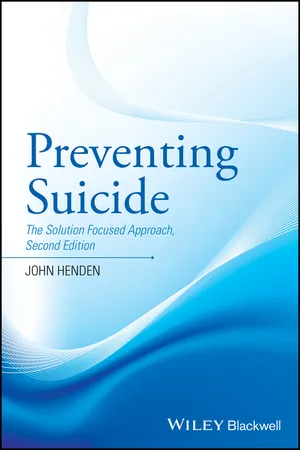
- Offers invaluable guidance for suicide prevention by showing "what works" in treating those struggling with suicidal thoughts
- Provides straightforward ways to deal frankly with the subject of suicide, along with a range of tools and techniques that are helpful to clients
- Includes actual dialogue between practitioners and clients to allow readers to gain a better understanding of how to work with suicidal clients
- Compares and contrasts a ground-breaking approach to suicide prevention with more traditional approaches to risk assessment and management
- Features numerous updates and revisions along with brand new sections dealing with the international landscape, blaming the suicided person, Dr Alys Cole-King's 'Connecting with People', and telephone work with the suicidal, Human Givens Therapy, and zero suicide
- English
- ePUB (mobile friendly)
- Available on iOS & Android
eBook - ePub
About this book
New edition of an acclaimed manual which uses the solution focused approach to take an empathetic and validating approach to working with individuals considering suicide.
Information
1
How to use this book
Whether you are a healthcare professional, an academic, advice‐line volunteer, or someone who is feeling suicidal at the present time, you will find this book helpful.
If you are a healthcare professional (general practitioner, psychiatrist, psychologist, counsellor, therapist, mental health nurse, social worker, or another member of either a primary care team or a specialist mental health team); and, have already a basic grounding in solution focused brief therapy, then you might find it most helpful or useful to go straight to Chapter 8. Here you will find out about the specialised solution focused tools and techniques and see how they are applied to the suicidal service user.
If you have no previous knowledge about solution focused brief therapy and want to learn about it in a nutshell, then you might like to begin at Chapter 6, before picking up on the specialised techniques in Chapter 8.
You might be inquisitive as to how the solution focused approach to preventing suicide sits alongside other approaches and models of working. You might be from an established tradition (e.g. biomedical, cognitive behavioural, person‐centred, etc.) and are curious as to how solution focused compares and contrasts with your own way of working. A number of other models are set out in Chapter 4. The author is respectful of other ways of working: all have validity.
If your interest in the subject is purely academic and you are on a journey of discovery within the wider subject of ‘suicidology’, then you might like to begin at Chapter 2, ‘The Book’s style and purpose’.
You may be a tutor running a counselling or psychotherapy course, either wanting to understand the solution focused approach a little more and/or wanting to see how you might teach the tools and techniques herein to your students. You will find the book easy to follow and understand, and will find the many examples and sections of counsellor‐client dialogue helpful in learning about which techniques to apply and when. Also, you will appreciate, I hope, that the solution focused approach is not simply ‘techniquey’, but is a relational process between worker and client that flows. Also, you will discover that the approach produces long‐lasting results, despite the relatively few number of sessions required.
You might be a reader who has made an attempt on your life already or are thinking of doing so. I hope you will find the book both interesting and helpful to you in your current state of thinking. If you are such a reader, I would suggest you go straight to the ‘worst case (graveside) scenario’ in Chapter 8 and spend about 10–15 minutes answering it as carefully and honestly as you can, before reading other chapters in the book. You might like to read either Suicide: The Forever Decision: For Those Thinking about Suicide, and for Those who Know, Love or Counsel Them, by Paul G. Quinnett, or How I Stayed Alive When my Brain was Trying to Kill Me: One Person’s Guide to Suicide Prevention, by Susan Blauner. (See Reference section at the back for full details.)
You might be a solution focused practitioner who is interested in finding out about yet another specialist area which has been given the solution focused treatment or had solution focused principles applied to it. In the spirit of generosity, which is a fundamental part of the solution focused tradition, this is my offering. Please feel free to use any of the exercises in your work for the benefit of others. All I ask is that you acknowledge the source. Throughout the book, apart from a little within Chapters 4 and 5, I have avoided using the jargon of the study of suicide. The main reason for this is to keep the book simple and understandable for the widest possible readership. As first and foremost a practitioner and trainer, my overall aim is both to save lives and to help others to save lives too. My ‘academic hat’ is very much secondary. This whole area of research, education and practice has been given the title ‘suicidology’. For those readers wishing to know what the jargon of suicidology is comprised of, and for serious academics who may wish to study aspects of the subject further, I would suggest you enter this term into your preferred internet search engines, along with other terms such as, ‘suicidal ideation’, ‘completed suicide’, and ‘postvention’. Many of the references at the back of the book will be helpful too.
Throughout the book, you will find many different titles for ‘practitioner’ and for ‘client’. I have used a maximum of interchangeability with the many terms that refer to these two titles, in order to ensure the book is of widest appeal across the healthcare, helping, social care, and welfare sectors, where suicidal people are encountered. So for ‘practitioners’ the following alternative terms will appear: ‘health professional’, ‘worker’, ‘therapist’, ‘helper’, ‘clinician’, and ‘counsellor’. For ‘client’ the following titles will be used: ‘patient’, ‘service user’, ‘person’, and ‘helpee’. Also, I have used the male and female pronouns interchangeably from time to time.
2
The book’s style and purpose
It is the quality of the personal encounters which, in the end, are the essential factors in creating positive change.(John Eldrid)
Before people kill themselves, many have had recent contact with a helping agency. Two‐thirds of those who contact their family doctor have received medication, which about half use to poison themselves.(David Aldridge, 1998)
Suicide remains the leading cause of death in England and Wales for men aged 20–34.(The Daily Telegraph, 19 February 2015)
The book – in a nutshell
For decades, health professionals and policy makers have resorted to head‐scratching, chest‐beating and hand‐wringing over high suicide rates. Questions were, and are still asked today, such as:
Could we have asked the right question?
Shouldn’t we have recognised the signs?
Wasn’t there a clue somewhere in what he/she said?(Aldridge, 1998)
The issue of resolving the problem of suicide has taxed intelligent minds across many disciplines for a very long time. Camus (1942) in referring to it said, ‘There is but one truly serious philosophical problem and that is suicide.’ In spite of the vast increase in research into the problem, nearly two‐thirds of a century later it seems, worldwide, we are little further forward. Another main purpose of this book is to shed new light and make in‐roads such that there is a real focus amongst both clinicians and researchers on ‘what works’ in face‐to‐face suicide prevention, rather than focusing on statistics, demographies, risk factors and restricting access to methods. My hope is that we will reach a point when the following statement applies: Simon’s (2002) statement (‘There are two kinds of psychiatrist: those who have had patients commit suicide and those who will.’), can be revised to something more wide ranging along the lines of: ‘There are two kinds of mental health care‐givers: those who used to have clients take their lives and those who do not.’
More recently, conversations have shifted from finding ways to reduce suicide further within healthcare agencies to ‘zero suicide rates’ (see Chapter 15). From what we know now, about effective interventions and discussions with other compassionate practitioners, I believe this is achievable.
Much has been written about the subject of suicide, but little on the specific ‘how‐to‐do’ or ‘what works’ in the 1:1 relationship between worker and suicidal person.
This book concentrates on how lives are saved; what workers do and say that is effective; and, what clients have said they found helpful.
The book’s style
I have aimed to make the style of this book clear, easy to read, and jargon‐free, wherever possible. The principle of ‘Occam’s Razor’ is applied: that is, if more straightforward words or stories can be used to describe something, then it is those which will be chosen.
Reasons for writing
An approach which is effective
The many tools and techniques outlined in later chapters were field‐tested over the past 20 years or so. They have been demonstrated to work both efficiently and effectively. Students of training workshops have reported similar success rates over the past six years or so. There is a growing body of practice‐based evidence which shows significant reductions in suicide rates both in individual caseloads and within teams. It is my hope that soon, researchers will conduct a randomised control trial to demonstrate a clear evidence‐base for SF suicide prevention, to be added to the seminal work of Franklin et al. (2012).
A shortage in the literature of effective brief therapy treatments for suicidal clients
From my extensive literature review, it seems the vast majority of research, review, and discussion material on the subject of suicide, is concerned with matters other than the matter of central concern: the verbal and non‐verbal communication that occurs in a 1:1 relationship with a suicidal person. Instead, writers become lost in national suicide trends and statistics, methods used in completed suicide, community attitudes, and beliefs towards suicidal behaviour, and so on. There are numerous research and discussion topics on suicide, generally, and these are dealt with more than adequately elsewhere. Should readers be interested in following up any of these, there are various avenues of inquiry. My concern is to emphasise the crucial matter of how to manage the one‐to‐one encounter with someone experiencing strong suicidal thoughts and ideas. There is a strong case for how the first ten minutes is conducted to make a significant difference to the outcome (see Chapter 7). This is the central focus of the book.
Personal involvement in the territory
My personal interest in this subject can be traced back to my early childhood years when I tried suffocating myself on many occasions, under the bed covers, in order to escape severe and enduring emotional abuse and neglect. On other occasions I prayed to God that he would take me away in my sleep. I am pleased to realise now that He had other plans! It is only in recent years, while talking to my brother, two years my junior that I learnt that he hoped to die too, as a way out.
No doubt another source of my interest is that my cousin, John Neil Henden, took his life by carbon monoxide poisoning some 15 years ago, as a result of various personal and employment difficulties. (He had been diagnosed earlier as being ‘clinically depressed’.) His death impacted on me both in that I lost a cousin, but also the less‐than‐satisfactory treatment he received when asking for help. Both my personal experience of suicidal thinking and the experience of close family members, has given me a heightened empathy towards suicidal people.
The connections I have had with helping agencies, both statutory and voluntary, over the past 40 years or so, have opened my eyes to what works; what helps a little; and, what patently fails those whose problems and difficulties are such that they experience recurrent suicidal thoughts and ideas.
During the course of my life, to date, I have taken various calculated risks to achieve personal objectives. On some occasions these did not work out. At those times, I ...
Table of contents
- Cover
- Title Page
- Table of Contents
- About the author
- Foreword
- Acknowledgments
- 1 How to use this book
- 2 The book’s style and purpose
- 3 Defining suicide and self‐injury
- 4 Current service provision
- 5 Other approaches to helping the suicidal
- 6 What is Solution Focused Brief Therapy?
- 7 Suicide encounters
- 8 The solution focused approach in working with the suicidal
- 9 Case study
- 10 Some more case vignettes
- 11 Connecting with people
- 12 Working on the phone with the suicidal person
- 13 Blaming those who took their lives
- 14 International solution focused applications to suicide prevention
- 15 Zero suicide
- 16 Where do we go from here?
- Appendix 1: Flow diagram for an episode of treatment
- Appendix 2: Specialist solution focused training workshops
- Appendix 3: Evidence base for solution‐focused working
- References
- Index
- End User License Agreement
Trusted by 375,005 students
Access to over 1.5 million titles for a fair monthly price.
Study more efficiently using our study tools.
Frequently asked questions
Yes, you can cancel anytime from the Subscription tab in your account settings on the Perlego website. Your subscription will stay active until the end of your current billing period. Learn how to cancel your subscription
No, books cannot be downloaded as external files, such as PDFs, for use outside of Perlego. However, you can download books within the Perlego app for offline reading on mobile or tablet. Learn how to download books offline
Perlego offers two plans: Essential and Complete
- Essential is ideal for learners and professionals who enjoy exploring a wide range of subjects. Access the Essential Library with 800,000+ trusted titles and best-sellers across business, personal growth, and the humanities. Includes unlimited reading time and Standard Read Aloud voice.
- Complete: Perfect for advanced learners and researchers needing full, unrestricted access. Unlock 1.5M+ books across hundreds of subjects, including academic and specialized titles. The Complete Plan also includes advanced features like Premium Read Aloud and Research Assistant.
We are an online textbook subscription service, where you can get access to an entire online library for less than the price of a single book per month. With over 1.5 million books across 990+ topics, we’ve got you covered! Learn about our mission
Look out for the read-aloud symbol on your next book to see if you can listen to it. The read-aloud tool reads text aloud for you, highlighting the text as it is being read. You can pause it, speed it up and slow it down. Learn more about Read Aloud
Yes! You can use the Perlego app on both iOS and Android devices to read anytime, anywhere — even offline. Perfect for commutes or when you’re on the go.
Please note we cannot support devices running on iOS 13 and Android 7 or earlier. Learn more about using the app
Please note we cannot support devices running on iOS 13 and Android 7 or earlier. Learn more about using the app
Yes, you can access Preventing Suicide by John Henden in PDF and/or ePUB format, as well as other popular books in Psychology & Abnormal Psychology. We have over 1.5 million books available in our catalogue for you to explore.