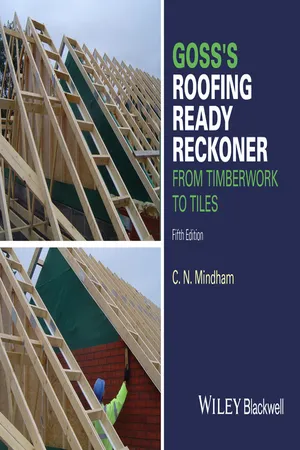
Goss's Roofing Ready Reckoner provides cutting angle and lengths for traditional 'cut' roofs and design tables for timber sizing, based on BS5268 'Structural use of timber' and now including a comparison of timber sizes using Eurocode 5 'Design of Timber Structures'. Additional information is provided on wall plate and gable strapping, wind bracing, truss clips and other roofing metalwork, plus information on tools, equipment and health and safety matters. Detailed drawings for tiling, slating and other roof coverings are included, with fixing requirements revised to BS 5534:2014. Information on lead substitutes and roofing putties is also provided. Design of warm and cold roofs is fully covered, including ventilation and insulation requirements. The fifth edition also includes new chapters on engineered timber roofing components, solar panel fixing and outbuilding roofs.
- English
- ePUB (mobile friendly)
- Available on iOS & Android
eBook - ePub
About this book
Information
1
Introduction and Acknowledgements
The aim of this book, when first published in 1948, was to provide quick reference tables for the length and angles of cut for timber members in a traditional cut roof construction. Today, when many houses use trussed rafters for their roof construction, there is still a need for some parts of those roofs to be built using traditional methods, especially with the ever-increasing use of attic roof structures. The renovation of older roofs, extensions and conversions all require knowledge of roofing from wall plate to ridge, and the correct detailing of the roof covering materials themselves.
Relaxation in planning controls has allowed a wide range of smaller buildings to be constructed without planning permission. These include sheds, garages, garden office buildings and workshops. New information on the limitations of building profile and construction is included in this edition, together with some helpful drawings.
This book assumes that a basic architectural design of the roof to be constructed is already completed, that is, the span, pitch, length and any additional supporting walls. Guidance is given on how to calculate the size of individual roof member timbers, the cutting length, the angles and the compound cuts. The tables shown are based on BS5268 ‘Structural use of timber’ and a comparison of timber sizes using Euro code 5 ‘Design of Timber Structures’ is shown as both design documents are currently acceptable by building control regulations. The book now also includes all aspects to be considered when choosing the roof covering, including the suitability of the tiles or slates for the pitch and exposure of the roof concerned, the choice of a ‘warm’ or ‘cold’ roof, the considerations to be given to the correct insulation, and the possibilities and avoidance of condensation within the roof space by dealing correctly with ventilation.
Solar panels, now frequently fitted to both new and existing roofs, impose different loads on roof structures and these have been addressed in a new chapter.
Finally, Health and Safety matters are addressed, including the ‘Working at Heights Regulations’, loading the roof structure with the roof coverings, lifting components, and the correct use of preservative-treated timber.
Acknowledgements
My thanks are due to all the manufacturers who have allowed me to use their product illustrations. I am particularly indebted to Robinson Manufacturing Ltd, for the help they have given on engineering timber components, and especially for help on spandrel panels. Thanks are also due to Kier Living Ltd for access to their construction site for photography for the cover of this book.
The Trussed Rafter Association helped with solar panel fixing research, and Anthony Gwynne kindly contributed with his overview of the building regulation requirements with regards to thermal performance.
2
Roofing terminology
The main terminology used for roofing is listed below (see Figures 2.1–2.4).
Wall plate The ‘foundation’ of the roof, usually 50 × 100 mm wide, must be bedded solid, level and straight on the top of the wall, or nailed to the timber-framed panel and strapped in place to prevent movement from the structure.
Purlin The member carrying part load of the long common rafters, traditionally placed at rightangles to the rafter but now more commonly fixed vertically.
Pitch The angle made by the slope of the roof with the horizontal. This may be stated in degrees on the drawing, it may have to be measured by protractor from the drawing, or it may have to be calculated by measurement if the new work is to match an existing roof.
Ridge The timber at the top of the roof where the rafters meet, giving a longitudinal tie to the roof structure, commonly 38 mm thick, and of a depth equal to the top cut on the rafter plus approximately 38 mm. This depth will depend on the pitch of the roof and the tile batten thickness.
Common rafter The timber running from the ridge, down over the purlin if fitted, over the wall plate, and to the back of the fascia.
Jack rafter The timber running from the hip rafter down over the purlin if fitted, over the wall plate, and to the back of the fascia.

Figure 2.1 Illustration of terms used in chapter.

Figure 2.2 Illustration of terms used in chapter.
Valley jack rafter The timber running from the ridge, down over the purlin, down to the valley board or rafter.
Trussed rafter A prefabricated framework incorporating rafter, ceiling joist (or tie), and strengthening webs forming a fully triangulated structural element.
Ceiling joist or tie Timber supporting the ceiling of the building, but often importantly ‘tying’ the feet of the common and jack rafters together thus triangulating and stabilising the roof.
Wind bracing Usually 25 mm × 100 mm timber nailed to the underside of rafters and trussed rafters running at approximately 45. to them, to triangulate and stabilise the roof in its vertical plane.
Attic or room-in-the-roof truss or trussed rafter This popular truss shape allows the use of steeper pitch roof voids for habitable accommodation. There are no set minimums for dimensions H and W, but 2.3 m and 1.2.1.5 m are practical recommended minimums unless the room is to be restricted to storage only (see Fig. 2.3)
Longitudinal bracing Usually 25 mm × 100 mm timber nailed to the underside of rafters and trussed rafters both at the ridge position on a trussed rafter roof, and at ceiling joist level on all roofs, to maintain accurate spacing and stiffening of the members to which it is fixed (Fig. 2.4).
Hip or hip rafter This is a substantial timber member running from the corner of the roof at wall plate level to the end of the ridge. In some designs the hip may stop lower down the roof, producing a small gable at high level (Fig. 2.4).

Figure 2.3 Attic or room-in the-roof truss.
Birds mouth The cut in rafters at the ...
Table of contents
- Cover
- Title page
- Copyright
- 1 Introduction and Acknowledgements
- 2 Roofing terminology
- 3 Calculating the size of timber members
- 4 Calculating the length and cutting angles of timber members: data tables 5°–75°
- 5 Wall Plates – Strapping and Gable Strapping
- 6 Wind bracing and openings for dormers and roof windows
- 7 Roofing metalwork and fixings
- 8 Engineered timber roofing components and prefabricated roofs
- 9 Roof coverings – underlay, battens and tiles
- 10 Roof coverings – building detail drawings
- 11 Solar panels
- 12 Sheds and outbuildings
- 13 Tools and equipment
- 14 HEALTH & SAFETY CONSIDERATIONS
- Bibliography
- Index
- EULA
Trusted by 375,005 students
Access to over 1.5 million titles for a fair monthly price.
Study more efficiently using our study tools.
Frequently asked questions
Yes, you can cancel anytime from the Subscription tab in your account settings on the Perlego website. Your subscription will stay active until the end of your current billing period. Learn how to cancel your subscription
No, books cannot be downloaded as external files, such as PDFs, for use outside of Perlego. However, you can download books within the Perlego app for offline reading on mobile or tablet. Learn how to download books offline
Perlego offers two plans: Essential and Complete
- Essential is ideal for learners and professionals who enjoy exploring a wide range of subjects. Access the Essential Library with 800,000+ trusted titles and best-sellers across business, personal growth, and the humanities. Includes unlimited reading time and Standard Read Aloud voice.
- Complete: Perfect for advanced learners and researchers needing full, unrestricted access. Unlock 1.5M+ books across hundreds of subjects, including academic and specialized titles. The Complete Plan also includes advanced features like Premium Read Aloud and Research Assistant.
We are an online textbook subscription service, where you can get access to an entire online library for less than the price of a single book per month. With over 1.5 million books across 990+ topics, we’ve got you covered! Learn about our mission
Look out for the read-aloud symbol on your next book to see if you can listen to it. The read-aloud tool reads text aloud for you, highlighting the text as it is being read. You can pause it, speed it up and slow it down. Learn more about Read Aloud
Yes! You can use the Perlego app on both iOS and Android devices to read anytime, anywhere — even offline. Perfect for commutes or when you’re on the go.
Please note we cannot support devices running on iOS 13 and Android 7 or earlier. Learn more about using the app
Please note we cannot support devices running on iOS 13 and Android 7 or earlier. Learn more about using the app
Yes, you can access Goss's Roofing Ready Reckoner by C. N. Mindham in PDF and/or ePUB format, as well as other popular books in Technik & Maschinenbau & Bau- & Architekturtechnik. We have over 1.5 million books available in our catalogue for you to explore.