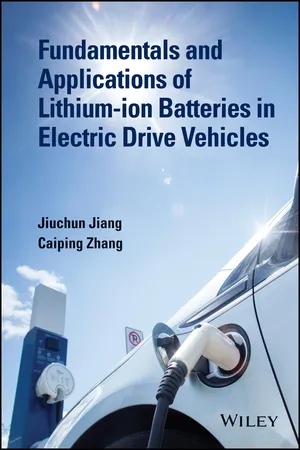
Fundamentals and Applications of Lithium-ion Batteries in Electric Drive Vehicles
eBook - ePub

Fundamentals and Applications of Lithium-ion Batteries in Electric Drive Vehicles

  1. English
  2. ePUB (mobile friendly)
  3. Available on iOS & Android
eBook - ePub

Fundamentals and Applications of Lithium-ion Batteries in Electric Drive Vehicles

About this book

A theoretical and technical guide to the electric vehicle lithium-ion battery management system

Covers the timely topic of battery management systems for lithium batteries. After introducing the problem and basic background theory, it discusses battery modeling and state estimation. In addition to theoretical modeling it also contains practical information on charging and discharging control technology, cell equalisation and application to electric vehicles, and a discussion of the key technologies and research methods of the lithium-ion power battery management system.

The author systematically expounds the theory knowledge included in the lithium-ion battery management systems and its practical application in electric vehicles, describing the theoretical connotation and practical application of the battery management systems. Selected graphics in the book are directly derived from the real vehicle tests. Through comparative analysis of the different system structures and different graphic symbols, related concepts are clear and the understanding of the battery management systems is enhanced.

Contents include: key technologies and the difficulty point of vehicle power battery management system; lithium-ion battery performance modeling and simulation; the estimation theory and methods of the lithium-ion battery state of charge, state of energy, state of health and peak power; lithium-ion battery charge and discharge control technology; consistent evaluation and equalization techniques of the battery pack; battery management system design and application in electric vehicles.

  • A theoretical and technical guide to the electric vehicle lithium-ion battery management system
  • Using simulation technology, schematic diagrams and case studies, the basic concepts are described clearly and offer detailed analysis of battery charge and discharge control principles
  • Equips the reader with the understanding and concept of the power battery, providing a clear cognition of the application and management of lithium ion batteries in electric vehicles
  • Arms audiences with lots of case studies

Essential reading for Researchers and professionals working in energy technologies, utility planners and system engineers.

Trusted by 375,005 students

Access to over 1.5 million titles for a fair monthly price.

Study more efficiently using our study tools.

Information

Publisher
Wiley
Year
2015
Print ISBN
9781118414781
Edition
1
eBook ISBN
9781118414811

1
Introduction

1.1 The Development of Batteries in Electric Drive Vehicles

1.1.1 The Goals

Energy and environmental issues have long been challenges facing the world’s automotive industry. In recent years, the grim energy and environmental situation around the world has accelerated the strategic transformation of transportation and energy technology, and thus set off a worldwide upsurge of new energy vehicle development. Under the various scenarios depicted in the technology roadmaps of new energy vehicles, hybrid electric vehicles (HEV), battery electric vehicles (BEV), and fuel cell vehicles (FCEV) are generally considered as important development directions for future automotive energy power systems, and have become a high strategic priority of major automobile manufacturers worldwide.
The power battery is an important component of an electric vehicle (EV), directly providing its source of energy. In general, the goals for a powertrain system in EVs are: excellent safety, high specific energy, high specific power, good temperature characteristics, long cycle life, low cost, no maintenance, low self-discharge, good consistency, no environmental pollution, good recoverability, and recyclability. In BEV, the specific energy determines the total driving distance in the pure electric drive mode; the specific power determines the vehicle dynamics, such as the maximum gradeability and the maximum vehicle speed; and the cycle life and the cost of the powertrain system have direct effect on EV manufacture and running costs. For a long time, battery technology has been a bottleneck in the development of EVs; some existing battery technologies have achieved some of these goals, but it is far more challenging to meet all the goals simultaneously [1].

1.1.2 Trends in Development of the Batteries

Power batteries used in EVs basically include nickel-metal hydride and lithium-ion batteries (LIBs). The nickel-metal hydride batteries are widely used in HEVs owing to their high charge-and-discharge rate and environmentally friendly features. However, the application of nickel-metal hydride batteries in EVs remains limited because they have low voltage and are unsuitable for parallel connection. The LIBs, with the advantages of a high voltage performance platform, such as high energy density (theoretical specific capacity reaches 3860 mAh g–1), environmentally benign features, wide operating temperature range, low self-discharge rate, no memory effect, high efficiency, and long cycle life, have become widely accepted in recent years, and have become one of the most important components for the new generation of EVs.
LIBs can be classified into lithium cobalt oxide, lithium manganate (LMO), lithium iron phosphate (LFP), lithium-polymer, and lithium nickel-manganese-cobalt (NMC) batteries, which are based on positive active materials. The comparisons of various materials are shown in Table 1.1 [2]. Lithium cobalt oxide and nickel acid lithium batteries, developed earlier, have encountered a bottleneck owing to the use of cobalt and nickel, which have high costs and poor consistency. The LMO and LFP batteries have more application opportunities in EVs in recent years, with the progress in technology and enhancement of safety performance; safety no longer being a concern due to the improvement of consistency and elimination of explosion risk. At the Beijing Olympic Games, 50 pure electric buses used LMO batteries as the power system, the Shanghai World Expo and Guangzhou Asian Games, used 60 and 35 units, respectively. A type of 8-ton sanitation truck produced by Foton Motor and a large number of trolleybuses in Beijing also use LMO and LFP batteries as a power source. Furthermore, EVs developed by most automobile manufacturers in China use LFP batteries as the power system, such as the E6 pure electric taxi by BYD, 2008EV, and 5008EV by Hangzhou Zhongtai, “Tongyue” pure electric cars by JAC, Bonbon MINI pure electric cars by Chang-an Automobile, S18 pure electric cars by Chery, and so on. So far, the E6 pure electric taxi by BYD, 2008EV, and 5008EV by Hangzhou Zhongtai, and “Tongyue” pure electric cars by JAC have achieved small-scale mass production and have been put into demonstration operation.
Table 1.1 Comparisons of different types of LIB.
Category of lithium batteriesLithium cobalt oxideLithium iron phosphateLithium manganateLithium titanateTernary materialsLithium-polymer
AdvantagesGood reversibility, high energy densityLong cycle life, high safetyRich resources, high safetyLong cycle life, high safety, good rate characteristicsGood cycling performance and good thermal stabilityStrong over-charge abilities
DisadvantagesPoor cobalt resource, bad anti-abuse capabilitiesLow energy density, poorly conductivePoor recycling performance in high temperatureLow density, high costHigh cost, complicated manufacturing processLow density, long cycle life
It is noticeable that the LIBs, which have lithium titanate (LTO) as a negative electrode, have attracted wide attention in recent years, because of their wide working temperature range, good ratio characteristics and long cycle life. However, they have been merely experimentally demonstrated on EVs owing to their low energy density, higher cost, immature bulk production technology, and so on.

1.1.3 Application Issues of LIBs

Although LIBs, with their superior performance, have been widely used in portable devices, they have limited application in EVs, the main reasons being summarized below.

1.1.3.1 Poor Working Environment

  1. A large number of large capacity batteries are used through series and parallel connection. In order to reach the corresponding level of voltage, power, and energy, a large number of large-capacity batteries need to be used in EVs through series and parallel connection, which requires high consistency among the battery pack. Additionally, different from an individual battery, grouping management in a battery pack also requires more advanced technology.
  2. Large working current and extreme current fluctuation. Figure 1.1 [3] shows the working current, representative cell voltage and the speed of the Beijing Olympic Games EV bus during the acceleration process. It can be seen that the battery current is high (maximum value over 350 A) and changes quickly (the time to change from 300 to 0 A is <0.5 s), which may result in over-discharge and over-heating, as well as the problem of capacity and low energy utilization, and also may cause difficulty for the online estimation of the battery state.
  3. Limited space. This may increase the difficulty of the assembly process, heat radiation and cooling ventilation design of battery systems (including batteries, battery management system (BMS), and protection modules). For example, if the battery works in a high temperature environment for a long time, the decrease in battery capacity will be accelerated, which may even result in thermal runaway and cause safety risks. Further, temperature fluctuation will cause differences between the degradation speed and the self-discharge coefficient, which may lead to accelerated inconsistency of the battery pack, capacity loss, and low energy utilization. Realizing efficient management of the battery pack poses a far more serious challenge in battery research and development.
  4. Poor working conditions. Vehicle bumping and shaking requires higher anti-shock and anti-vibration performance; dusty, rainy, and line wear conditions may cause short circuit or other insulation problems.
c1-fig-0001
Figure 1.1 Acceleration curve of Olympic EV buses.
(Reproduced with permission from Feng Wen, “Study on basic issues of the Li-ion battery pack management technology for Pure Electric Vehicles.”, Beijing Jiaotong University ©2009.)

1.1.3.2 Poor Anti-Abuse Capabilities

The anti-abuse capability of LIBs is insufficient. More specifically, irrational use (such as operation at high or low temperature regularly or for a long time, too high or low state of charge (SOC), over-current, etc.) will substantially shorten the battery life. Such battery abuse may cause battery failure, and even fire, explosion, or other safety problems.

1.1.4 Significance of Battery Management Technology

In order to improve the performance of future LIBs, researchers in the electrochemistry field have conducted further research on LIBs in terms of the electrochemical mechanism, including the effects of temperature [4,5], voltage, current, and aging on the battery performance [6–8], the influence of over-charge, over-discharge [9], over-current and over-heating [10], and so on. By enhancing the anode and cathode materials...

Table of contents

  1. Cover
  2. Title page
  3. Table of Contents
  4. About the Authors
  5. Foreword
  6. Preface
  7. 1 Introduction
  8. 2 Performance Modeling of Lithium-ion Batteries
  9. 3 Battery State Estimation
  10. 4 The Prediction of Battery Pack Peak Power
  11. 5 Charging Control Technologies for Lithium-ion Batteries
  12. 6 Evaluation and Equalization of Battery Consistency
  13. 7 Technologies for the Design and Application of the Battery Management System
  14. Index
  15. End User License Agreement

Frequently asked questions

Yes, you can cancel anytime from the Subscription tab in your account settings on the Perlego website. Your subscription will stay active until the end of your current billing period. Learn how to cancel your subscription
No, books cannot be downloaded as external files, such as PDFs, for use outside of Perlego. However, you can download books within the Perlego app for offline reading on mobile or tablet. Learn how to download books offline
Perlego offers two plans: Essential and Complete
  • Essential is ideal for learners and professionals who enjoy exploring a wide range of subjects. Access the Essential Library with 800,000+ trusted titles and best-sellers across business, personal growth, and the humanities. Includes unlimited reading time and Standard Read Aloud voice.
  • Complete: Perfect for advanced learners and researchers needing full, unrestricted access. Unlock 1.5M+ books across hundreds of subjects, including academic and specialized titles. The Complete Plan also includes advanced features like Premium Read Aloud and Research Assistant.
Both plans are available with monthly, semester, or annual billing cycles.
We are an online textbook subscription service, where you can get access to an entire online library for less than the price of a single book per month. With over 1.5 million books across 990+ topics, we’ve got you covered! Learn about our mission
Look out for the read-aloud symbol on your next book to see if you can listen to it. The read-aloud tool reads text aloud for you, highlighting the text as it is being read. You can pause it, speed it up and slow it down. Learn more about Read Aloud
Yes! You can use the Perlego app on both iOS and Android devices to read anytime, anywhere — even offline. Perfect for commutes or when you’re on the go.
Please note we cannot support devices running on iOS 13 and Android 7 or earlier. Learn more about using the app
Yes, you can access Fundamentals and Applications of Lithium-ion Batteries in Electric Drive Vehicles by Jiuchun Jiang,Caiping Zhang in PDF and/or ePUB format, as well as other popular books in Technology & Engineering & Electrical Engineering & Telecommunications. We have over 1.5 million books available in our catalogue for you to explore.