Handbook of Concentrator Photovoltaic Technology
eBook - ePub

Handbook of Concentrator Photovoltaic Technology

  1. English
  2. ePUB (mobile friendly)
  3. Available on iOS & Android
eBook - ePub

Handbook of Concentrator Photovoltaic Technology

About this book

Concentrator Photovoltaics (CPV) is one of the most promising technologies to produce solar electricity at competitive prices. High performing CPV systems with efficiencies well over 30% and multi-megawatt CPV plants are now a reality. As a result of these achievements, the global CPV market is expected to grow dramatically over the next few years reaching cumulative installed capacity of 12.5 GW by 2020. In this context, both new and consolidated players are moving fast to gain a strategic advantage in this emerging market.

Written with clear, brief and self-contained technical explanations, Handbook of Concentrator Photovoltaic Technology  provides a complete overview of CPV covering: the fundamentals of solar radiation, solar cells, concentrator optics, modules and trackers; all aspects of characterization and reliability; case studies based on the description of actual systems and plants in the field; environmental impact, market potential and cost analysis.

CPV technology is at a key point of expansion. This timely handbook aims to provide a comprehensive assessment of all CPV scientific, technological and engineering background with a view to equipping engineers and industry professionals with all of the vital information they need to help them sustain the impetus of this encouraging technology.

Key features:

  • Uniquely combines an explanation of the fundamentals of CPV systems and components with an overview of the market place and their real-life applications.
  • Each chapter is written by well-known industry specialists with extensive expertise in each particular field of CPV technology.
  • Reviews the basic concepts of multi-junction solar cells and new concepts for CPV cells, highlighting the key differences between them.
  • Demonstrates the state of the art of several CPV centres and companies.
  • Facilitates future cost calculation models for CPV.
  • Features extensive case studies in each chapter, including coverage of CPV modules and systems.

Trusted by 375,005 students

Access to over 1.5 million titles for a fair monthly price.

Study more efficiently using our study tools.

Information

Publisher
Wiley
Year
2016
Print ISBN
9781118472965
Edition
1
eBook ISBN
9781118755648

1
Direct Normal Radiation

Daryl R. Myers
National Renewable Energy Lab., United States

1.1 Concepts and Definitions

The harvesting and conversion of solar radiation by concentrating photovoltaic (CPV) technologies depends explicitly on the quality and quantity of the solar resource that is available, as well as the optical and electrical properties of the photovoltaic technology. This chapter will address the quantitative and qualitative aspects of the solar resource, the direct solar radiation, and briefly, more qualitative discussions of the interaction of the resource with the photovoltaic technologies and system design issues. More quantitative discussion of the latter will be addressed in detail in subsequent chapters.

1.1.1 Orbital and Geometrical Considerations

The Earth orbits a typical star, the sun, which provides energy in the form of optical and thermal radiation that enables and supports life on our planet. A reference for most of the numerical data presented in this section is Allen's Astrophysical Quantities [1].
The sun has a diameter (ds) of 1 390 000 km (840 000 miles). At the surface of the sun (at radius Rs = 695 000 km from the center) the power flux density emitted is about 6.33 × 10⁷ Wm−2. The Earth's orbit about the sun is an ellipse with an eccentricity of 0.0167. Closest approach of the Earth to the sun (perihelion) occurs on about January 2 or 3, and the furthest distance (aphelion) occurs on about July 4 or 5. The Earth's perihelion, Rp, and aphelion, Ra, distances are about 147.5 million km and 152.6 million km, respectively. That is, the Earth-Sun distance varies from −1.4% to +2.0% of the average Earth-Sun distance, or a range of 3.4% during the year. The average distance (Ro) between the sun and Earth is 1 Astronomical Unit (AU) of 149 597 870.7 km (92 955 807.273 miles).
Using simple geometry, the apparent angular diameter of the solar disk in degrees at 1 AU is arctangent (ds/Ro) = arctangent (1.390/149.59787) = 0.532° or 9.28 mrad. The apparent diameter of the solar disk changes by 3.4% as the sun moves from aphelion (arctan (ds/Ra) = 0.521 = 0.91 mrad) to perihelion (arctan (ds/Rp) = 0.539° = 0.94 mrad). In the absence of an atmosphere, because the solar disk subtends a solid angle of about 0.5°, an observer on the Earth's surface will observe that the rays of sunlight falling on a plane surface with the surface normal (perpendicular) pointed at the center of the solar disk fill a solid angle of the same dimensions. The solar radiation filling the 0.5° cone of rays falling on a surface which is normal (i.e., perpendicular) to the axis of the cone constitute the direct normal radiation, or direct beam irradiance, also called direct normal irradiance, or DNI. Note than in the presence a clear, cloudless atmosphere, the actual solid angle of the DNI over short periods of time will vary slightly, both in time and physical extent. These tiny variations are due to the effects of turbulence and variations in density of the atmosphere as the direct beam radiation propagates through the atmosphere. The magnitude of these effects is demonstrated by the ‘twinkling’ of starlight from much more distant and more truly point-source-like stars.
As the sun moves in elevation from the horizon at sunrise, to higher in the sky at noon, to the horizon at sunset, the elevation angle, e, of the solar disk, or angle from the horizon to the center of the disk, is constantly changing. Thus the path length through the atmosphere for the photons (defined as the air mass, m) also changes from long to shorter to longer as the sun moves from sunrise to noon to sunset. The geometrical air mass, m, is defined as approximately m = 1/sin(e). The complement of the solar elevation angle is the solar zenith angle, z, the angle between the local vertical and the center of the solar disk, thus m is also defined approximately as m = 1/cos(z).
For a surface or collector to capture the DNI, the normal or perpendicular to the surface must point to the center of the solar disk throughout the day. This will keep the incidence angle (the angle between the DNI beam and the surface normal, θ) of the DNI beam near zero, and requires a mechanism to track the elevation and azimuth of the sun throughout the day. The accuracy of the mechanical system in performing the tracking function is an important aspect of the design of systems for intercepting and concentrating, or focusing the direct beam radiation.
For a stationary horizontal surface the incident angle of the direct beam will vary from 90° at sunrise to the (less than 90°, depending on the latitude of the site) solar elevation angle at noon to 90...
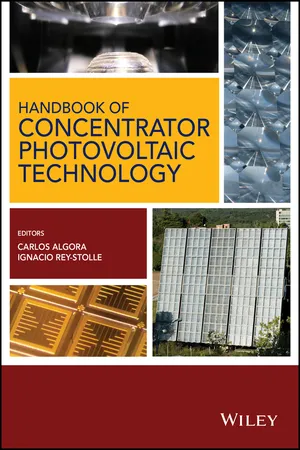
Table of contents

  1. Cover
  2. Title Page
  3. Copyright
  4. Dedication
  5. List of Contributors
  6. Preface
  7. 1: Direct Normal Radiation
  8. 2: Concentrator Multijunction Solar Cells
  9. 3: Emerging High Efficiency Concepts for Concentrator Solar Cells
  10. 4: CPV Optics
  11. 4-I Annex: Étendue Calculation
  12. 4-II Annex: 2D Treatment of Rotational and Linear 3D Optical Systems
  13. 4-III Annex: Design of the XR Concentrator
  14. 5: Temperature Effects on CPV Solar Cells, Optics and Modules
  15. 6: CPV Tracking and Trackers
  16. 7: CPV Modules
  17. 7-I Annex: Abengoa's CPV Modules and Systems
  18. 7-II Annex: CPV Modules and Systems from Daido Steel
  19. 7-III Annex: Soitec CPV Modules and Systems
  20. 7-IV Annex: Suncore Photovoltaics' CPV Modules
  21. 8: CPV Power Plants
  22. 8-I Annex: Software Tools for CPV Plant Design and Analysis
  23. 8-II Annex: CPV Power Plants at ISFOC
  24. 8-III Annex: Soitec Power Plants
  25. 9: Reliability
  26. 10: CPV Multijunction Solar Cell Characterization
  27. 11: Characterization of Optics for Concentrator Photovoltaics
  28. 12: Characterization of CPV Modules and Receivers
  29. 13: Life Cycle Analysis of CPV Systems
  30. 13-I Annex: Energy Flow Diagrams for Amonix 7700 System Components
  31. 14: Cost Analysis
  32. Index
  33. End User License Agreement

Frequently asked questions

Yes, you can cancel anytime from the Subscription tab in your account settings on the Perlego website. Your subscription will stay active until the end of your current billing period. Learn how to cancel your subscription
No, books cannot be downloaded as external files, such as PDFs, for use outside of Perlego. However, you can download books within the Perlego app for offline reading on mobile or tablet. Learn how to download books offline
Perlego offers two plans: Essential and Complete
  • Essential is ideal for learners and professionals who enjoy exploring a wide range of subjects. Access the Essential Library with 800,000+ trusted titles and best-sellers across business, personal growth, and the humanities. Includes unlimited reading time and Standard Read Aloud voice.
  • Complete: Perfect for advanced learners and researchers needing full, unrestricted access. Unlock 1.5M+ books across hundreds of subjects, including academic and specialized titles. The Complete Plan also includes advanced features like Premium Read Aloud and Research Assistant.
Both plans are available with monthly, semester, or annual billing cycles.
We are an online textbook subscription service, where you can get access to an entire online library for less than the price of a single book per month. With over 1.5 million books across 990+ topics, we’ve got you covered! Learn about our mission
Look out for the read-aloud symbol on your next book to see if you can listen to it. The read-aloud tool reads text aloud for you, highlighting the text as it is being read. You can pause it, speed it up and slow it down. Learn more about Read Aloud
Yes! You can use the Perlego app on both iOS and Android devices to read anytime, anywhere — even offline. Perfect for commutes or when you’re on the go.
Please note we cannot support devices running on iOS 13 and Android 7 or earlier. Learn more about using the app
Yes, you can access Handbook of Concentrator Photovoltaic Technology by Carlos Algora,Ignacio Rey-Stolle in PDF and/or ePUB format, as well as other popular books in Technology & Engineering & Electrical Engineering & Telecommunications. We have over 1.5 million books available in our catalogue for you to explore.