Backyard Poultry Medicine and Surgery
eBook - ePub

Backyard Poultry Medicine and Surgery

A Guide for Veterinary Practitioners

  1. English
  2. ePUB (mobile friendly)
  3. Available on iOS & Android
eBook - ePub

Backyard Poultry Medicine and Surgery

A Guide for Veterinary Practitioners

About this book

Backyard Poultry Medicine and Surgery is a practical resource offering guidance on developing diagnostic and treatment plans for individual companion poultry or small flocks.  Organized by body system to aid in developing a differential diagnosis list for common presenting signs, the book provides all the information clinicians need to effectively treat backyard poultry. Written by experts from both the commercial poultry field and the companion avian field, the book provides thorough coverage of both common and less common diseases of backyard chickens, ducks, and other poultry. 

The book begins with introductory chapters covering general information, an overview of US laws, and basic husbandry concerns, then moves into specific disease chapters organized by system.  The book takes an individual medicine perspective throughout, with photographs, radiographs, and histopathological photomicrographs to illustrate principles and diseases.  Backyard Poultry Medicine and Surgery is an invaluable guide to diseases and treatments for any practitioners treating backyard poultry.
Trusted by 375,005 students

Access to over 1.5 million titles for a fair monthly price.

Study more efficiently using our study tools.

Information

Year
2014
Print ISBN
9781118335437
eBook ISBN
9781118403860
Edition
1
Section II
Medicine and Surgery

Chapter 7
Physical Examination, Anatomy, and Physiology

Wael Khamas1, Josep Rutllant-Labeaga1, and Cheryl B. Greenacre2
1College of Veterinary Medicine, Western University of Health Sciences, Pomona, CA, USA
2Department of Small Animal Clinical Sciences, University of Tennessee, College of Veterinary Medicine, Knoxville, TN, USA

Physical examination

Introduction

A physical examination is important for identifying any abnormalities that may be occurring in the flock and in the individual bird. The following will focus on the chicken, but the information can be applied to physical examinations of most birds. It is important to understand what is normal, including behavior, before deeming a finding abnormal. Before restraining the bird for a physical examination, obtain a thorough history.

History

Obtain signalment of the bird (breed, age, and gender) and determine its use. Is it a pet, a pet that happens to lay eggs, is it kept for egg production, for meat production, for show, or for breeding? How many chickens are owned, how long has the flock been owned, did they come from multiple sources at multiple times (i.e., is it an open or closed flock), when was the last addition to the flock, how long has this chicken been owned, where was it obtained, any previous diseases, any previous treatments? Also ask about housing, substrate, perch size and composition, and space of coop and range. Are they brought in at night? Ask about diet including type, brand, amount, where purchased, how old is the food, any treats or supplements, medicated foods? Are they offered greens and insects for enrichment? If laying, how many nest boxes are set up and what is the laying history? Last, what is the presenting complaint and how long has it been occurring, are multiple birds affected, and is it progressive?
image
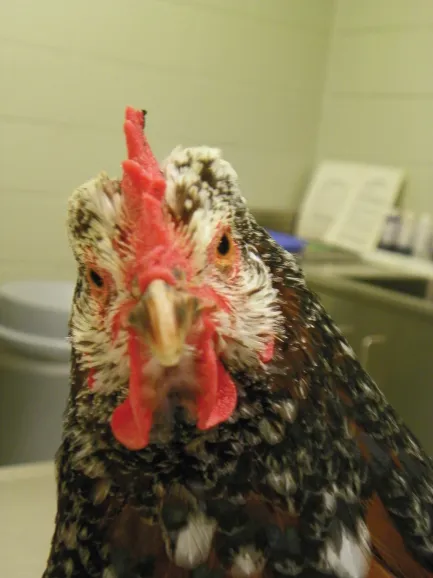
Figure 7.1 Healthy, curious chicken with round, open, bright eyes and head up.

Restraint

Prior to restraint

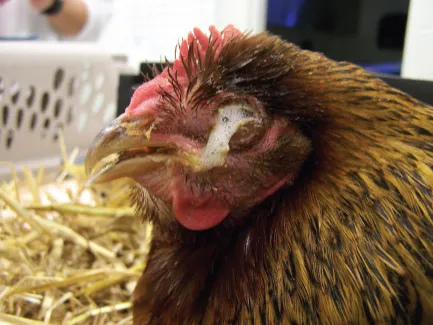
Before restraining the bird, perform a visual examination of the bird and its surroundings from a distance, preferably before the bird becomes aware of you. See if the bird brightens up after it is aware of your presence as this could be indicative of a bird trying to “put on a good show” or appear healthier than it is, because birds that look sick are pecked by conspecifics or become a meal for a predator. Examine the alertness of the bird and if it is interacting with others in the flock or off in a corner by itself. Healthy birds are curious and hold their head high with bright open round eyes, whereas sick birds hold their head down with the eyelids partially closed (Figure 7.1 and Figure 7.2). Observe stance and ability to walk normally. Examine the droppings for consistency, blood, or abnormal smell. Realize that chickens have two types of feces, the more common drier droppings and the wetter cecal droppings.

Restraint

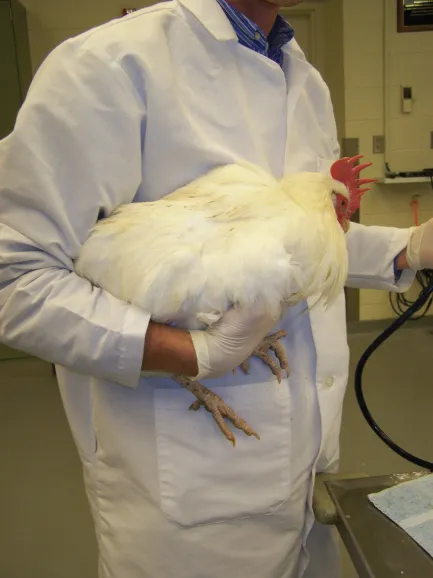
The restraint of any bird begins with controlling the weapons of that bird, for example with parrots the head is restrained first, and with raptors the talons are restrained first. Chickens flap their wings and may injure themselves or you, so first restrain their wings gently by holding the wings to the body in their normal folded position with your fingers spread wide apart to
image
Figure 7.2 Sick chicken with closed eyes, head down, and a copious oculonasal discharge.
restrain as much of the wing as possible. Do not bend the wings backwards, as the relatively flimsy wings of chickens can be easily luxated at the shoulder or elbow. Also, remember to allow the normal up and down excursions of the keel so the chicken can breathe, because birds lack a diaphragm. The bird can then be tucked under your arm either pointing forward or backward (Figure 7.3). Placing a towel on a table is a great way to evaluate a bird at your eye level. Most chickens are very calm and usually the less restraint the better. Systematically evaluate the chicken from head to toe, but do save the oral examination for last as this is highly perturbing to the chicken (see website for video of a complete physical examination in a duck.)
image
Figure 7.3 Demonstration of proper restraint in a chicken with the bird tucked under the arm with the head pointed forward. Alternatively, the head can be pointed backwards.

Physical examination

Examine the head for symmetry of the beak, eyes, sinuses, and nostrils. Examine for discharge, crusts, scratches, scabs, swellings, and discolorations. The beak tips should come to a point. The iris should be the same color on both sides. A lighter color of one iris may be indicative of the ocular form of Marek's disease. Also, the eyes (anterior chamber or lens) should not be cloudy. Ocular discharge can appear as matted feathers along the cranial ventral lid margin. Flip the feathers cranially that cover the ear and examine the shallow ear of the chicken for discharge, blood, or parasites.
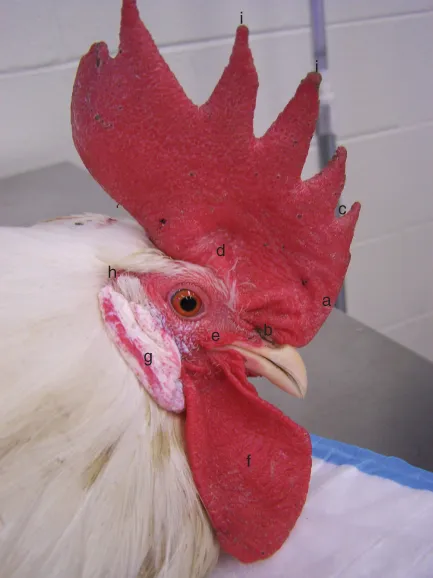
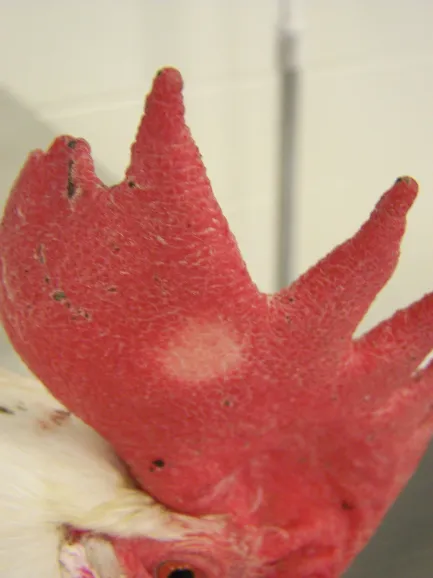
The comb should be firm and red (Figure 7.4). A capillary refill time can be performed on the comb by digitally pressing and releasing (Figure 7.5). It should refill in about two seconds. The comb should not be pale. Occasionally the comb is flopped over to one side, which can be normal as long as this did not occur suddenly.
image
Figure 7.4 Healthy rooster with a firm, red comb. External features of the head are identified (a) blade of comb; (b) operculum; (c) crest of comb; (d) body of comb; (e) maxillary rectus; (f) wattle; (g) ear lobe; (h) external acoustic meatus; (i) points of comb.
image
Figure 7.5 Same rooster as in Figure 7.4 after the comb has been digitally pressed and released. The “refill time” is approximately 2 seconds.
Alternatively, the basilic vein (cutaneous ulnar vein) located just distal to the ventral surface of the elbow can be digitally pressed as in other birds to examine refill time. Normally, when the finger is removed from the vein, refilling will be so fast that it cannot be witnessed visually. If it can be witnessed visually then the bird is considered approximately 5% dehydrated, and if one second can be counted, then the bird is about 10% dehydrated or in shock. Decreased corneal moisture exhibited by a dull surface appearance to the eye, or in severe cases, recession of the globe, is also indicative of dehydration [1].
Palpate the crop. It should feel soft and fluctuant, similar to a bean bag, and have crop movements about once per minute. Birds lack organized lymph nodes, so normally there should be no subcutaneous masses pres...

Table of contents

  1. Cover
  2. Title Page
  3. Copyright
  4. Dedication
  5. Contributors
  6. Foreword
  7. Preface
  8. Acknowledgments
  9. Companion website
  10. Section I: General Information
  11. Section II: Medicine and Surgery
  12. Section III: Diagnostics, Drugs, and Vaccines
  13. Index
  14. End User License Agreement

Frequently asked questions

Yes, you can cancel anytime from the Subscription tab in your account settings on the Perlego website. Your subscription will stay active until the end of your current billing period. Learn how to cancel your subscription
No, books cannot be downloaded as external files, such as PDFs, for use outside of Perlego. However, you can download books within the Perlego app for offline reading on mobile or tablet. Learn how to download books offline
Perlego offers two plans: Essential and Complete
  • Essential is ideal for learners and professionals who enjoy exploring a wide range of subjects. Access the Essential Library with 800,000+ trusted titles and best-sellers across business, personal growth, and the humanities. Includes unlimited reading time and Standard Read Aloud voice.
  • Complete: Perfect for advanced learners and researchers needing full, unrestricted access. Unlock 1.5M+ books across hundreds of subjects, including academic and specialized titles. The Complete Plan also includes advanced features like Premium Read Aloud and Research Assistant.
Both plans are available with monthly, semester, or annual billing cycles.
We are an online textbook subscription service, where you can get access to an entire online library for less than the price of a single book per month. With over 1.5 million books across 990+ topics, we’ve got you covered! Learn about our mission
Look out for the read-aloud symbol on your next book to see if you can listen to it. The read-aloud tool reads text aloud for you, highlighting the text as it is being read. You can pause it, speed it up and slow it down. Learn more about Read Aloud
Yes! You can use the Perlego app on both iOS and Android devices to read anytime, anywhere — even offline. Perfect for commutes or when you’re on the go.
Please note we cannot support devices running on iOS 13 and Android 7 or earlier. Learn more about using the app
Yes, you can access Backyard Poultry Medicine and Surgery by Cheryl B. Greenacre, Teresa Y. Morishita, Cheryl B. Greenacre,Teresa Y. Morishita in PDF and/or ePUB format, as well as other popular books in Medicine & Veterinary Medicine. We have over 1.5 million books available in our catalogue for you to explore.